
5.2 & 5.3 Comprehension Quiz
How the Scales are Structured
Who Usually Takes This Test?
See How You Compare
Below is a preview of how scores are typically distributed across each scale.
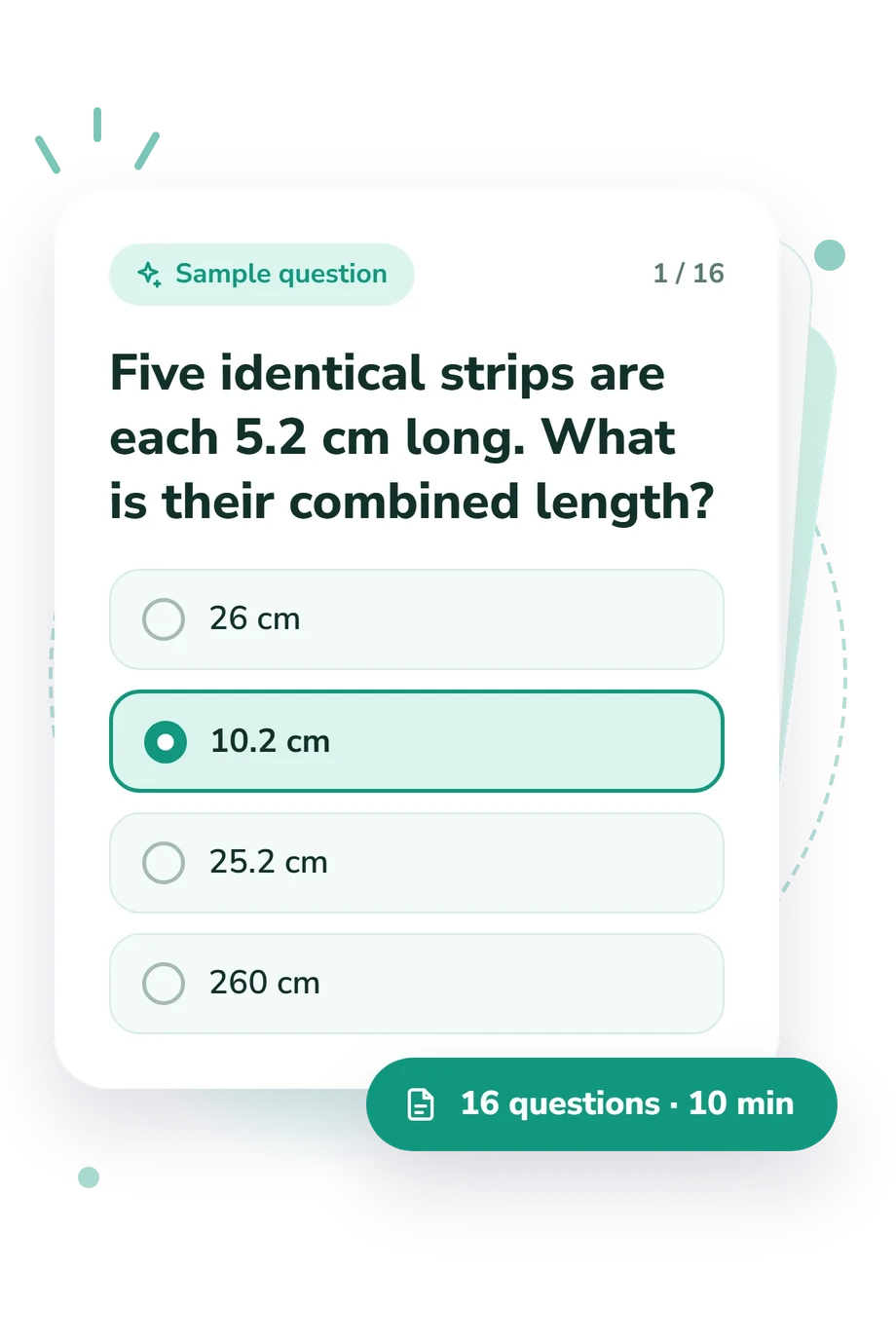
Example Questions From the Test
- 26 cm
- 2 cm
- 2 cm
- 260 cm
- 20 and 5.30
- 52 and 53
- 52 and 0.53
- 520 and 530
- 1
- 1
- 5
- 01
5.2 & 5.3 Comprehension Quiz - Description and methodology of the test
Learners and educators who want a focused check of decimal reasoning can use this assessment to examine how 5.2 and 5.3 work in common mathematical situations. The 5.2 & 5.3 comprehension quiz turns answers into a profile of secure skills and concepts worth practising. It suits anyone reviewing these decimals. As a 5.2 and 5.3 comprehension quiz, it keeps the focus on one defined topic.
What This Assessment Measures
These items connect decimal notation with quantity through comparisons, calculations, measurements, fractions, rounding, and number-line tasks. The decimal comprehension assessment suits learners practising these concepts or reviewing foundations. As a decimal place value quiz, it keeps attention on how digits, values, and relationships work together.
The result reflects four related areas:
- Place value shows whether digit positions are linked to tenths and tens.
- Equivalence shows whether trailing zeros and fraction forms represent equal quantities.
- Magnitude shows whether decimals can be ordered, located, and measured on a number line.
- Application shows whether decimal operations transfer to everyday lengths, weights, and amounts.
The single displayed scale is 5.2 & 5.3 Decimal Knowledge (0-16). Its bands are Foundations to revisit (0-6), Developing understanding (7-12), and Strong understanding (13-16). This educational score describes performance in tested contexts, not overall mathematics ability.
Methodology and Evidence Base
Each question presents a short problem with four answer choices. Some items use equations, while others place decimals in contexts involving lengths, weights, recipes, and parcels. This response format tests both symbolic manipulation and interpretation of decimals as quantities. The questionnaire reports a total based on performance across the items; differential weighting is not specified.
Conceptually, the content is consistent with Lortie-Forgues and Siegler (2017), whose work distinguishes decimal magnitude, arithmetic procedures, and the direction of an operation’s effect. Malone, Loehr, and Fuchs (2017) link decimal magnitude understanding with place-value labels, equivalence, and number-line representations. Dietrich and colleagues (2016) explain why place-value knowledge matters in number-line estimation. These studies support the quiz’s content, but it is not presented as an adaptation of any one published instrument.
This decimal reasoning test is best read as a focused learning check. It is presented as an educational, self-administered exercise rather than a standardized or norm-referenced instrument. The online decimal quiz can guide review: lower performance points to place value and equivalence, middle performance to consistency, and stronger performance to extended applications. Results can be influenced by guessing, attention, and current familiarity with the examples.
- Lortie-Forgues, H., & Siegler, R. S. (2017). Conceptual knowledge of decimal arithmetic. Journal of Educational Psychology, 109(3), 374-386. 10.1037/edu0000148
- Malone, A. S., Loehr, A. M., & Fuchs, L. S. (2017). The role of domain-general cognitive abilities and decimal labels in at-risk fourth-grade students' decimal magnitude understanding. Learning and Individual Differences, 58, 90-96. 10.1016/j.lindif.2017.05.007
- Dietrich, J. F., Huber, S., Dackermann, T., Moeller, K., & Fischer, U. (2016). Place-value understanding in number line estimation predicts future arithmetic performance. British Journal of Developmental Psychology, 34(4), 502-517. 10.1111/bjdp.12146
Updated: