
Connotation and Denotation Quiz
How the Scales are Structured
Who Usually Takes This Test?
See How You Compare
Below is a preview of how scores are typically distributed across each scale.
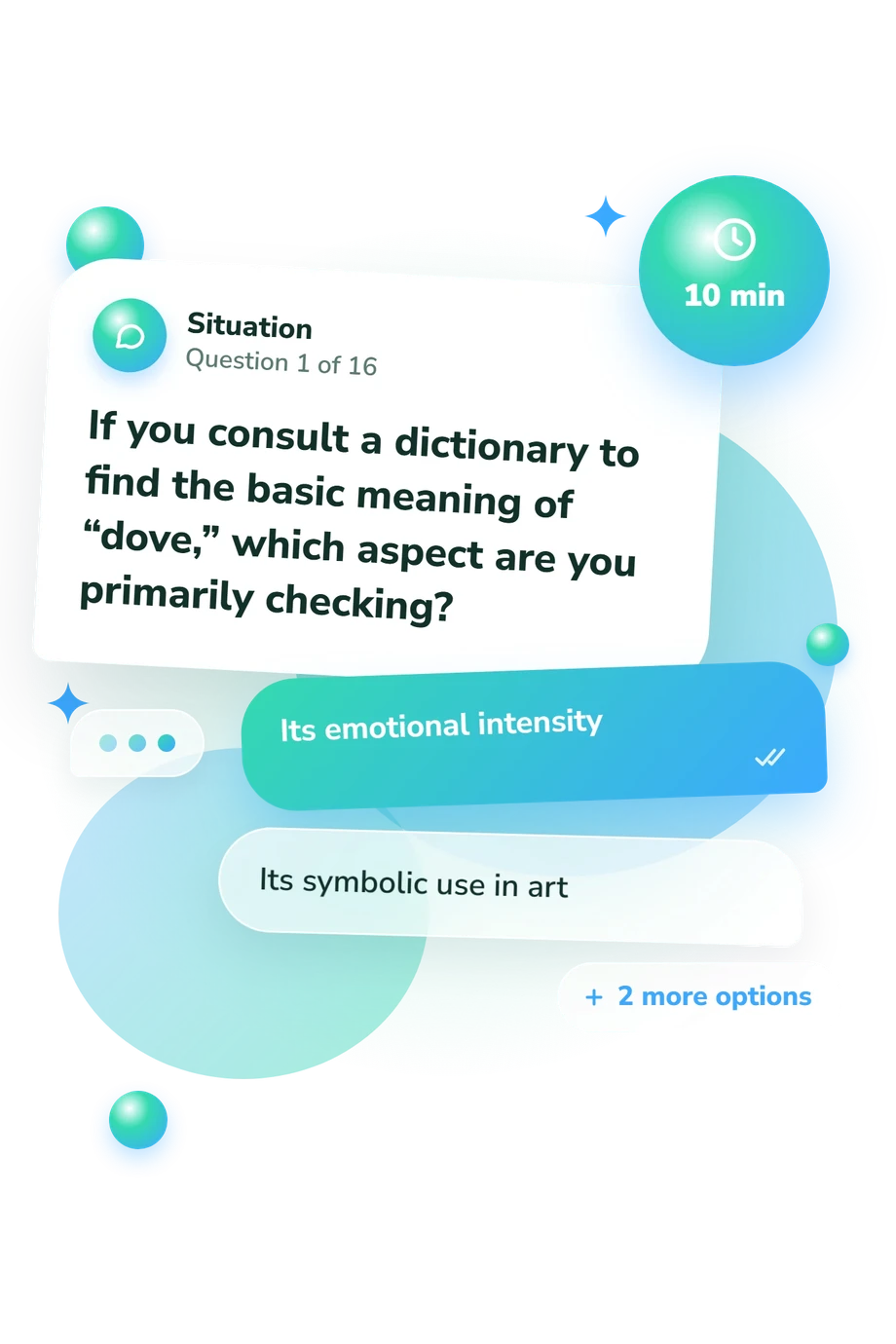
Example Questions From the Test
- Its emotional intensity
- Its symbolic use in art
- Its associations with peace
- Its denotation
- Its level of formality in a sentence
- The emotion it creates in every reader
- Its literal or dictionary meaning
- The writer’s personal reason for choosing it
- The bright lamp lit the entire desk.
- Bright sunlight reflected from the window.
- A bright yellow sign marked the entrance.
- Mina is a bright student who learns quickly.
Connotation and Denotation Quiz - Description and methodology of the test
Readers who want to sharpen close reading, writing, or word choice can use the connotation and denotation quiz to examine how they separate a word’s dictionary meaning from the attitudes and associations it may evoke. It is suited to students, writers, editors, and curious readers who want a clearer grasp of tone. A connotation quiz can point to concepts worth reviewing after the result.
What This Assessment Explores
At its core, the assessment asks whether you can identify denotation-the literal or dictionary meaning of a word-and distinguish it from connotation, an emotional, evaluative, or cultural association. It also tests how context changes interpretation without changing a word’s basic reference.
Examples cover dictionary definitions, positive and negative tone, neutral wording, figurative use, personification, euphemism, and associations shaped by experience or culture. The denotation and connotation test therefore suits reading comprehension, vocabulary study, writing, editing, advertising, and everyday communication.
The single scale, Connotation and Denotation Knowledge, runs from 0-16 and summarizes performance on this item set rather than general language ability. Its bands mean:
- Foundation (0-6) indicates emerging understanding, with some confusion between literal meaning and associated feeling.
- Developing (7-12) shows the core distinction is usually understood, though subtle associations may be difficult.
- Strong (13-16) indicates consistent recognition of how word choice shapes tone.
Methodology and Evidence Base
Each item presents a definition or a brief sentence-based situation with four answer choices. The choices ask the reader to identify literal meaning, judge emotional or evaluative tone, recognize figurative wording, or infer why a writer selected one term instead of another. The format is a structured multiple-choice knowledge assessment, not a self-report inventory: the result reflects selected answers to language examples.
Methodologically, the questionnaire is conceptually consistent with Connotation/Denotation (Chapman and Routledge, 2009), which distinguishes literal reference from associated meaning. It also fits the semantic framework associated with Ogden and Richards and Lyons, especially the relationships among symbols, thought, sense, reference, and denotation. These works provide the conceptual evidence base; the online questionnaire is not presented as an adaptation or standardized administration of any of them.
Scoring reports a total and places it in the displayed band; no additional weighting or normative conversion is specified. The connotation denotation quiz has no stated norm group, reliability estimate, or validation study for its online form. Vocabulary familiarity, cultural experience, and the wording of a particular example can affect performance, so the result is an educational snapshot rather than a complete measure of communication skill.
- Chapman, Siobhan, and Christopher Routledge. “Connotation/Denotation.” In Key Ideas in Linguistics and the Philosophy of Language, 25-26. Edinburgh: Edinburgh University Press, 2009. 10.1515/9780748631421-013.
- Ogden, Charles Kay, and Ivor Armstrong Richards. The Meaning of Meaning: A Study of the Influence of Language upon Thought and of the Science of Symbolism. London: Kegan Paul, Trench, Trubner; New York: Harcourt, Brace, 1923.
- Lyons, John. “Reference, Sense and Denotation.” In Semantics, 174-229. Cambridge: Cambridge University Press, 1977. 10.1017/CBO9781139165693.009.
Updated: