
Addition and Subtraction Quiz
How the Scales are Structured
Who Usually Takes This Test?
See How You Compare
Below is a preview of how scores are typically distributed across each scale.
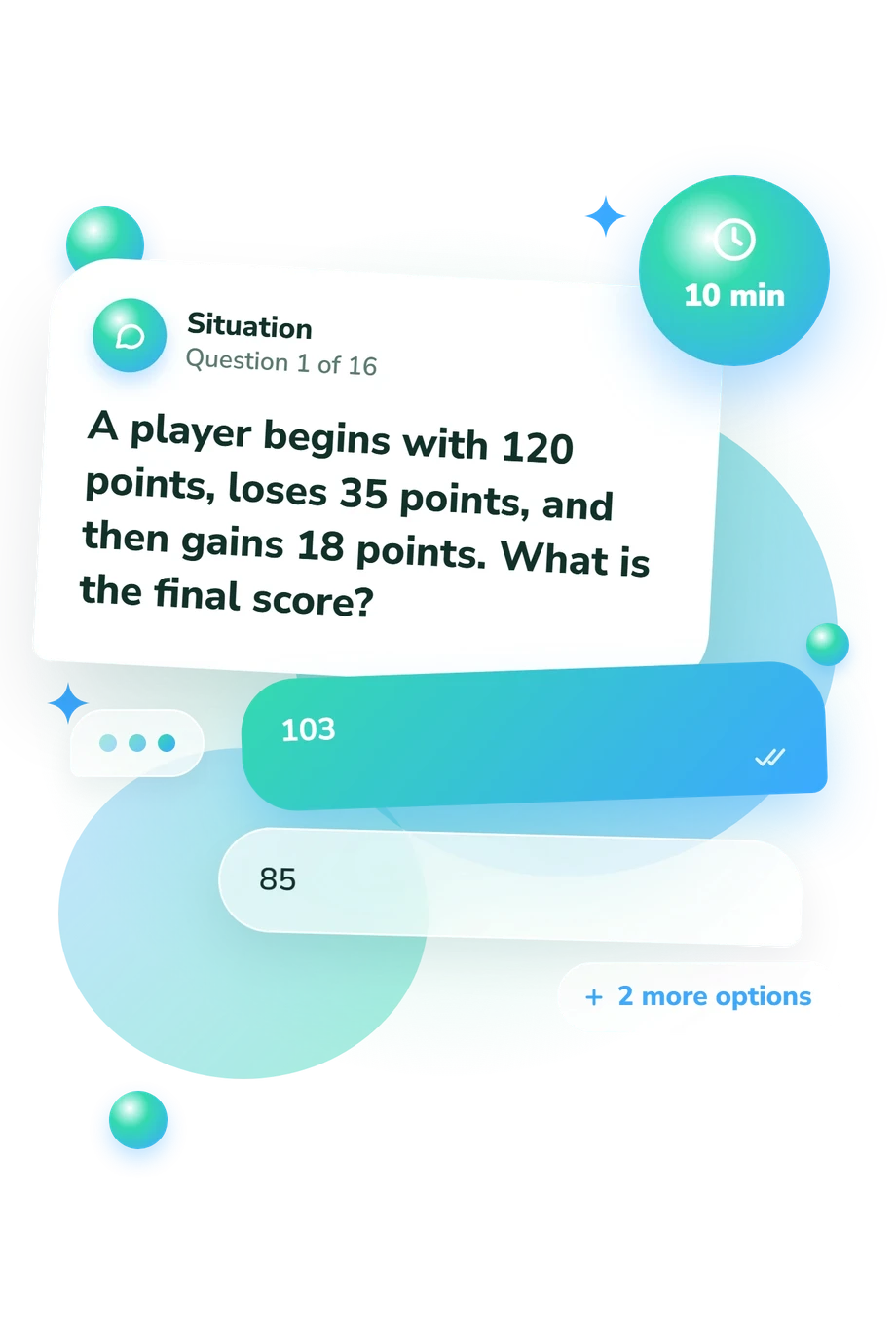
Example Questions From the Test
- 103
- 85
- 67
- 173
- 3 1/4
- 2 3/4
- 2 1/4
- 3 3/4
- 46
- 34
- 36
- 130
Addition and Subtraction Quiz - Description and methodology of the test
People who want to check how confidently they work with everyday calculations can use this addition and subtraction quiz as a focused learning snapshot. After completing the quiz, learners can review their plus and minus quiz answers to identify areas for practice. The result offers a practical starting point for choosing what to practise next, without reducing mathematical ability to one number.
What This Assessment Measures
This questionnaire checks direct and applied addition and subtraction tasks. Learners use place value, regrouping, compensation, inverse checking, fractions, decimals, negative temperatures, money, measurement, and estimation. The result reflects accuracy and the ability to select a sensible operation or strategy, making it relevant to anyone reviewing foundational calculation skills.
The result can guide addition and subtraction practice across these strands:
- Whole-number calculation shows accuracy with larger values and regrouping.
- Rational-number work shows control of fractions and decimals.
- Applied reasoning shows how situations become correct calculations.
- Checking and estimation show use of inverse operations, compensation, and approximate values.
The displayed scale is Addition and Subtraction Knowledge, 0-16: Building Foundations (0-6), Developing Knowledge (7-12), and Strong Knowledge (13-16). These bands describe performance on the tested content, not mathematical ability in every setting.
Methodology and Evidence Base
Items use four-option selected responses covering direct calculations, missing-number equations, error analysis, estimation, and short contexts. Distractors can reveal regrouping, fraction, sign, or checking errors. No separate weighting rule is stated, so individual point contributions should not be inferred from the displayed total.
Within the addition and subtraction questions, the learner selects an answer rather than writing a solution. The approach is conceptually consistent with National Research Council (2001), which connects procedural fluency, conceptual understanding, strategic competence, and reasoning. It also fits the competency model and rational-number progression described by Arieli-Attali and Cayton-Hodges (2014), while one negative-temperature item conceptually parallels the calculation focus of Nurnberger-Haag, Kratky, and Karpinski (2022) without supporting this questionnaire. These publications offer conceptual context, not evidence that this online questionnaire was validated, normed, or adapted from them.
Interpret the band as feedback about tested content, not a percentile or diagnosis. Attention, notation familiarity, time pressure, and self-explanation can affect performance, while an online score cannot show every strategy a learner can use. Reviewing missed item types alongside the band can guide the next round of calculation practice.
- National Research Council. 2001. Adding It Up: Helping Children Learn Mathematics. Washington, DC: National Academies Press. 10.17226/9822
- Meirav Arieli-Attali and Gabrielle A. Cayton-Hodges. 2014. Expanding the CBAL Mathematics Assessments to Elementary Grades: The Development of a Competency Model and a Rational Number Learning Progression. ETS Research Reports Series, 2014(1), 1-41. 10.1002/ets2.12008
- Julie Nurnberger-Haag, Joseph Kratky, and Aryn C. Karpinski. 2022. The Integer Test of Primary Operations: A Practical and Validated Assessment of Middle School Students' Calculations with Negative Numbers. International Electronic Journal of Mathematics Education, 17(1), Article em0667. 10.29333/iejme/11471
Updated: