
Odd One Out Quiz
How the Scales are Structured
Who Usually Takes This Test?
See How You Compare
Below is a preview of how scores are typically distributed across each scale.
Example Questions From the Test
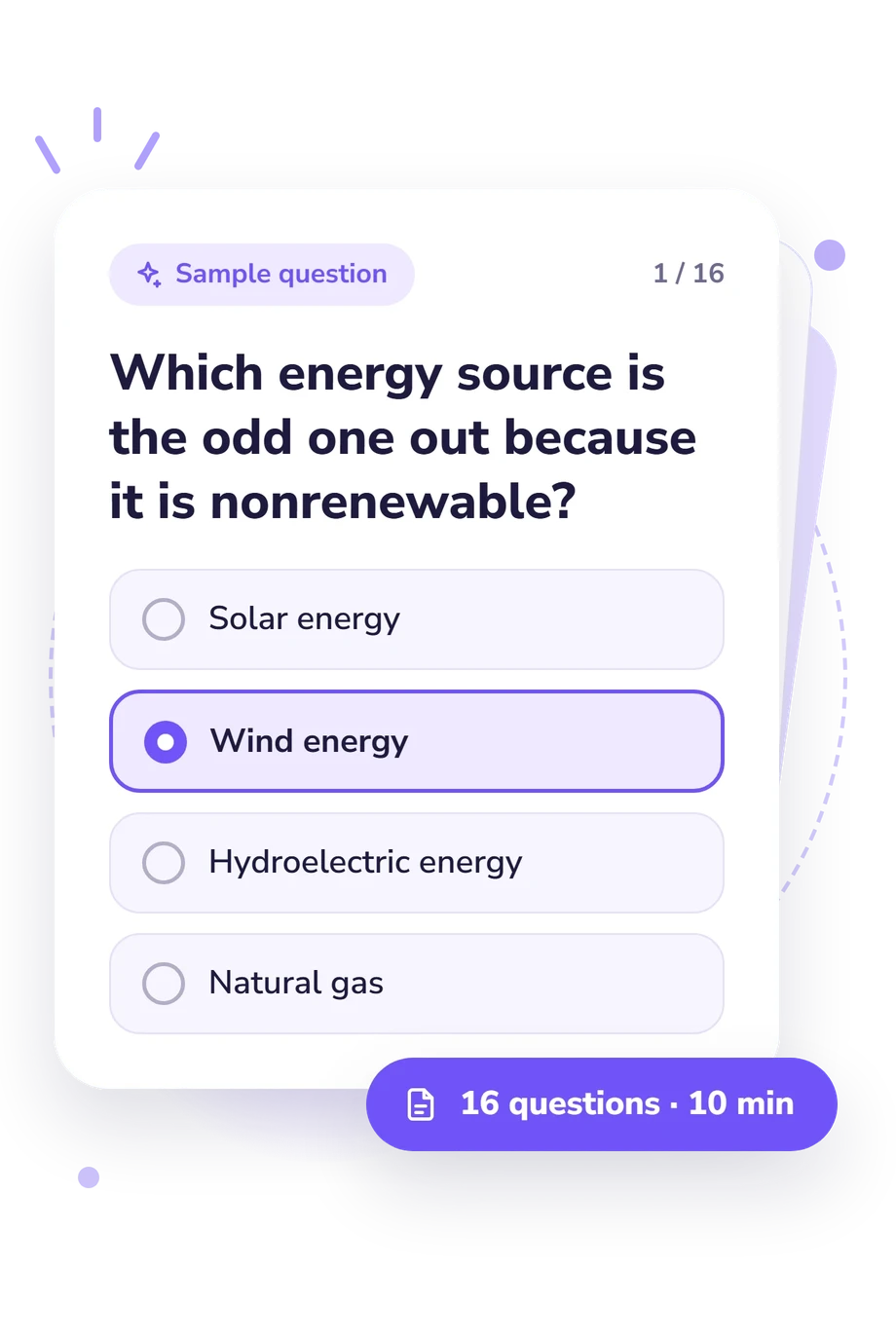
- Solar energy
- Wind energy
- Hydroelectric energy
- Natural gas
- Violin
- Cello
- Flute
- Harp
- Carbon (C)
- Hydrogen (H)
- Oxygen (O)
- Sodium (Na)
Odd One Out Quiz - Description and methodology of the test
People who want to examine how they compare information across subjects can use this odd one out quiz to explore broad reasoning rather than a single school skill. It suits adults and learners who enjoy testing classification, exception spotting, and general knowledge. As a quiz about which is the odd one out, it shows how readily a respondent identifies the rule or fact that separates one option from its group.
What This Assessment Explores
The questionnaire measures practical classification: each item asks the respondent to compare four alternatives and identify the one separated by a stated or inferable property. Examples span science, language, mathematics, geography, technology, and literature, so the task samples flexible comparison rather than one curriculum. As an odd one out test, it examines whether facts can be organized into a governing category or rule.
The result is reported through one scale and its three displayed bands: Odd One Out Knowledge (0-16).
- Foundation Forming (0-6) indicates that broad categories are emerging, while less obvious distinctions may escape notice.
- Developing Discriminator (7-12) indicates that the governing pattern is usually identified and applied across several subjects.
- Sharp Sorter (13-16) indicates consistent detection of precise category, rule, and factual differences, including less obvious exceptions.
Methodology and Scientific Basis
Each prompt presents four choices and one intended distinction. Some questions state the condition directly; others require inference from the relation shared by three options. Comparing the full set matters more than choosing the most familiar answer. Results are interpreted through the displayed scale and its bands.
Methodologically, the questionnaire is conceptually consistent with odd-one-out classification problems discussed by Ruiz (2011), because each set is built around a discriminating relation that separates one option from the others. Research by Diascro and Brody (1994) examined odd-man-out performance and intelligence. These sources provide context for the classification task, but they do not show that this online questionnaire is an adaptation of either published work.
The questionnaire is an online performance exercise rather than a standardized or norm-referenced measure. Language, subject familiarity, attention, concentration, and current context can affect performance in this odd man out quiz, so the result is best read as a structured snapshot of performance on these classification problems.
- Ruiz, Philippe E. (2011). Building and solving odd-one-out classification problems: A systematic approach. Intelligence, 39(5), 342-350. 10.1016/j.intell.2011.06.002
- Diascro, Matthew N., & Brody, Nathan. (1994). Odd-man-out and intelligence. Intelligence, 19(1), 79-92. 10.1016/0160-2896(94)90055-8
Updated: