
Pogue or Kook Quiz
How the Scales are Structured
Who Usually Takes This Test?
See How You Compare
Below is a preview of how scores are typically distributed across each scale.
Example Questions From the Test
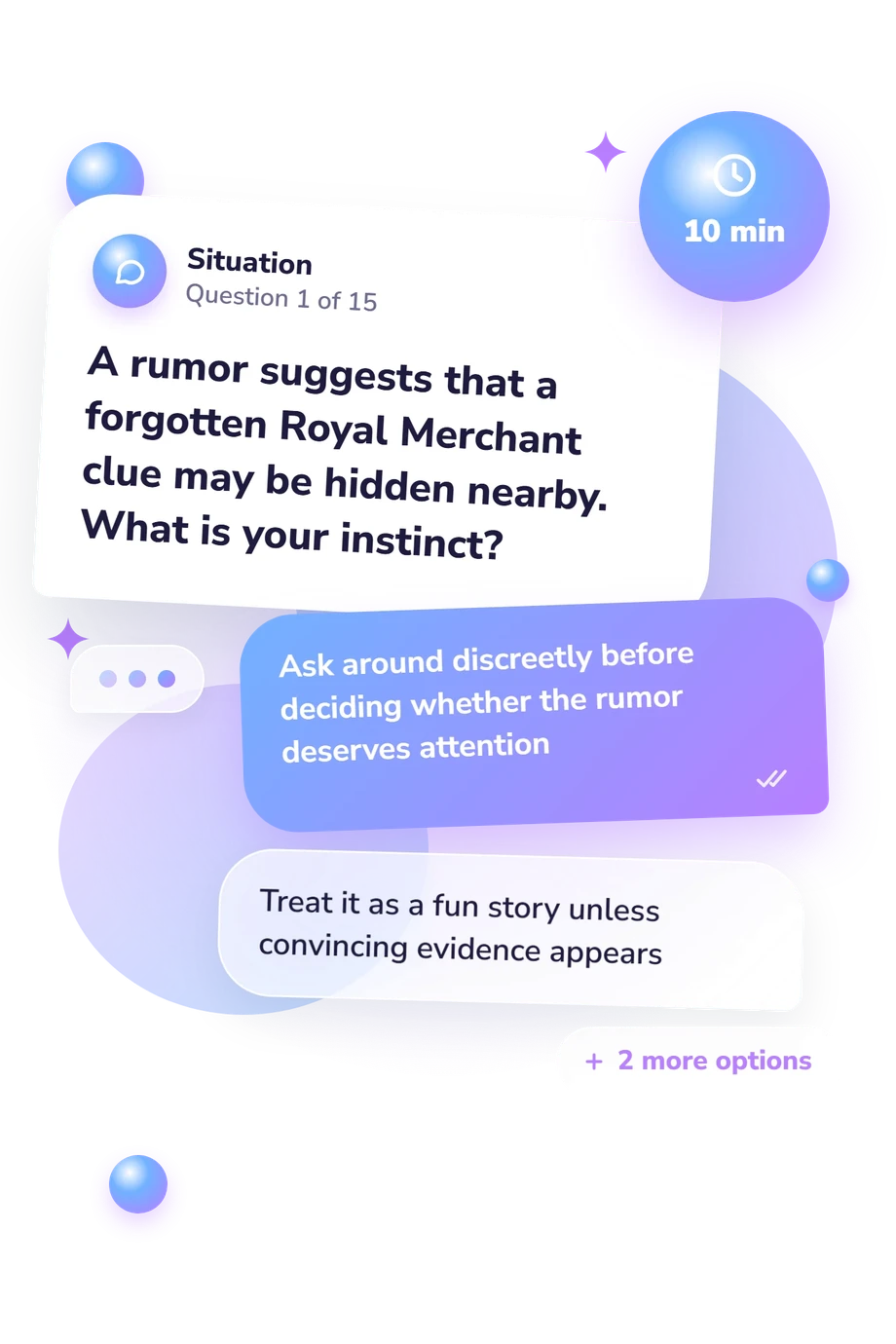
- Ask around discreetly before deciding whether the rumor deserves attention
- Treat it as a fun story unless convincing evidence appears
- Leave the search to people with better resources and connections
- Gather your closest friends and start following the trail
- Support the group whose values already match mine
- Listen to both sides, translate what each is missing, and look for common ground
- Stay neutral until the conflict settles down
- Speak separately with people on both sides before suggesting a compromise
- Cover only the essentials and improvise the rest along the way
- Secure quality equipment, comfortable transport, and experienced help
- Invest in a few reliable upgrades while keeping the trip flexible
- Save most of it and choose one convenience that everyone will value
Pogue or Kook Quiz - Description and methodology of the test
For readers drawn to the Outer Banks’ social contrasts, the Pogue or Kook Quiz offers a playful way to examine belonging, loyalty, independence, status, and social flexibility. Its format explores both identities without treating either as fixed. The result shows which values feel most natural and whether your outlook is better described as a blend than a single label. The kook and pogue quiz format also supports comparison across different kinds of island identity.
What This Assessment Explores
The questions use situations involving rumors, expeditions, friendship conflicts, tradition, presentation, access, and loyalty. They suit anyone comparing personal preferences with the Pogue-Kook divide without treating fictional social worlds as fixed identities. Rather than forcing a choice, the scenarios frame the exercise as an are you a kook or pogue quiz about resourcefulness, polish, connection, and boundary-crossing.
The three result scales describe these dimensions:
- Bridge Between Worlds Affinity (0-15) shows your tendency to translate perspectives: Firmly Rooted (0-5), Boundary Crosser (6-10), or Island Bridge (11-15).
- Kook Affinity (0-15) shows your attraction to established circles and refined surroundings: Outside the Club (0-5), Kook Lean (6-10), or Kook at Heart (11-15).
- Pogue Affinity (0-15) shows your pull toward informal loyalty and improvisation: Different Current (0-5), Pogue Lean (6-10), or Pogue at Heart (11-15).
Methodology and Conceptual Basis
Each item in this Pogue or Kook personality test presents a scenario with four response options. Choose the statement closest to your instinct; alternatives contrast improvisation, access, comfort, loyalty, tradition, and movement between groups. This self-report format captures preferences rather than factual knowledge.
To turn choices into a profile, the questionnaire produces three parallel 0-15 scores. Interpretation depends on their relationship as well as each band: when two results fall within one point, the outcome is blended rather than forced into a single category.
Lötscher (2022) offers a cultural reading of the series’ class and coming-of-age tensions. Tajfel and Turner’s social identity theory and Roccas and Brewer’s social identity complexity offer relevant conceptual comparisons for group boundaries, belonging, and bridge-building. The questionnaire is conceptually consistent with these works; they do not validate it, and it is not an adaptation of them.
Because answers depend on mood, self-awareness, and honest self-description, the profile is a snapshot of stated preferences. The questionnaire has no established normative sample, reliability estimates, or clinical cutoffs, so its bands organize results without turning them into a diagnosis.
- Lötscher, Christine. (2022). "Coming of Age transclasse: Reflections on Netflix's Teen Series Outer Banks (2020-)." In The Whole Life: Representations of Work in Texts about Childhood and Youth, edited by Caroline Roeder and Christine Lötscher, 333-343. J.B. Metzler. 10.1007/978-3-662-65409-5_21
- Roccas, Sonia, and Marilynn B. Brewer. (2002). "Social Identity Complexity." Personality and Social Psychology Review, 6(2), 88-106. 10.1207/S15327957PSPR0602_01
- Tajfel, Henri, and John Charles Turner. (1979). "An Integrative Theory of Intergroup Conflict." In The Social Psychology of Intergroup Relations, edited by Stephen Worchel and William G. Austin, 33-47. Brooks/Cole.
Updated: