
Commonly Misspelled Words Quiz
How the Scales are Structured
Who Usually Takes This Test?
See How You Compare
Below is a preview of how scores are typically distributed across each scale.
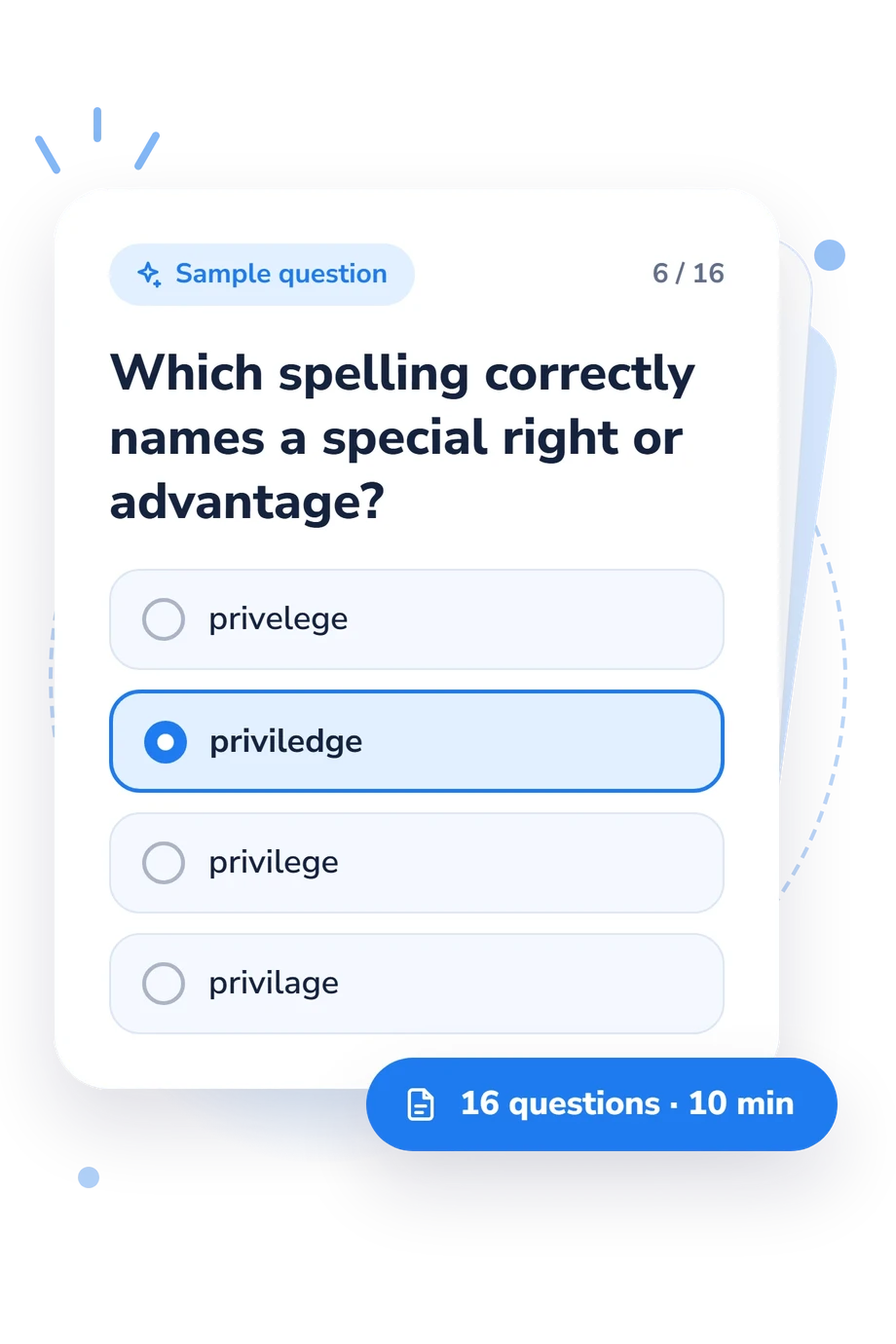
Example Questions From the Test
- seperate
- seperrate
- separete
- separate
- rythm
- rhythm
- rythym
- rhythym
- pronounciation
- pronuncation
- pronunciation
- pronouncation
Commonly Misspelled Words Quiz - Description and methodology of the test
Readers who want to check practical spelling knowledge can use this assessment to separate secure recognition from familiar traps. The commonly misspelled words quiz focuses on standard US English rather than handwriting, grammar, or vocabulary. It suits learners, writers, and anyone reviewing everyday accuracy. The format works as a common spelling mistakes test, making each result useful for review rather than a label of personal ability.
What This Assessment Explores
The questions examine recognition of conventional spellings in short, everyday contexts. This assessment is a quiz covering the most commonly misspelled words, with familiar errors tested inside practical sentences. It suits anyone checking written English accuracy when sound, memory, or visual habit makes a word uncertain.
The main spelling situations represented by the questions are:
- Doubled-letter traps show whether you distinguish forms such as accommodate and occurrence from near matches.
- Vowel errors reveal whether necessary letters remain visible in separate, maintenance, and definitely.
- Pronunciation-resistant spellings test choices such as rhythm and pronunciation when sound misleads.
The displayed scale, Commonly Misspelled Words Knowledge (0-16), reflects correctly identified spellings in standard US English. Results are Building Foundations (0-6), Developing Accuracy (7-12), or Strong Command (13-16).
Methodology and Evidence Base
In this format, the misspelled word quiz presents 16 sentence-based multiple-choice items with four spelling options. Contexts include ordinary written communication, so recognition is tested in use rather than as isolated letter strings. The score reflects how many spellings were identified correctly.
The evidence base is conceptual. Content is consistent with ETS Spelling Corpus (Flor et al., 2015), which documents recurring English spelling errors, and with Bebout (1985), which examines misspellings across first- and second-language learners. Venezky’s orthographic model explains why conventional spellings may not be recoverable from pronunciation alone. This questionnaire is conceptually consistent with those works and is not an adaptation of them.
Because it is an online questionnaire rather than a normed psychometric scale, its bands describe performance on these selected items, not standing against a reference population. Results can be affected by word familiarity, language background, attention, and guessing. A strong score supports confidence with the tested forms; a lower score highlights where targeted practice may improve accuracy.
- Flor, Michael, Yoko Futagi, Melissa Lopez, and Matthew Mulholland. 2015. “Patterns of Misspellings in L2 and L1 English: A View from the ETS Spelling Corpus.” Bergen Language and Linguistics Studies 6. 10.15845/bells.v6i0.811
- Bebout, Linda. 1985. “An Error Analysis of Misspellings Made by Learners of English as a First and as a Second Language.” Journal of Psycholinguistic Research 14 (6): 569-593. 10.1007/BF01067386
- Venezky, Richard L. 1970. The Structure of English Orthography. Berlin and New York: De Gruyter Mouton. 10.1515/9783110804478
Updated: