
English Monarchs Quiz
How the Scales are Structured
Who Usually Takes This Test?
See How You Compare
Below is a preview of how scores are typically distributed across each scale.
Example Questions From the Test
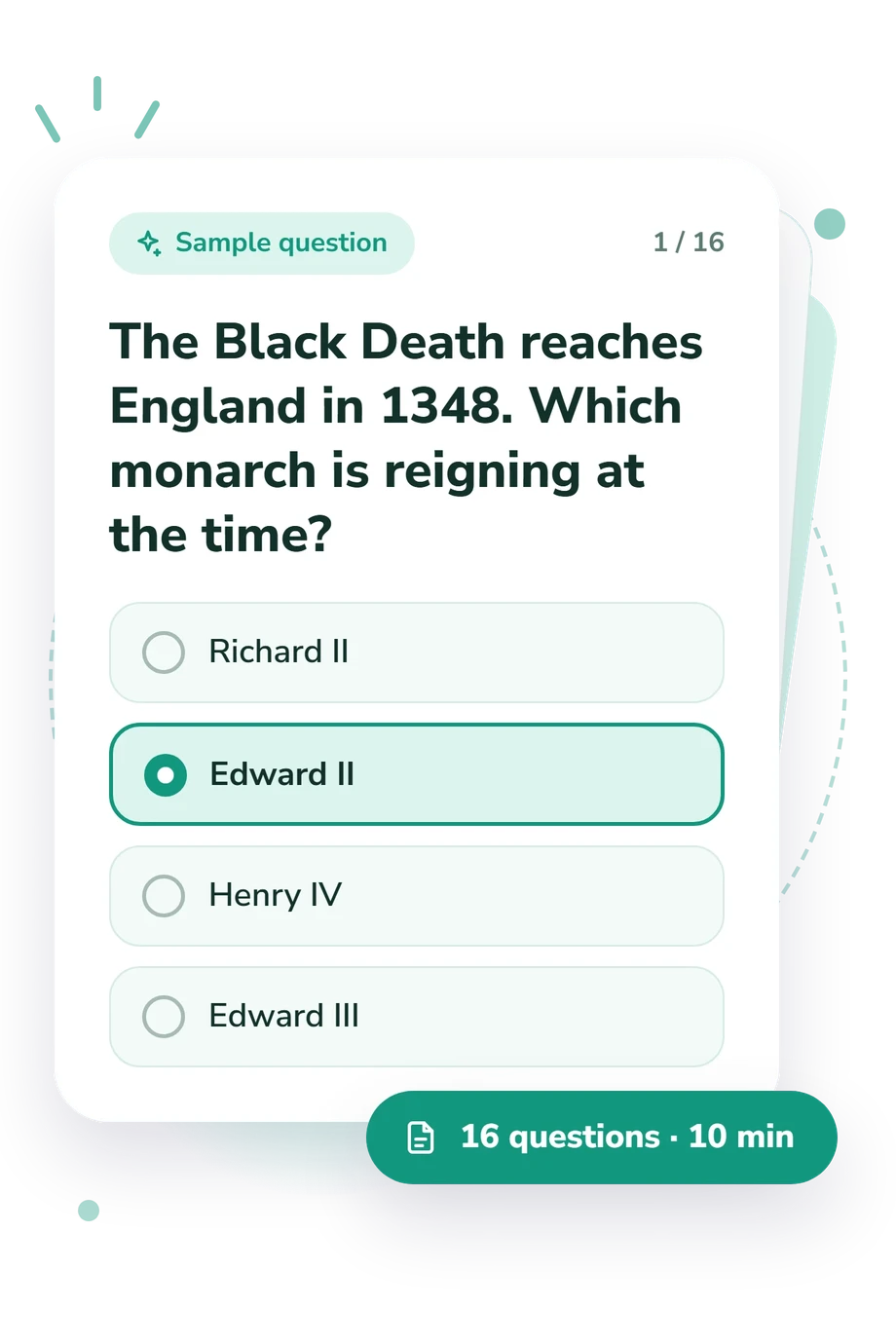
- Richard II
- Edward II
- Henry IV
- Edward III
- Edward II
- Henry V
- Richard II
- Edward III
- Mary II
- Anne
- George I
- William III
English Monarchs Quiz - Description and methodology of the test
Designed for readers checking their grasp of royal chronology, the English Monarchs Quiz turns major reigns and political turning points into a focused knowledge check. It suits learners, trivia fans, and anyone planning a refresher. The result shows how accurately you connect monarchs with events and reflects demonstrated historical knowledge. Learners can use these questions to practise linking English monarchs with events in an English kings and queens quiz format.
What This Test Measures
The questions cover rulers from the Norman period to the early eighteenth century. They test whether you can place monarchs within dated events, identify claimants and successors, and connect conflicts such as the Hundred Years’ War, the Wars of the Roses, and the Civil War with the correct sovereign or house. Questions about the kings and queens of England quiz your knowledge of chronology and context, helping strengthen both.
The result is organized on the English Monarchs Knowledge scale (0-16), with three bands:
- Foundations to build (0-6) indicates recognition of some royal history alongside substantial room to review reigns, successions, and turning points.
- Developing knowledge (7-12) indicates a solid grasp of many monarchs, with gaps remaining in chronology or context.
- Strong knowledge (13-16) indicates accurate connections between rulers and defining events across several periods.
The bands describe performance on these history questions rather than overall historical ability.
Methodology and Evidence Base
Each item presents a historical situation or direct question with four answer choices. The method tests recognition, chronology, and context: respondents select among plausible monarchs rather than supply an unprompted name. Topics range from rulers and dynastic disputes to landmark documents, religious change, invasions, rebellions, and constitutional developments.
Scoring produces one knowledge result with three interpretation bands. The result is a structured content check, not a measure of essay writing, research skill, or every area of British history. Its historical frame is consistent with the work of Cannon and Hargreaves on rulers and succession, Cannon and Griffiths on chronology and institutional context, and Dodd on late medieval kingship.
The questionnaire presents a content-based history exercise with displayed bands. Its items run from the Norman Conquest and medieval succession through Tudor religious change, civil conflict, restoration, and the 1707 union. Answers may vary with education, recent study, wording familiarity, and the choice of a single best option. Reviewing the result can prompt targeted review of monarchs, events, and chronology covered in this kings and queens quiz.
- Cannon, John, and Anne Hargreaves. The Kings and Queens of Britain. Oxford University Press, 2009. ISBN 9780199559220.
- Cannon, John, and Ralph A. Griffiths. The Oxford Illustrated History of the British Monarchy. 2nd ed. Oxford University Press, 2000. ISBN 9780192893284.
- Dodd, Gwilym, ed. The Cambridge Companion to Late Medieval English Kingship. Cambridge University Press, 2025. DOI 10.1017/9781009382045.
Updated: