
Chinese Zodiac Quiz
How the Scales are Structured
Who Usually Takes This Test?
See How You Compare
Below is a preview of how scores are typically distributed across each scale.
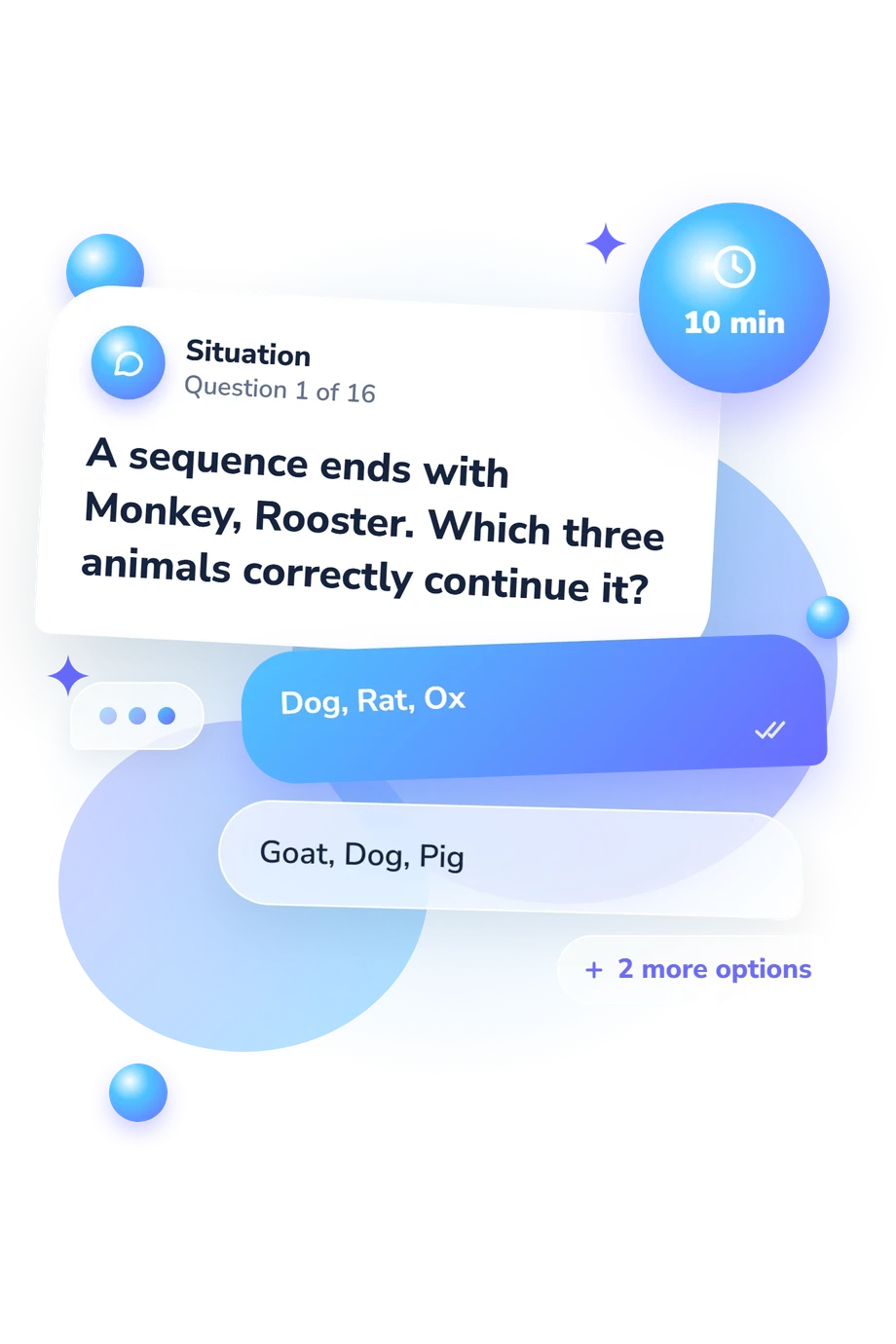
Example Questions From the Test
- Dog, Rat, Ox
- Goat, Dog, Pig
- Pig, Rat, Ox
- Dog, Pig, Rat
- Ten
- Twelve
- Five
- Sixty
- Horse
- Snake
- Rabbit
- Goat
Chinese Zodiac Quiz - Description and methodology of the test
People who want to understand how birth years and calendar boundaries determine an animal sign can use the Chinese Zodiac Quiz as a knowledge check rather than a personality reading. It suits learners seeking a Chinese zodiac knowledge test. Near the year transition, a personal sign requires checking the relevant calendar date separately. The result guides further learning.
What This Assessment Explores
This questionnaire measures zodiac knowledge, not personality, fate, or cultural belonging. It tests the 12-animal order, sequence positions, and year-based versus Western sun signs.
Calendar awareness matters: January or February cannot always use January 1 as the boundary, so identifying a Chinese zodiac animal requires the relevant year transition. Items also cover animal hours, Five Phases, alternate names, ben ming nian, and the 60-year cycle.
The result covers:
- Animal order shows whether you can follow the sequence and transitions.
- Cycle concepts reflect knowledge of animal hours, Five Phases, ben ming nian, and the 60-year structure.
- Chinese Zodiac Knowledge (0-16) reports factual performance: Starting Point (0-6) recognizes core ideas and may benefit from review; Developing Knowledge (7-12) reflects many essentials with details to refine; and Strong Knowledge (13-16) shows a well-rounded grasp of sequence, calendar logic, and the larger cycle.
Methodology and Scientific Basis
Each item uses four answer choices. The alternatives test animal order, calendar rules, and related calendrical systems. The result is a performance profile for this knowledge set, not intelligence or personality.
A reader seeking to verify a Chinese zodiac birth-year sign should treat the result as knowledge of tested calendar conventions, not a personal sign calculation. It shows familiarity with the conventions tested, but does not calculate a sign from a birth date.
The calendar logic tested here appears in calendar-focused work by Reingold and Dershowitz, while Raphals supplies context for the 60-year cycle. Xu and Sharifian are relevant more narrowly to terminology and cultural variation, including alternate English animal names; their work does not establish that this questionnaire measures broader zodiac meanings.
Translated animal names, prior exposure, and current attention can affect answers. The displayed score is descriptive and limited to performance on these items. For a personal sign near January or February, check the exact Chinese New Year date for the relevant year separately.
- Xu, Zhichang, and Farzad Sharifian. Cultural conceptualizations of Chinese zodiac animals in Chinese English. World Englishes, 37(4), 590-606, 2018. 10.1111/weng.12351
- Reingold, Edward M., and Nachum Dershowitz. The Chinese Calendar. In Calendrical Calculations: The Ultimate Edition, pp. 305-334. Cambridge University Press, 2018. 10.1017/9781107415058.022
- Raphals, Lisa. The sexagenary cycle. In Divination and Prediction in Early China and Ancient Greece, pp. 396-398. Cambridge University Press, 2013. 10.1017/CBO9780511863233.015
Updated: