
Am I Sexually Frustrated Quiz
How the Scales are Structured
Who Usually Takes This Test?
See How You Compare
Below is a preview of how scores are typically distributed across each scale.
Example Questions From the Test
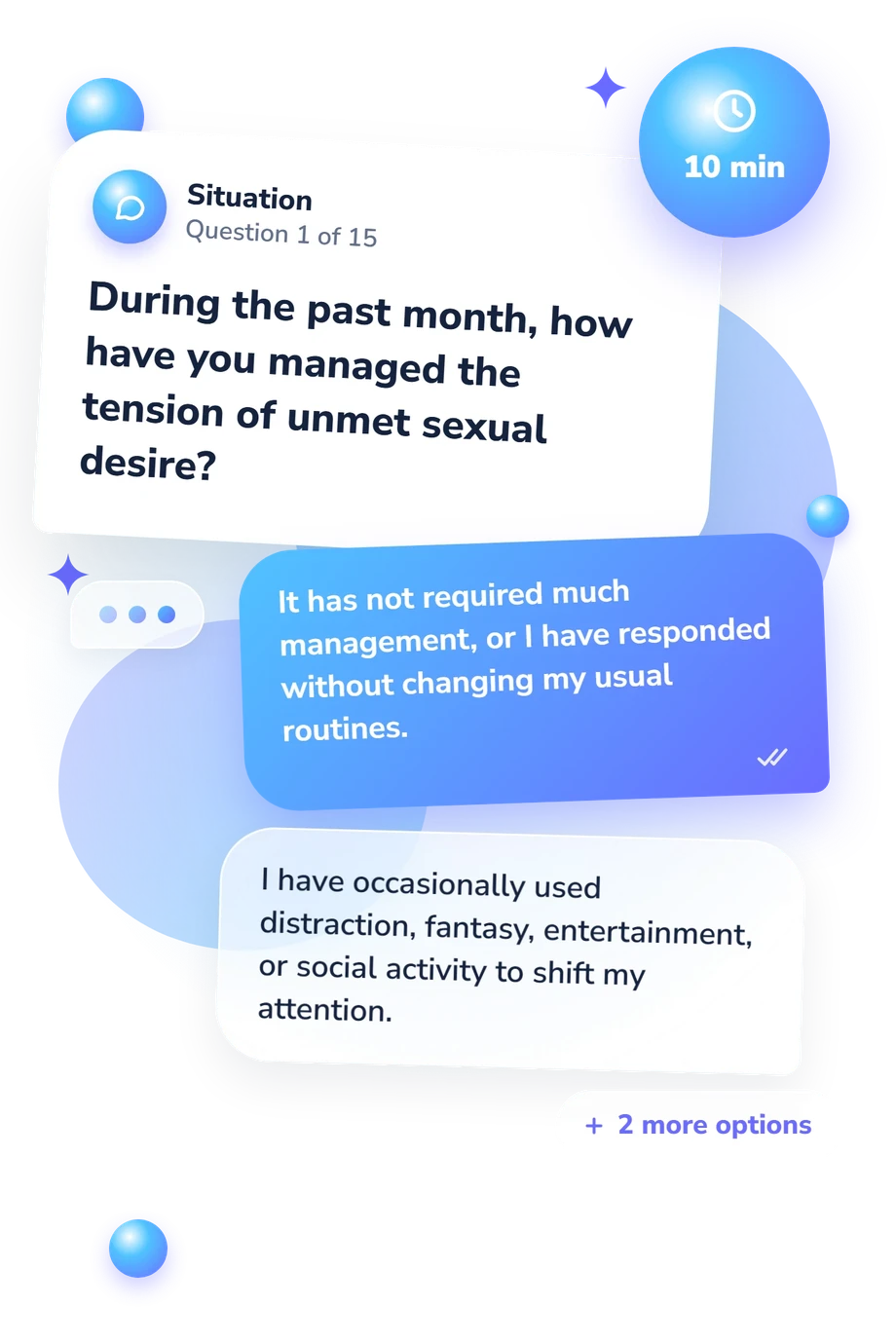
- It has not required much management, or I have responded without changing my usual routines.
- I have occasionally used distraction, fantasy, entertainment, or social activity to shift my attention.
- I have repeatedly fallen into coping habits that do not leave me feeling satisfied afterward.
- My routines are frequently driven by attempts to escape the tension, and redirecting myself feels difficult.
- Never or almost never; it usually passes or is fulfilled without lingering tension.
- Occasionally, especially during unusually busy or disconnected periods.
- Often enough that unresolved desire has become a familiar experience.
- Very often; the sense of unresolved desire is present much of the time.
- I can express interest respectfully while leaving room for any response.
- I usually offer a subtle signal first and proceed only if interest seems clearly mutual.
- I often keep my interest hidden because awkwardness or rejection feels difficult to face.
- Even in an appropriate situation, I almost never express my interest and am left with it unspoken.
Am I Sexually Frustrated Quiz - Description and methodology of the test
For people trying to understand whether unmet sexual desire is affecting more than a single moment, the Am I Sexually Frustrated Quiz offers a structured reflection on current patterns. This sexual frustration quiz can help distinguish concerns about fulfillment, spillover, and agency. It is suited to people considering tension, communication, mood, or daily functioning, and presents a three-part profile rather than a single label.
What This Assessment Explores
The questionnaire treats frustration as a relationship between desired and experienced fulfillment, then considers how that mismatch may appear in emotion, attention, self-image, interactions, and choices. It also asks about clarity of preferences, communication, consensual alternatives, privacy, time, and the ability to express interest respectfully. In this sense, the sexual frustration assessment describes patterns rather than identifying one cause.
The three dimensions are:
- Desire-Fulfillment Gap (0-15) shows whether desired and experienced fulfillment are Mostly aligned (0-5), a Noticeable mismatch (6-10), or a Persistent mismatch (11-15).
- Emotional and Daily-Life Spillover (0-15) shows whether unmet desire has Limited spillover (0-5), Meaningful spillover (6-10), or Broad spillover (11-15) across mood, attention, confidence, habits, or interactions.
- Expression and Agency Barriers (0-15) shows whether needs are Generally expressible (0-5), involve Some friction (6-10), or encounter Strong barriers (11-15) when identifying, communicating, or pursuing consensual options.
Methodology and Scientific Basis
Each prompt offers four ordered self-report responses, moving from little or manageable impact toward persistent tension, spillover, uncertainty, or blocked action. Responses form three displayed subtotals, but no standardized weighting rule or clinical cutoff is stated. A higher score reflects more of the tendency represented by that dimension, not a known cause or fixed severity.
The evidence base is conceptual rather than a claim that this online questionnaire reproduces a published instrument. Zacchilli et al. (2024) describe an inventory separating sexual satisfaction from frustration, making it the closest named comparison for this focus. Frost and Donovan (2018) offer a related distress framework for intimate and relationship experiences. Jodouin et al. (2021) connect partnered desire discrepancy with later sexual distress, supporting attention to mismatch without establishing causation here.
As an online sexual frustration test, it is an unvalidated reflective profile rather than a standardized adaptation. Results can shift with current circumstances, self-awareness, communication conditions, and response bias. Persistent distress, pain, unsafe experiences, or pressure from another person warrants appropriate support; frustration never overrides mutual consent.
- Zacchilli, T. L., Ault, L. K., Zamora, R. C., Garnier, A., & Marrero, A. (2024). The Development of the Sexual Satisfaction and Frustration Inventory for Women. Psi Chi Journal of Psychological Research, 29(2), 110-119. 10.24839/2325-7342.JN29.2.110
- Frost, R., & Donovan, C. (2018). The Development and Validation of the Sexual and Relationship Distress Scale. Journal of Sexual Medicine, 15(8), 1167-1179. 10.1016/j.jsxm.2018.06.004
- Jodouin, J.-F., Rosen, N. O., Merwin, K., & Bergeron, S. (2021). Discrepancy in Dyadic Sexual Desire Predicts Sexual Distress over Time in a Community Sample of Committed Couples: A Daily Diary and Longitudinal Study. Archives of Sexual Behavior, 50(8), 3637-3649. 10.1007/s10508-021-01967-0
Updated: