
Intro to Psychology Quiz
How the Scales are Structured
Who Usually Takes This Test?
See How You Compare
Below is a preview of how scores are typically distributed across each scale.
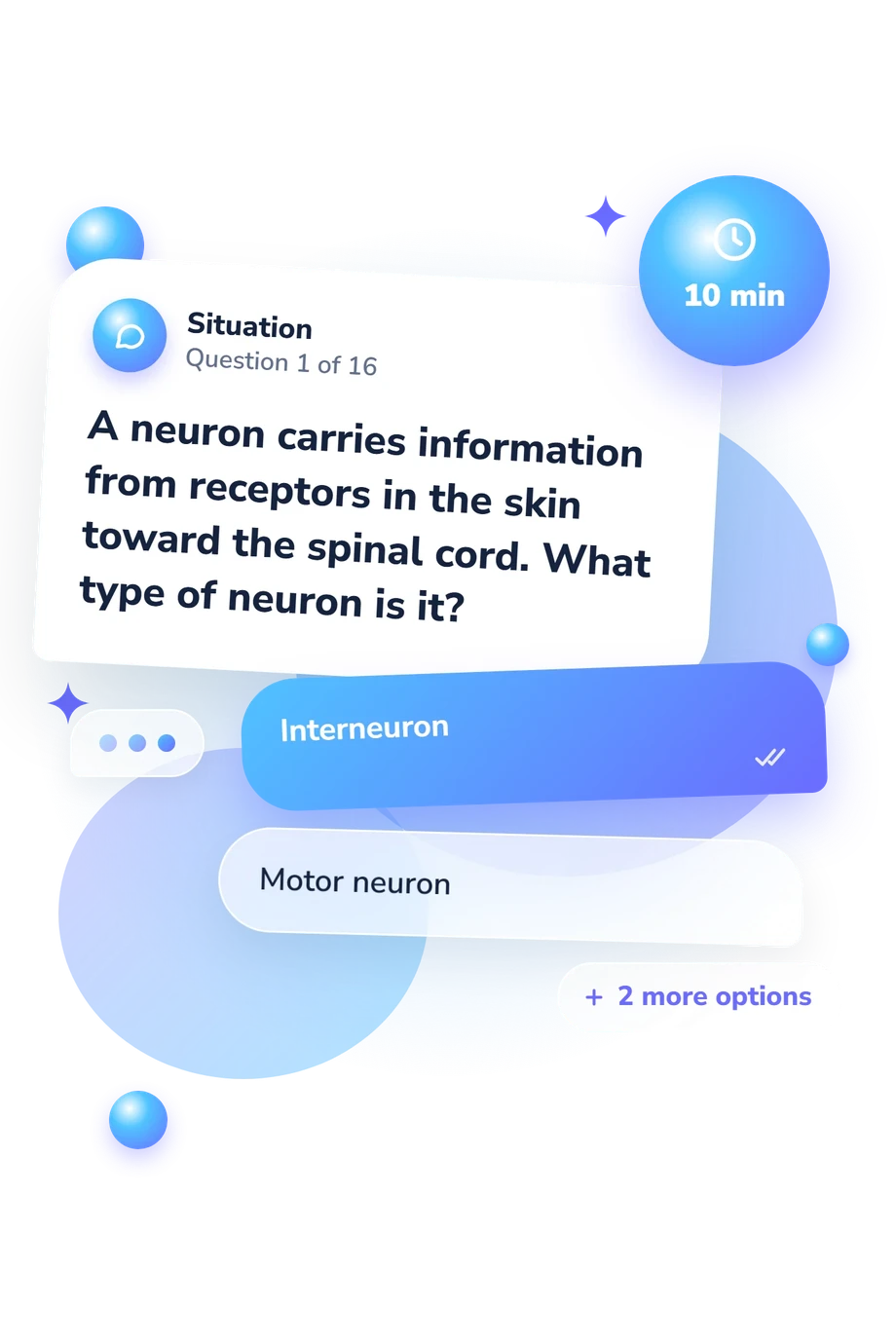
Example Questions From the Test
- Interneuron
- Motor neuron
- Sensory neuron
- Mirror neuron
- The amount of sleep participants receive
- The participants' attention scores
- The number of participants studied
- The researcher's prediction about attention
- Medulla
- Hippocampus
- Cerebellum
- Hypothalamus
Intro to Psychology Quiz - Description and methodology of the test
Students, curious readers, and learners returning to foundational material can use this assessment to check how confidently they apply basic psychological ideas. The intro to psychology quiz lets readers test that confidence through practical situations drawn from an introductory course. This introduction to psychology quiz gives readers a clear starting point before they revisit the subject.
What This Quiz Measures
Across the items, the respondent identifies terms, interprets research situations, and applies concepts to everyday examples. The content suits people reviewing a broad introductory foundation, rather than those seeking a personality, symptom, or clinical profile.
The groups show how the quiz samples psychology basics:
- Research methods tests distinctions among variables, correlation, random assignment, reliability, validity, and experimental controls.
- Biological foundations covers neurons, brain structures, sleep stages, and links between bodily systems and behavior.
- Memory and cognition examines working memory, explicit memory, bias, dissonance, and object permanence.
- Learning and social behavior asks the reader to apply conditioning principles and explain how situations and other people influence action.
One overall scale, Intro to Psychology Knowledge (0-16), summarizes performance across the quiz. Its bands are Foundations to Build (0-6), Developing Knowledge (7-12), and Strong Foundation (13-16), indicating how much introductory review may be useful.
Methodology and Evidence Base
Each item in the intro to psych quiz presents a brief prompt and four answer choices. The respondent selects the option that best matches a concept, research principle, or everyday example. This format tests recognition and application, while the single total keeps interpretation focused on educational performance.
Content is conceptually consistent with the introductory framework described in OpenStax Psychology, the breadth-and-depth model for introductory psychology courses discussed by Gurung and colleagues, and the APA Introductory Psychology Initiative. These sources support the quiz's coverage; they do not make it an adaptation or standardized administration of a published instrument.
Results are presented on one overall scale rather than as separate trait scores. The joint testing standards issued by AERA, APA, and NCME (2014) emphasize that score meaning depends on purpose, content coverage, and evidence for intended use. This result is educational rather than clinical, with no stated normative benchmark. Prior study, guessing, attention, wording, and concentration can affect performance, so use it to choose what to review next.
- Spielman, Rose M., William J. Jenkins, and Marilyn D. Lovett. Psychology 2e. OpenStax, 2020.
- Gurung, Regan A., James Hackathorn, Christine Enns, Susan Frantz, John T. Cacioppo, Todd Loop, and John E. Freeman. Strengthening introductory psychology: A new model for teaching the introductory course. American Psychologist, 71(2), 112-124, 2016. 10.1037/a0040012
- American Psychological Association. APA Introductory Psychology Initiative (IPI) Student Learning Outcomes for Introductory Psychology. American Psychological Association, 2021.
- American Educational Research Association, American Psychological Association, and National Council on Measurement in Education. Standards for Educational and Psychological Testing. American Educational Research Association, 2014.
Updated: