
Julius Caesar Act 3 Quiz
How the Scales are Structured
Who Usually Takes This Test?
See How You Compare
Below is a preview of how scores are typically distributed across each scale.
Example Questions From the Test
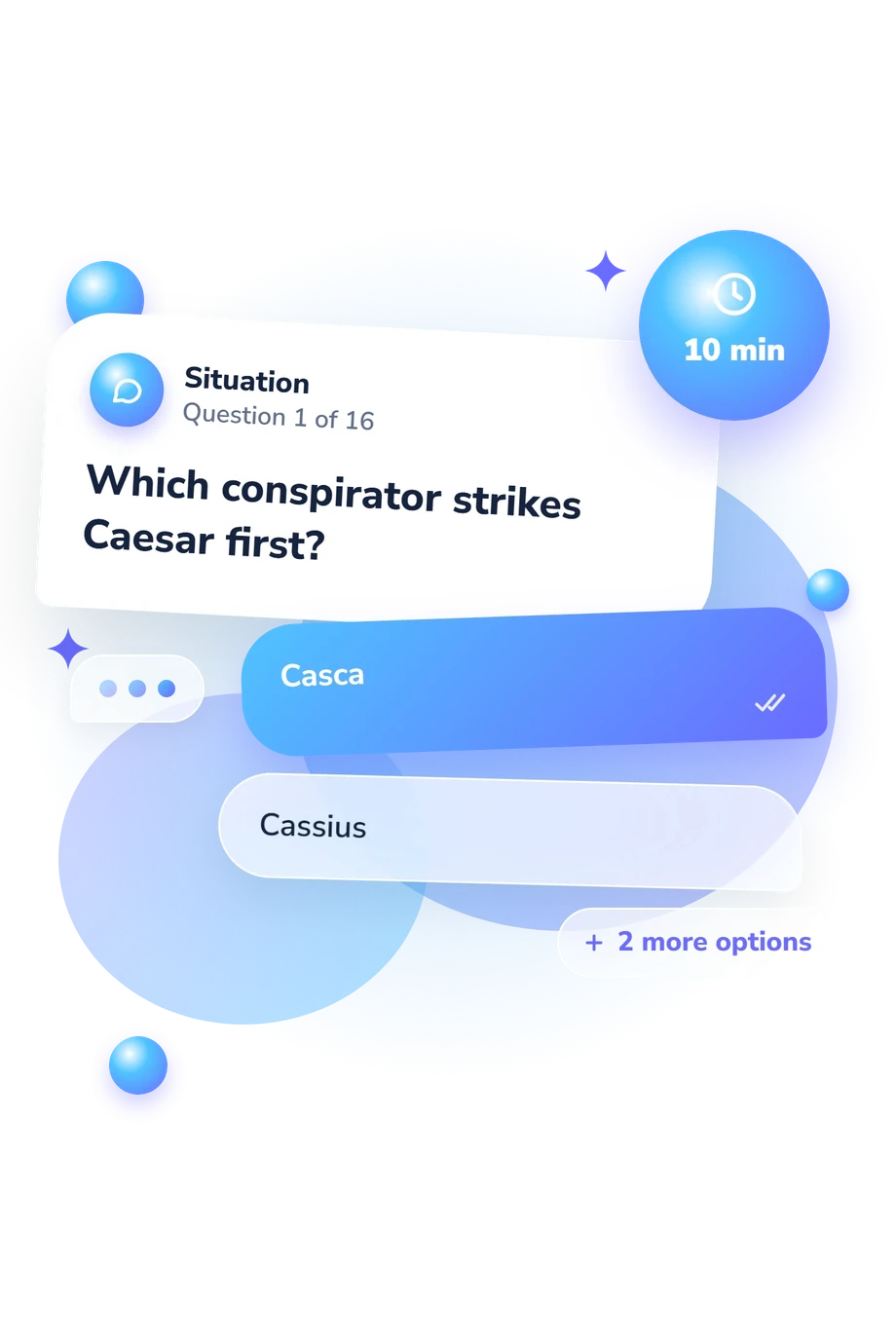
- Casca
- Cassius
- Decius Brutus
- Brutus
- He gives the letter to Antony to examine privately
- He orders Artemidorus to present it before the Senate
- He reads the letter but dismisses its warning as superstition
- He says matters concerning himself will be attended to last
- A petition asking Caesar to recall Publius Cimber from exile
- A letter naming the conspirators and warning Caesar of the plot
- A message reporting that Antony has joined the conspirators
- A prophecy explaining Calpurnia’s dream
Julius Caesar Act 3 Quiz - Description and methodology of the test
Readers revising Shakespeare’s Roman tragedy can use the Julius Caesar Act 3 Quiz to check whether their understanding reaches beyond plot recall. It suits students, teachers, and independent readers who want to distinguish remembered events from interpretation and use the result to plan closer rereading. When you take the Julius Caesar Act III quiz, your result points to the scenes and interpretive skills that deserve another close reading.
What This Assessment Explores
Rather than measuring literary ability in general, the questionnaire focuses on what happens in Act 3 and why the characters’ decisions matter. It asks readers to connect sequence, motive, public reaction, and rhetorical technique across the Capitol, the funeral speeches, and the violence that follows. The Julius Caesar Act 3 test suits anyone who has read the act and wants to check memory alongside interpretation.
The result reflects four kinds of understanding:
- Assassination sequence shows whether you can place warnings, petitions, attacks, and consequences in dramatic order.
- Character motivation shows how Brutus’s republican justification differs from Cassius’s caution and Antony’s strategy.
- Rhetorical analysis shows whether you recognize irony, emotional imagery, repetition, and competing appeals.
- Dramatic consequence shows whether you understand how Caesar’s death shifts public opinion toward his allies.
Methodology and Scientific Basis
Each item offers four answer choices and combines scene knowledge with interpretation of motive, rhetoric, dramatic irony, and political change. The answer options include plausible misunderstandings within the act. This Julius Caesar Act 3 practice quiz asks readers to reason from the text rather than recognize isolated quotations.
The online questionnaire has no documented norms, psychometric standardization, or individual point-allocation rule. Shakespeare’s Act 3 supplies the events, speeches, and wording being tested. Julia Griffin’s 2014 discussion of Cinna’s mistaken identity helps frame that episode, while Jean Fuzier’s 1974 analysis provides context for the funeral speeches’ competing rhetorical strategies. The questionnaire is conceptually consistent with these works, not an adaptation of either study.
Your result is reported on the Julius Caesar Act 3 Knowledge scale (0-16). The displayed bands are Foundation to revisit (0-6), Developing command (7-12), and Strong command (13-16). They describe coverage of plot, characterization, rhetoric, themes, and decisions; reading recency, classroom emphasis, and familiarity with Shakespearean language can also affect performance, so use the result to guide rereading rather than as a final judgment of literary ability.
- Shakespeare, William. Julius Caesar. Edited by Marvin Spevack, with an introduction by Jeremy Lopez. Cambridge University Press, 2017, pp. 87-107. 10.1017/9781316105108
- Griffin, Julia. "Cinnas of memory." In Shakespeare Survey, Volume 67: Shakespeare's Collaborative Work, pp. 299-309. Cambridge University Press, 2014. 10.1017/SSO9781107775572.021
- Fuzier, Jean. "Rhetoric Versus Rhetoric: A Study of Shakespeare's Julius Caesar, Act III, Scene 2." Cahiers Élisabéthains, vol. 5, no. 1, 1974, pp. 25-65. 10.1177/018476787400500102
Updated: