
What Is My Net Worth Quiz
How the Scales are Structured
Who Usually Takes This Test?
See How You Compare
Below is a preview of how scores are typically distributed across each scale.
Example Questions From the Test
- I could list nearly every balance from recent statements, including loans, cards, and other obligations.
- I know the main debts, but I would need to search for some balances.
- I could list most debts, though a few balances might come from older statements.
- I mainly keep track of required monthly payments rather than total balances.
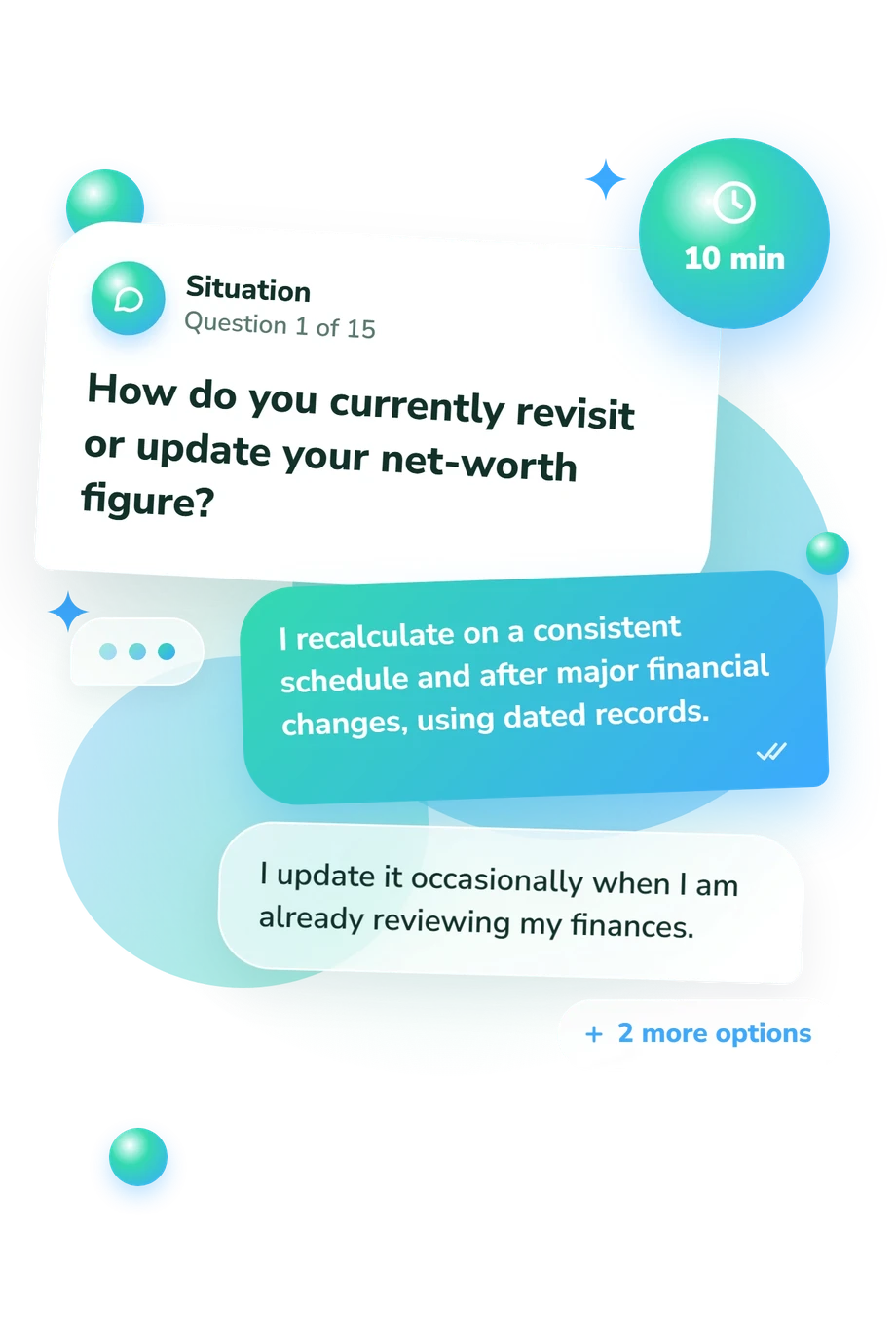
- I recalculate on a consistent schedule and after major financial changes, using dated records.
- I update it occasionally when I am already reviewing my finances.
- I have calculated it before but do not have a particular review pattern.
- I have not yet created a dated calculation that I could update.
- The latest available current balance, with pending activity checked if it could materially affect the total.
- The statement balance because it is the formal figure I already have.
- My credit limit minus the amount I think remains available.
- The current balance shown by the issuer, while accepting that very recent transactions may still post.
What Is My Net Worth Quiz - Description and methodology of the test
People organizing accounts, debts, property, or shared obligations can use the What Is My Net Worth Quiz to examine how ready they are to build and review a financial snapshot. This personal net worth assessment focuses on record quality and calculation habits, helping readers see where information is complete, approximate, or still needs verification. It describes financial-review readiness, not the size of someone’s wealth.
What This Assessment Explores
Questions focus on financial-inventory quality rather than income or wealth size. They cover locating accounts and obligations, choosing defensible values, checking ownership and dates, and interpreting changes without turning a snapshot into a judgment of personal worth. Three displayed scales cover assets, liabilities, and net worth review:
- Asset Picture (0-15) measures identifying and valuing owned assets: Starting Inventory (0-5) means details need gathering; Partial Picture (6-10) means values remain approximate; Well-Defined Picture (11-15) means current records support coverage.
- Liability Picture (0-15) measures identifying balances and obligations: Starting Inventory (0-5) signals gaps; Partial Picture (6-10) means details need clarification; Well-Defined Picture (11-15) reflects a comprehensive current total.
- Net-Worth Calculation and Review (0-15) measures combining both sides into a repeatable snapshot: Building the Method (0-5) signals a need for structure; Workable Method (6-10) supports an estimate; Established Method (11-15) reflects a revisable process.
Methodology and Scientific Basis
Each item presents a practical record-keeping problem with four response choices. The alternatives contrast current balances, supportable estimates, legal responsibility, matching dates, and interpretation of change. Self-report is central: documents are not inspected and entries are not independently verified.
The questionnaire examines how someone would assemble and review a figure for net worth tracking rather than asking for the actual dollar total. Results are reported across three dimensions; weighting or any combined score is not stated.
Dew and Xiao's Financial Management Behavior Scale is a conceptual reference related to the questionnaire's attention to financial practices, not its source or an adaptation. Work by Cubbin and colleagues most directly matches the questionnaire's attention to assets, liabilities, ownership, and valuation; Huston and Lusardi and Mitchell add financial-literacy context. None of these studies validates this online version.
The displayed bands are descriptive readiness categories, and no population norms, reliability estimates, or clinical cutoffs are claimed for this online questionnaire.
Memory, current circumstances, and confidence can shape answers. The result describes financial-review readiness; a large change still requires checking records, dates, and assumptions.
- Dew, Jeffrey P., and Jing Jian Xiao. “The Financial Management Behavior Scale: Development and Validation.” Journal of Financial Counseling and Planning, 22(1), 43-59, 2011.
- Cubbin, Catherine, Craig Pollack, Brian Flaherty, Mark Hayward, Ayesha Sania, Donna Vallone, and Paula Braveman. “Assessing Alternative Measures of Wealth in Health Research.” American Journal of Public Health, 101(5), 939-947, 2011. 10.2105/AJPH.2010.194175
- Huston, Sandra J. “Measuring Financial Literacy.” Journal of Consumer Affairs, 44(2), 296-316, 2010. 10.1111/j.1745-6606.2010.01170.x
- Lusardi, Annamaria, and Olivia S. Mitchell. “The Economic Importance of Financial Literacy: Theory and Evidence.” Journal of Economic Literature, 52(1), 5-44, 2014. 10.1257/jel.52.1.5
Updated: