
IT Quiz Questions
How the Scales are Structured
Who Usually Takes This Test?
See How You Compare
Below is a preview of how scores are typically distributed across each scale.
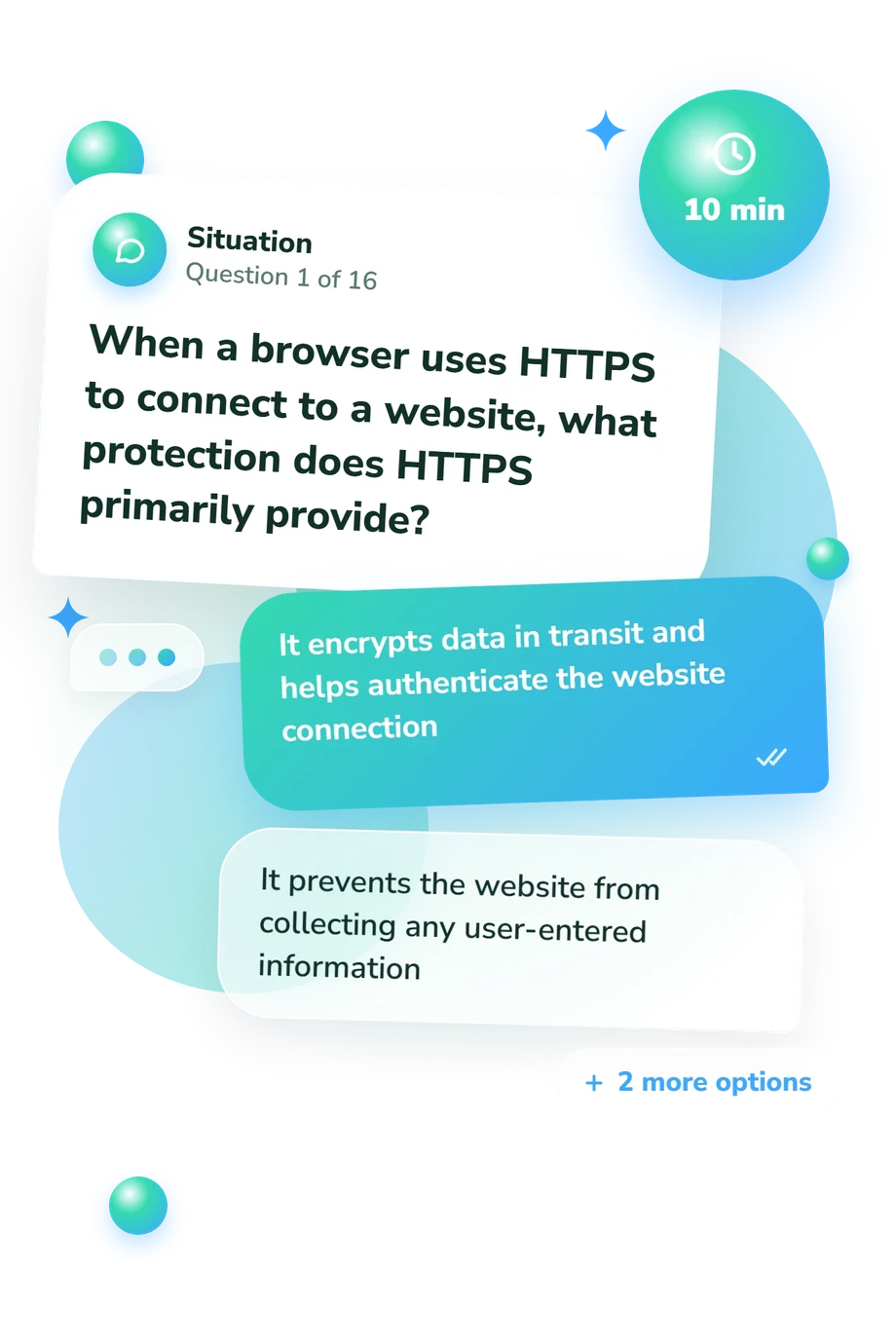
Example Questions From the Test
- An SSD can store only operating-system files
- An SSD requires an internet connection to retain files
- An SSD stores data without mechanical moving parts
- An SSD uses magnetic spinning platters at a higher speed
- They guarantee that the device will never fail
- They permanently remove the need for antivirus tools
- They can fix vulnerabilities that attackers might exploit
- They convert all locally stored files into cloud files
- Solid-state drive
- RAM
- CPU cache stored permanently on disk
- Power supply unit
IT Quiz Questions - Description and methodology of the test
People who want to check common computing knowledge can use IT Quiz Questions to examine how they handle foundational concepts across everyday technology. The IT-related quiz questions in this assessment give learners, new employees, and curious users concrete situations for checking common computing concepts. The result shows where knowledge is stronger and which areas may warrant review, rather than judging intelligence, experience, or professional competence.
What This Assessment Measures
Designed for everyday use, the questionnaire checks whether a respondent can recognize core ideas in work, study, and personal technology. It emphasizes applied understanding: identifying what a tool does, choosing a sensible first action, and distinguishing safer from riskier practice. Results indicate stronger and weaker performance across the tested foundations, highlighting areas that may warrant review.
Together, these themes make the assessment an i t quiz covering the following practical groups:
- Devices and software show understanding of operating systems, RAM, storage, file formats, and applications.
- Networks and connectivity cover HTTPS, DNS, Wi-Fi, routers, and cloud service models.
- Data and access reflect backups, primary keys, permissions, and least privilege.
- Security and troubleshooting capture updates, phishing, MFA, and unresponsive applications.
- IT Knowledge spans 0-16: Foundations to Build (0-6), Developing Knowledge (7-12), and Strong Knowledge (13-16) describe increasing command of the tested foundations.
Methodology and Evidence Base
Items use short scenarios, definitions, or direct concept questions, each with four answer choices. The respondent selects the option that best matches established IT knowledge, and the result is reported on one overall scale rather than separate specialist scores. This format tests recognition and application of concepts, not live performance with a device or system.
Conceptually, this online IT knowledge quiz is consistent with the Computer Literacy Test (Simonson et al., 1987), a relevant precedent for assessing broad computer knowledge. Pierce, Lloyd, and Solak (2001) discuss how computer-literacy tests can support placement or remedial decisions when item quality and interpretation are handled carefully. Research from ICILS 2013, examined by Ihme and colleagues (2017), also highlights that item formats may not measure exactly the same aspects of a construct.
The cited instruments provide conceptual context, but their norms and validation do not apply to this questionnaire. Use results to plan further review or track topics over time. Guessing, prior exposure, language, and testing context can affect performance, so the result is a snapshot of current knowledge rather than a complete measure of technical ability.
- Simonson, Michael R., Matthew Maurer, Mary Montag-Torardi, and Mary Whitaker. Development of a Standardized Test of Computer Literacy and a Computer Anxiety Index. Journal of Educational Computing Research 3(2) (1987): 231-247. 10.2190/7CHY-5CM0-4D00-6JCG
- Pierce, Elizabeth M., Karl B. Lloyd, and James Solak. Lessons Learned from Piloting a Computer Literacy Test for Placement and Remedial Decisions. Journal of Information Systems Education 12(2) (2001): 81-92.
- Ihme, Jan Marten, Martin Senkbeil, Frank Goldhammer, and Julia Gerick. Assessment of Computer and Information Literacy in ICILS 2013: Do Different Item Types Measure the Same Construct? European Educational Research Journal 16(6) (2017): 716-732. 10.1177/1474904117696095
Updated: