
Common Grammar Mistakes Quiz
How the Scales are Structured
Who Usually Takes This Test?
See How You Compare
Below is a preview of how scores are typically distributed across each scale.
Example Questions From the Test
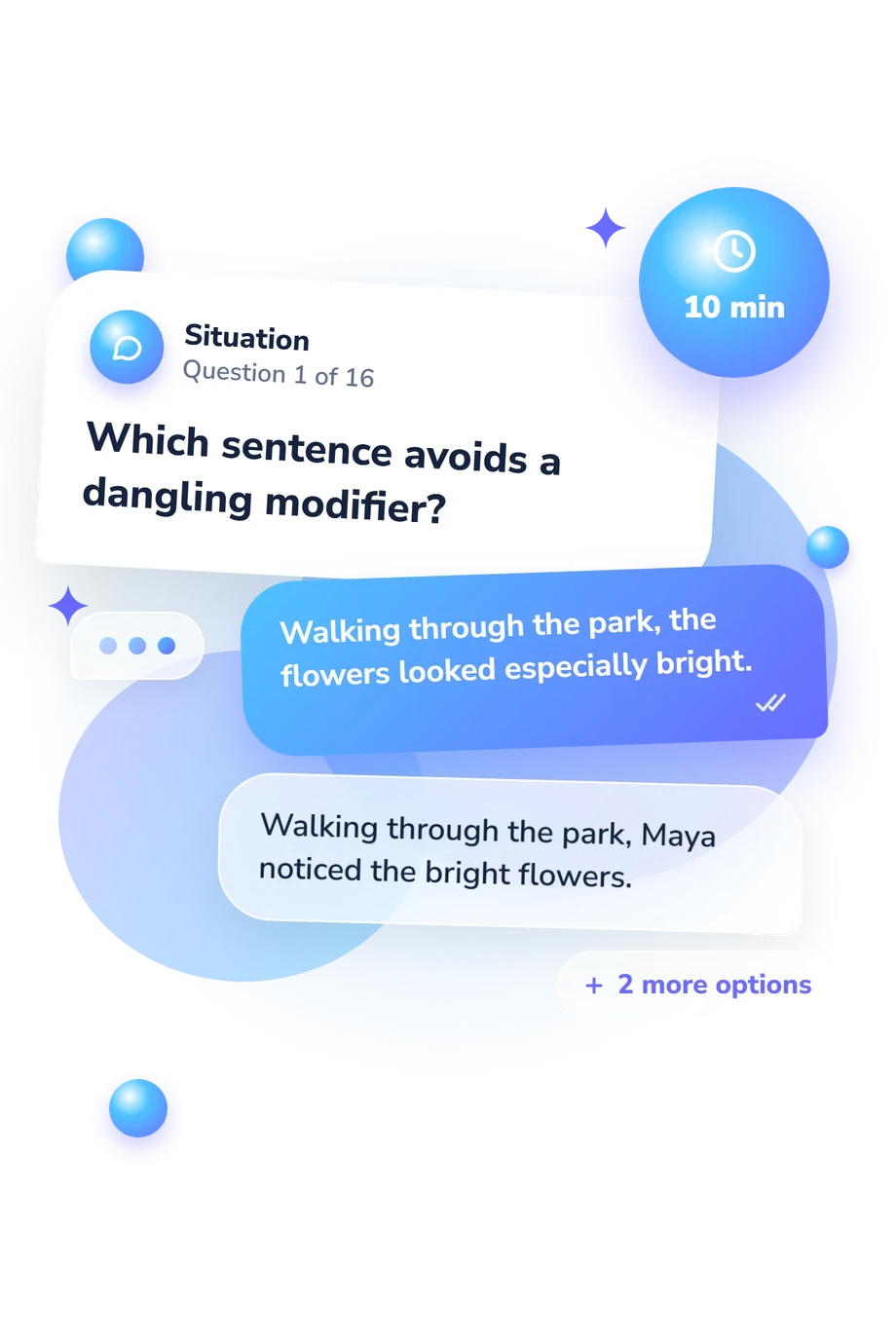
- Walking through the park, the flowers looked especially bright.
- Walking through the park, Maya noticed the bright flowers.
- While driving to work, the rain began to fall.
- After reading the report, several errors were obvious.
- If I had known about the event, I would have attended.
- If I had knew about the event, I would attend.
- If I would have known about the event, I attended.
- If I knew about the event, I would have attended.
- Each of the students has submitted the assignment.
- Each of the students have submitted the assignment.
- Each of the student have submitted the assignment.
- Each of the students were submitting the assignment.
Common Grammar Mistakes Quiz - Description and methodology of the test
For learners, writers, and editors, the common grammar mistakes quiz offers a practical check of everyday rule knowledge. It focuses on sentence-level decisions that influence clarity in ordinary writing. In practical terms, the common grammar errors quiz shows how reliably respondents recognize errors rather than measuring broad language ability. The result points to strengths and gaps that can shape focused practice.
What This Assessment Explores
The questions sample rule knowledge in edited English. They ask respondents to notice an error, choose a correction, or apply a rule in an everyday context. The emphasis is sentence-pattern accuracy rather than vocabulary breadth or conversational fluency.
Its coverage reflects the most common grammar mistakes tested by this quiz, especially areas affecting clarity and correctness:
- Modifier placement and completeness show whether an opening phrase connects to the right subject and forms a full thought.
- Verb forms and agreement show whether tense, auxiliaries, and subjects work together.
- Clauses and punctuation show whether independent ideas are joined and marked clearly.
- Word choice, possessives, comparisons, and pronouns show whether fine distinctions fit context.
Common Grammar Mistakes Knowledge (0-16) summarizes performance across these areas. Foundations to review (0-6) calls for core-rule practice; Developing accuracy (7-12) indicates partial control; Strong command (13-16) indicates accurate handling of most tested patterns.
Methodology and Evidence Base
Each item presents a prompt with four answer choices and one best response. The situations involve editing, workplace communication, and everyday usage; the options distinguish correct forms from plausible errors. This multiple-choice design samples recognition and application on selected examples rather than extended writing or spontaneous speech.
Currie and Chiramanee (2010) provide the closest methodological reference: item format can affect measurement of language-structure knowledge. This questionnaire is conceptually consistent with that perspective, not an adaptation of their study. Huddleston and Pullum support distinctions involving agreement, clause structure, pronoun case, and possessives. Purpura supports viewing grammar as knowledge applied to meaningful use. These sources explain the judgment areas but do not establish norms for this questionnaire.
The result from this grammar mistakes assessment gives a snapshot of current rule recognition, not a complete measure of English proficiency. Selected answers are aggregated into the displayed total, and the band describes success on the tested patterns. No independent norming or validation sample is stated, so interpretation remains descriptive; attention and familiarity with examples can also affect performance.
- Currie, Michael, and Thanyapa Chiramanee. The effect of the multiple-choice item format on the measurement of knowledge of language structure. Language Testing, 27(4), 471-491, 2010. 10.1177/0265532209356790
- Huddleston, Rodney, and Geoffrey K. Pullum. The Cambridge Grammar of the English Language. Cambridge University Press, 2002. 10.1017/9781316423530
- Purpura, James E. Assessing Grammar. Cambridge University Press, 2004. 10.1017/CBO9780511733086
Updated: