
Are We Meant to Be Together Name Quiz
How the Scales are Structured
Who Usually Takes This Test?
See How You Compare
Below is a preview of how scores are typically distributed across each scale.
Example Questions From the Test
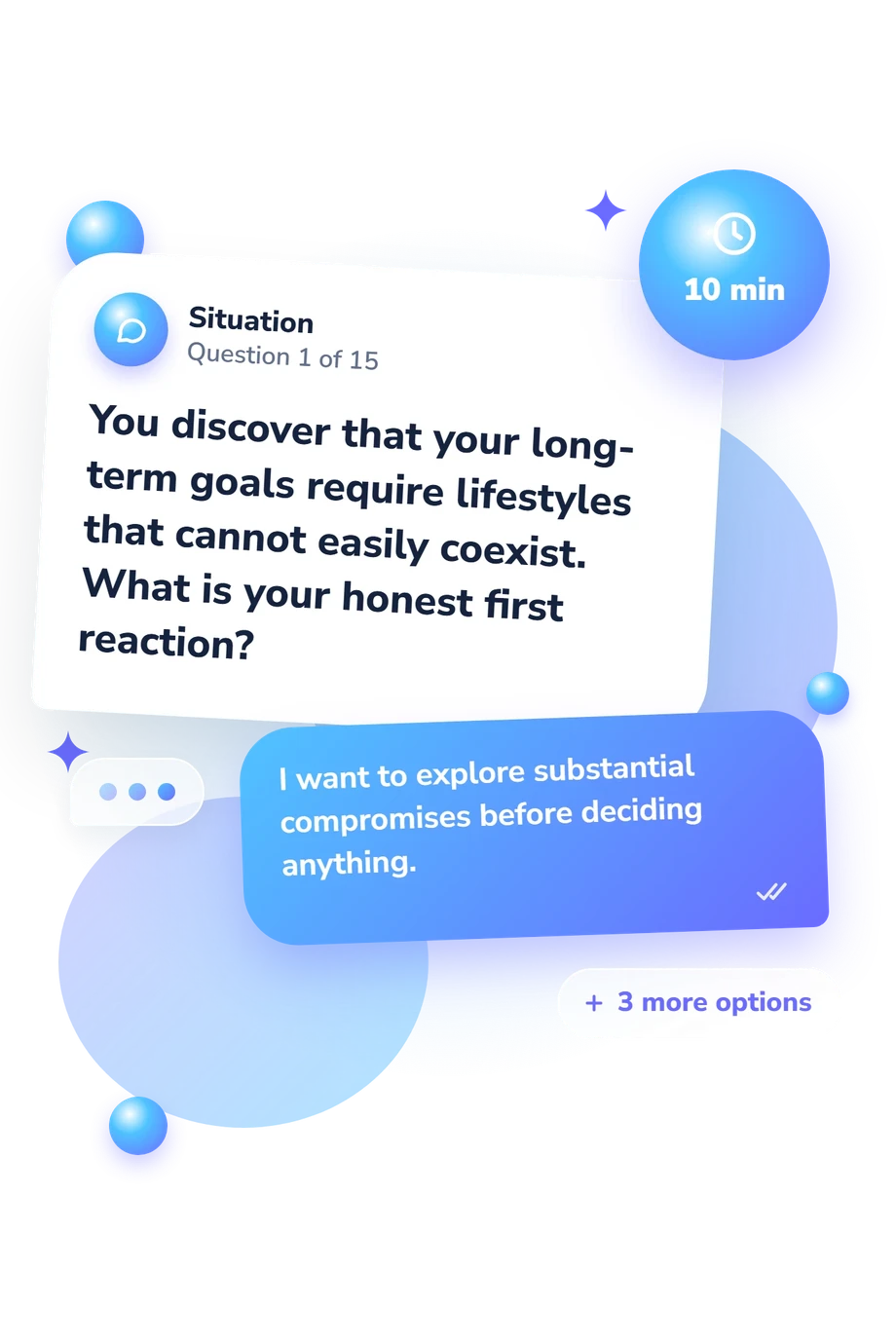
- I want to explore substantial compromises before deciding anything.
- I suspect one of us would eventually resent giving up too much.
- I see the difference as evidence that separate futures may fit us better.
- Our central goals are compatible enough that the conflict feels manageable.
- Connected and comfortable in myself.
- Generally content, while also ready for some personal space.
- Drained or less like myself, even if parts of the time were enjoyable.
- Relieved that the time is over and able to feel like myself again.
- A stable sense that we are still on the same side.
- Uncertainty about whether we understand each other as well as I thought.
- Some warmth, although one or both of us may need distance first.
- A preference to handle the stress separately rather than reconnect around it.
Are We Meant to Be Together Name Quiz - Description and methodology of the test
People weighing a romantic future can use this assessment to examine whether closeness, priorities, and effort point in the same direction. The Are We Meant to Be Together Name Quiz turns those concerns into structured reflection for someone considering compatibility, ongoing commitment, or a different path. The scenarios turn this relationship compatibility quiz into structured reflection on lived relationship patterns.
What This Assessment Explores
It explores emotional ease, time apart, mismatched goals, conflict, repair, priorities, support, and willingness to change. It suits someone weighing whether the relationship fits the life they want; this relationship compatibility assessment derives its profiles from relationship scenarios.
The three profiles describe the relationship evidence:
- Different Directions (0-15) reflects mismatch or ease apart: Low separation pull (0-5), Mixed direction (6-10), or Strong separation pull (11-15).
- Potential With Honest Work (0-15) reflects differences plus willingness to discuss, adjust, and repair: Limited work signal (0-5), Conditional potential (6-10), or Active growth path (11-15).
- Strong Foundation (0-15) reflects ease, support, compatible priorities, and shared direction: Independent footing (0-5), Meaningful connection (6-10), or Strong foundation (11-15). The highest profile marks strongest affinity; scores within one point suggest a blended result, while fear, threats, coercion, or harm matter regardless of score.
Methodology and Scientific Basis
Each item presents a relationship situation with four response statements covering goals, time apart, conflict, repair, commitment, future imagery, support, or willingness to change. The respondent chooses the closest option, making the format scenario-based rather than a simple agree-or-disagree scale.
Results are presented as three profile totals, not one overall compatibility score. The displayed bands describe each profile within this exercise; they are not population norms, probabilities, or clinical cutoffs.
Conceptually, the questionnaire parallels the Romantic Disengagement Scale in its attention to withdrawal and separation dynamics, the Investment Model Scale in its attention to satisfaction, alternatives, investment, and commitment, and Fletcher and colleagues’ work on perceived relationship quality. Brandau-Brown and Ragsdale’s work adds a perspective on commitment and repair. These are conceptual parallels only; those published instruments and studies do not establish validity, norms, or scoring for this online questionnaire.
Because it is an online relationship reflection tool, honest self-report remains central: current context, mood, and self-awareness can shape answers. Read the result as focused reflection on lived patterns, comparing all three profiles rather than treating one score as final.
- Robin A. Barry, Erika Lawrence, and Amie Langer (2008). Conceptualization and assessment of disengagement in romantic relationships. Personal Relationships, 15(3), 297-315. 10.1111/j.1475-6811.2008.00200.x
- Caryl E. Rusbult, John M. Martz, and Christopher R. Agnew (1998). The Investment Model Scale: Measuring commitment level, satisfaction level, quality of alternatives, and investment size. Personal Relationships, 5(4), 357-387. 10.1111/j.1475-6811.1998.tb00177.x
- Garth J. O. Fletcher, Jeffry A. Simpson, and Geoff Thomas (2000). The Measurement of Perceived Relationship Quality Components: A Confirmatory Factor Analytic Approach. Personality and Social Psychology Bulletin, 26(3), 340-354. 10.1177/0146167200265007
- Frances E. Brandau-Brown and J. Donald Ragsdale (2008). Personal, Moral, and Structural Commitment and the Repair of Marital Relationships. Southern Communication Journal, 73(1), 68-83. 10.1080/10417940701815659
Updated: