
British Quiz
How the Scales are Structured
Who Usually Takes This Test?
See How You Compare
Below is a preview of how scores are typically distributed across each scale.
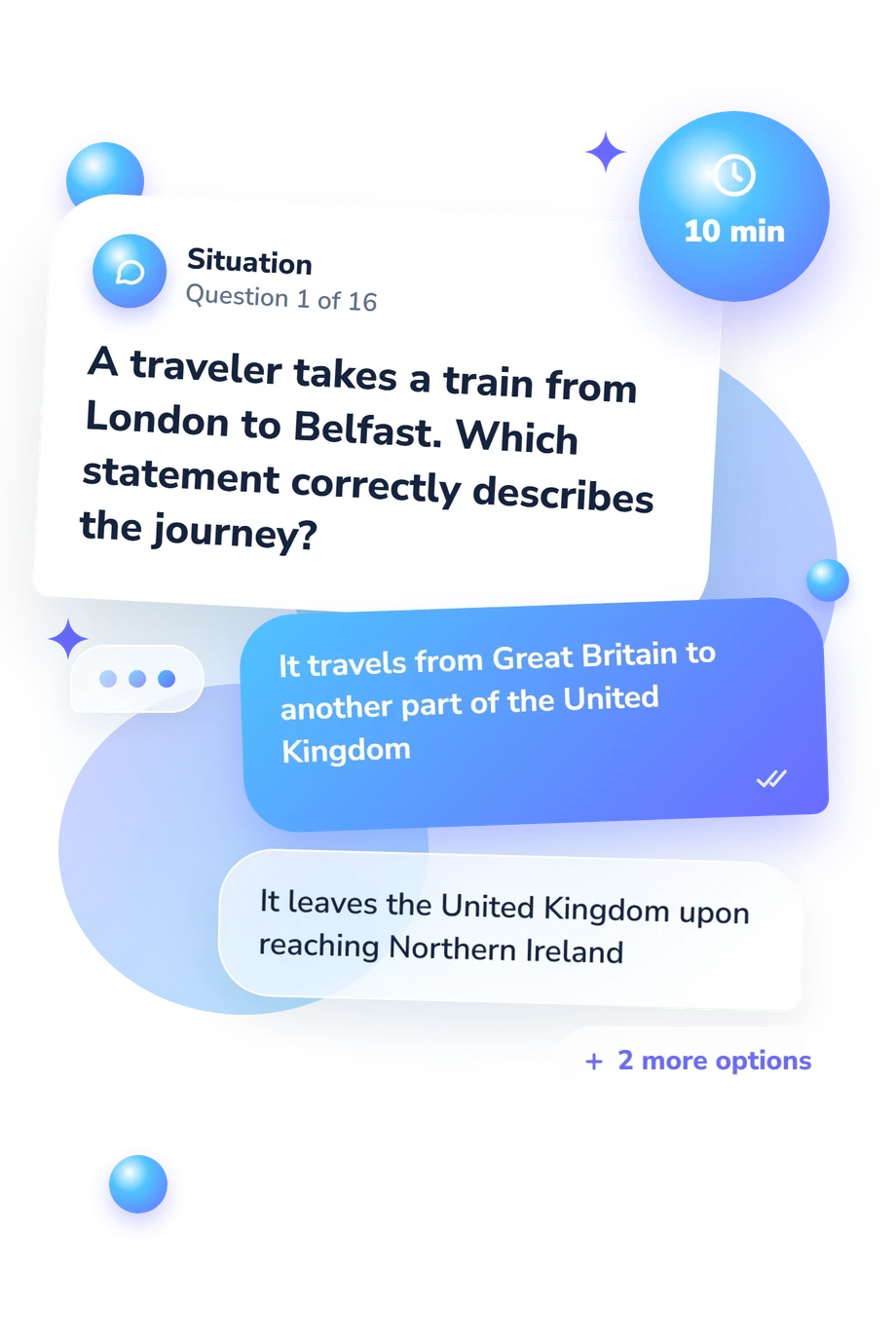
Example Questions From the Test
- St Andrew's Day
- Boxing Day
- Hogmanay
- Burns Night
- Afternoon supper
- High breakfast
- A cream tea
- Ploughman's tea
- A tournament devoted mainly to Highland sports
- A large program of comedy, theatre, music, and other performances
- A formal exhibition of Scottish royal treasures
- A seasonal market focused exclusively on Scottish food
British Quiz - Description and methodology of the test
For travellers, students, and culturally curious readers, the British Quiz offers a focused way to explore customs, institutions, and cultural references. It can prepare travellers for local encounters, give students context for study, and help curious readers connect everyday life with history and national identity. As a quiz about Britain, it turns those interests into concrete questions.
What This Assessment Explores
At its core, this assessment examines practical cultural knowledge rather than personality or opinion. It covers geography, customs, language, literature, food, sport, public traditions, and familiar references. Questions about Great Britain distinguish it from the United Kingdom, giving the assessment a geographic foundation and testing knowledge of Great Britain geography alongside wider cultural knowledge.
The result uses one scale, British Culture Knowledge, with a range of 0-16: Starting Point (0-6), Developing Knowledge (7-12), and Strong Knowledge (13-16). These bands describe breadth and accuracy of recognized information, not intelligence or personal worth.
The themes fall into three areas:
- National geography and identity show whether you recognize countries, symbols, boundaries, and related terms.
- Customs and cultural references show how readily you identify celebrations, language, literature, performances, and familiar expressions.
- Food, sport, and public traditions show how cultural knowledge appears in ordinary activities and well-known events.
Methodology and Evidence Base
Each item presents a short scenario or direct cultural question with four answer choices. The respondent selects the option that best fits the fact, term, place, or tradition described. This British culture test relies on recognition rather than free recall or personal rating.
Scoring produces one overall knowledge profile, with no separate result for each topic group. The displayed category summarizes performance across the content range; the interpretation can be influenced by prior study, travel, regional experience, attention, wording, and guessing.
Its content references include the Oxford guide to British culture, official civic guidance, and authoritative guidance on geographical naming. Together, they provide context for items about customs, institutions, and the distinction between Great Britain and the United Kingdom; they do not establish standardized validity for this questionnaire.
Reviewing missed items can help direct further learning, making the result a practical guide to deciding what to explore next.
- Crowther, Jonathan, and Kathryn Kavanagh, eds. Oxford Guide to British and American Culture: For Learners of English. 2nd ed. Oxford University Press, 1999. ISBN 9780194313322.
- Great Britain Home Office. Life in the United Kingdom: A Guide for New Residents. 3rd ed. TSO, 2013. ISBN 9780113413409.
- Janes, Dominic. “Beyond Ignorance: Using the Cultural Stereotypes of Americans Studying in the UK as a Resource for Learning and Teaching about British Culture.” Innovations in Education and Teaching International, vol. 48, no. 1, 2011, pp. 61-68. 10.1080/14703297.2010.543774.
- United Kingdom Permanent Committee on Geographical Names. Toponymic Guidelines for Map and Other Editors, United Kingdom of Great Britain and Northern Ireland., updated July 30, 2026.
Updated: