
Diversity Quiz
How the Scales are Structured
Who Usually Takes This Test?
See How You Compare
Below is a preview of how scores are typically distributed across each scale.
Example Questions From the Test
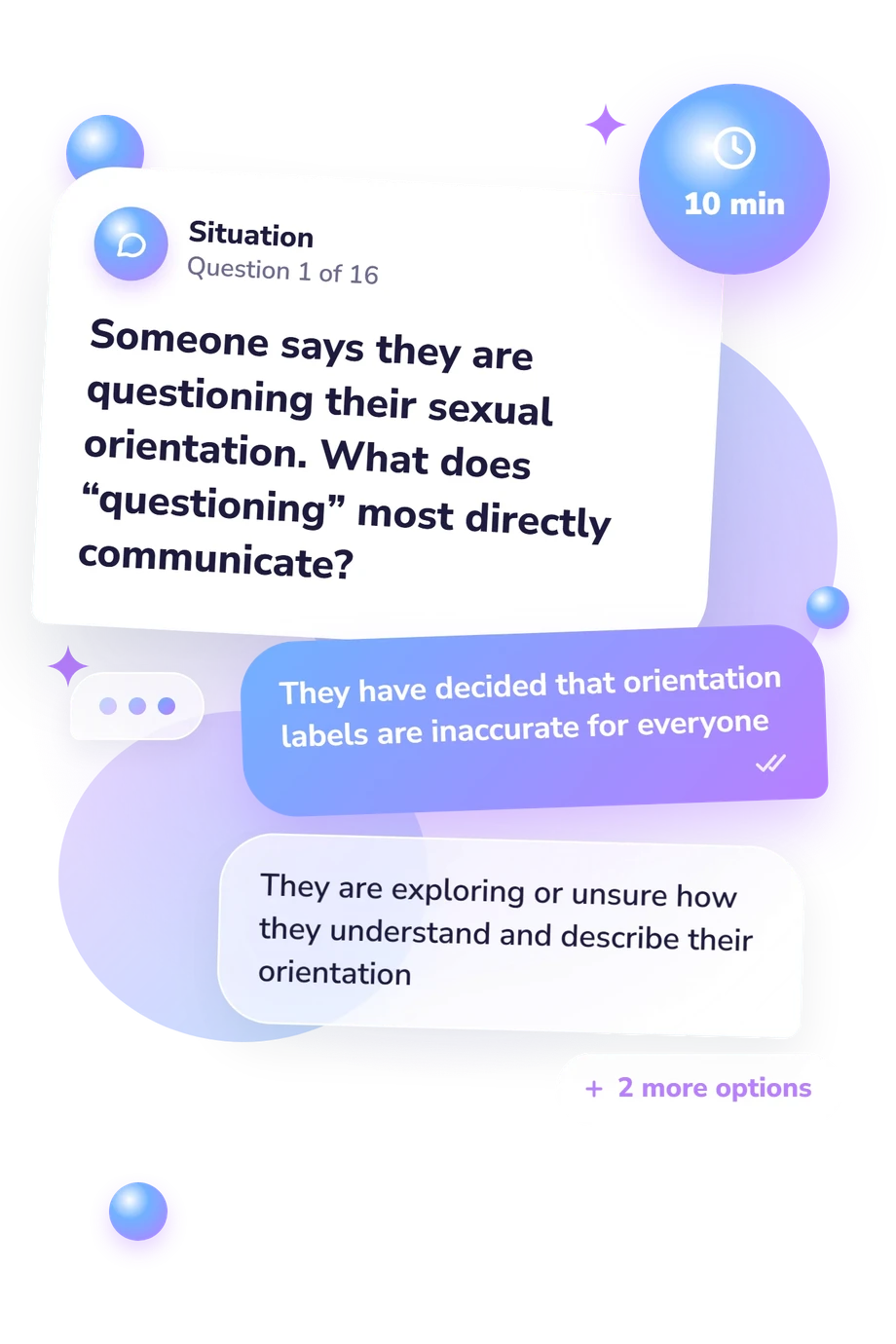
- They have decided that orientation labels are inaccurate for everyone
- They are exploring or unsure how they understand and describe their orientation
- They are asking other people to choose a label for them
- They are necessarily moving from one specific orientation to another
- Offer relevant options, allow self-description or multiple selections where appropriate, and include “prefer not to answer”
- Require every respondent to choose one label from a short fixed list
- Require an open-text explanation from every respondent
- Infer orientation from the gender of a respondent’s current partner
- Employees may bring a partner or guest
- Employees may bring an opposite-sex companion
- Employees may bring a spouse, if legally married
- Employees may bring a close friend rather than a partner
Diversity Quiz - Description and methodology of the test
Anyone who wants to build a more accurate and respectful understanding of sexual-orientation diversity can use this diversity quiz as a focused learning check. It suits learners, educators, and curious adults who want to examine terminology, inclusive communication, and everyday assumptions. In educational settings, it can highlight concepts that merit discussion, while the result identifies areas for further learning.
What This Assessment Explores
The questions examine practical sexual-orientation knowledge rather than personal disclosure. They cover orientation labels, questioning, asexuality, bisexuality, fluidity, romantic attraction, and distinctions between sexual orientation and gender. Scenarios apply these ideas to privacy, inclusive language, disclosure, stereotypes, and everyday assumptions. Together, these items test whether respondents can recognize accurate concepts and apply respectful practices.
The result is reported on Sexual Orientation Diversity Knowledge (0-16), a correct-answer score. It describes educational understanding, not a person’s orientation, identity, values, or capacity to support others.
The bands translate that score into three learning descriptions:
- Foundations to build (0-6) indicates that core distinctions or inclusive practices may still be unfamiliar.
- Developing understanding (7-12) shows recognition of many concepts, although applied nuance may be missed.
- Strong understanding (13-16) reflects broad, practical knowledge of sexual-orientation diversity.
Methodology and Evidence Base
Each item presents a short definition or situation with four answer choices. This self-administered multiple-choice format asks the respondent to select the option that best matches accurate, inclusive knowledge, so it tests recognition and application rather than personal orientation.
The items move from terminology to practical judgment: respondents distinguish concepts, choose inclusive survey wording, protect privacy, and respond constructively to stereotypes in ordinary social and workplace situations. Identity disclosure is not required.
Its main conceptual reference point is LGB-KASH (Worthington et al., 2005), a published measure of knowledge and attitudes about lesbian, gay, and bisexual topics. This questionnaire is conceptually consistent with that work, not an adaptation of it. National Academies (2022) also recommends clear, voluntary self-description options when collecting sexual-orientation information.
The questionnaire functions as a diversity test in quiz form: the total is the number of correct answers, interpreted through the displayed learning bands. Prior exposure, attention, wording interpretation, and current perspective can affect performance, so reviewing missed concepts and their underlying distinctions can help identify learning priorities and guide further discussion.
- Worthington, Roger L., Frank R. Dillon, and Ann M. Becker-Schutte. 2005. Development, Reliability, and Validity of the Lesbian, Gay, and Bisexual Knowledge and Attitudes Scale for Heterosexuals (LGB-KASH). Journal of Counseling Psychology 52(1): 104-118. 10.1037/0022-0167.52.1.104
- Harris, Mary B., Jane Nightengale, and Nancy Owen. 1995. Health Care Professionals' Experience, Knowledge, and Attitudes Concerning Homosexuality. Journal of Gay & Lesbian Social Services 2(2): 91-108. 10.1300/J041v02n02_06
- National Academies of Sciences, Engineering, and Medicine. 2022. Measuring Sex, Gender Identity, and Sexual Orientation. Washington, DC: The National Academies Press. 10.17226/26424
Updated: