
Create Quiz for Boyfriend
How the Scales are Structured
Who Usually Takes This Test?
See How You Compare
Below is a preview of how scores are typically distributed across each scale.
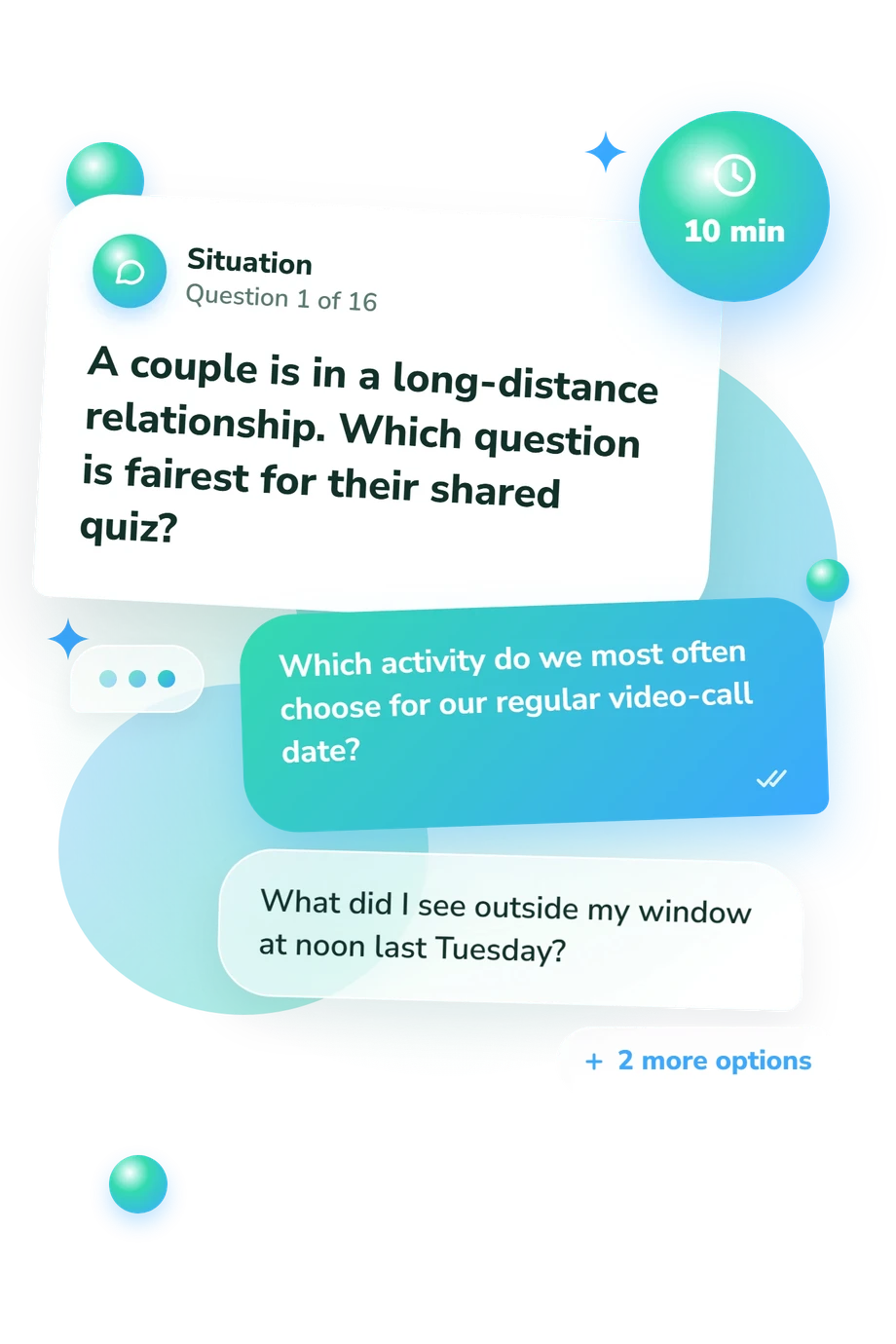
Example Questions From the Test
- Use several exceptions so every possible situation is covered
- Use an inside joke as the only clue to the intended meaning
- Use formal vocabulary to make the quiz feel authoritative
- Use a short, direct sentence and avoid double negatives
- Replace it with a believable option that does not mock him
- Make every wrong option an exaggerated version of his habits
- Keep it because embarrassment makes the answer memorable
- Leave it in but make the wording more difficult to notice
- Which past relationship affected me the most?
- What private fear have I never told anyone else?
- Which family conflict do I find most upsetting?
- What would my ideal relaxed weekend look like?
Create Quiz for Boyfriend - Description and methodology of the test
People planning a partner quiz can use Create Quiz for Boyfriend to examine whether their ideas are clear, fair, and comfortable for both partners. If your goal is to make a quiz for your boyfriend, the scenarios help you decide whether each question invites conversation rather than turning forgotten details into a verdict on love or compatibility.
What This Assessment Explores
Questions focus on the practical knowledge needed to design a personal quiz, not on relationship quality. Situations cover purpose, wording, topic choice, privacy, changing memories, differing perspectives, and constructive interpretation. The assessment suits anyone planning a partner quiz, including someone who wants to create a quiz for couples without making it competitive.
Results show how consistently the respondent recognizes considerate design principles, not affection, compatibility, or memory strength.
These dimensions shape the result:
- Purpose and scope show whether the creator sets a clear aim and chooses suitable topics.
- Clarity and coverage show whether wording is direct and the content goes beyond obscure facts.
- Fairness, sensitivity, and interpretation show whether the quiz respects boundaries and opens discussion instead of ranking commitment.
Boyfriend Quiz Creation Knowledge ranges from 0 to 16: Foundations to Build (0-6), Developing Quiz Creator (7-12), and Thoughtful Quiz Creator (13-16). It measures design knowledge, not relationship quality.
Methodology and Scientific Basis
Each item presents a design situation with answer choices. The respondent selects the option that best reflects clear, fair, or constructive practice. The groups address purpose, wording, coverage, distractor quality, changing information, sensitive topics, differing memories, and score interpretation.
The method is conceptually consistent with the Haladyna-Rodriguez item-development framework. Guidance associated with Haladyna and Downing supports direct wording, plausible alternatives, and options that test the intended principle rather than a trick. Dillman, Smyth, and Christian provide relevant survey-design guidance for an online self-report format. This questionnaire is not an adaptation of those works; they provide frameworks for evaluating its design.
Responses are evaluated against the questionnaire's intended principles and reported as a displayed total. As boyfriend quiz design feedback, the result can point to ambiguity, privacy, fairness, or context that deserves revision.
The questionnaire has no established population norms or independent validation for interpreting its score, so the result is structured design feedback rather than a standardized measure. Self-report can also reflect current context, memory, and personal assumptions; thoughtful answers are more useful than a flattering result.
- Haladyna, Thomas M., and Michael C. Rodriguez. Developing and Validating Test Items. Routledge, 2013.
- Haladyna, Thomas M., and Steven M. Downing. “A Taxonomy of Multiple-Choice Item-Writing Rules.” Applied Measurement in Education, vol. 2, no. 1, 1989, pp. 37-50. 10.1207/s15324818ame0201_3.
- Dillman, Don A., Jolene D. Smyth, and Leah Melani Christian. Internet, Phone, Mail, and Mixed-Mode Surveys: The Tailored Design Method. 4th ed., John Wiley & Sons, 2014. 10.1002/9781394260645.
Updated: