
The Story of an Hour Quiz
How the Scales are Structured
Who Usually Takes This Test?
See How You Compare
Below is a preview of how scores are typically distributed across each scale.
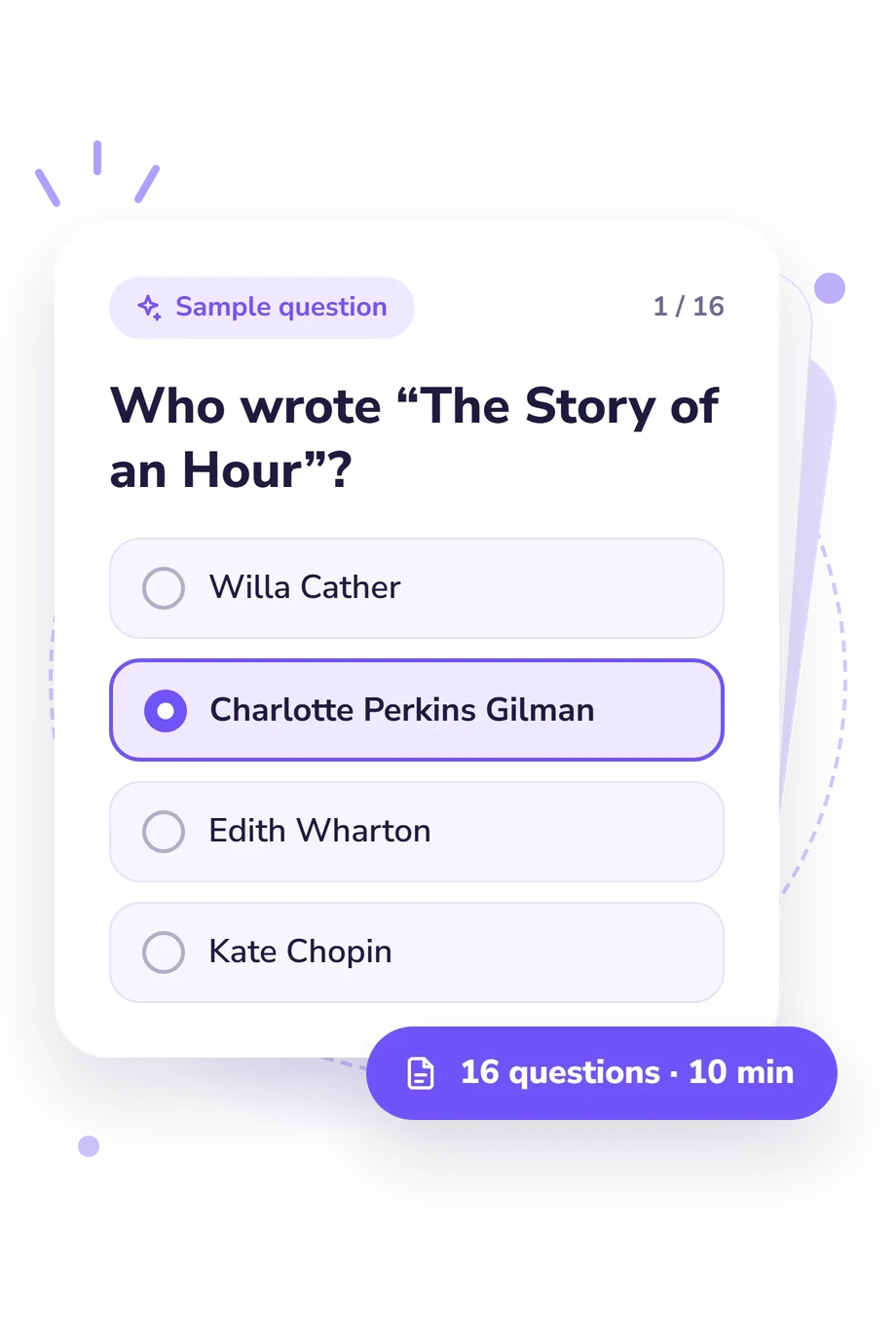
Example Questions From the Test
- Willa Cather
- Charlotte Perkins Gilman
- Edith Wharton
- Kate Chopin
- Richards’s discovery that the railroad report was false
- Louise’s emerging sense of possibility and freedom
- Josephine’s fear that Louise is making herself ill
- Brently’s difficult journey home through the storm
- She weeps immediately and then withdraws alone to her room
- She refuses to believe Josephine and leaves to find Richards
- She remains outwardly calm before fainting in the hallway
- She questions the report and asks to see the second telegram
The Story of an Hour Quiz - Description and methodology of the test
For readers checking close reading, The Story of an Hour Quiz helps them assess factual recall and interpretation. This Story of an Hour comprehension test suits students, book-club members, and independent readers who want to examine how a brief narrative turns plot, emotion, and irony into meaning. Its result indicates a general level of understanding and suggests whether closer rereading may be useful.
What This Assessment Explores
Plot, character motives, setting, imagery, language, themes, and dramatic irony are assessed. The quiz suits readers checking close reading for study, discussion, or classroom review. Questions in this Story of an Hour quiz address the accident report, Louise Mallard’s awakening, the open window, and the ending’s reversal.
The displayed scale is The Story of an Hour Knowledge (0-16). Starting Point (0-6) reflects recognition of some elements; Developing Command (7-12) reflects understanding of main events and several literary effects; Strong Command (13-16) reflects a well-supported grasp of the narrative and deeper implications. The result summarizes current literary understanding across these areas:
- Plot and character reading show how the report, reversal, and central figures shape meaning.
- Language and imagery show whether the open window and spring details suggest possibility.
- Themes and irony show whether you connect autonomy, social assumptions, and the ending.
Methodology and Evidence Base
The structured multiple-choice format presents each item with four answer choices. The set combines factual recall with sequencing, inference, symbolism, characterization, and situational irony. Reviewing answers to this Story of an Hour quiz can help distinguish a missed plot detail from an interpretation needing closer support, but the result remains one overall knowledge score; the choices are not separate traits, and no unlisted weighting rule should be inferred.
Its literary basis is Chopin's Story of an Hour (1894). Jamil's 2009 analysis emphasizes the story's emotional awakening and the reversal between Louise's imagined future and the ending. Ahmetspahić and Kahrić's 2020 study places her desire for liberty within the gendered expectations surrounding marriage. The questionnaire is conceptually consistent with these readings, not an adaptation of either study.
That single score describes performance on the quiz's plot, language, themes, and irony questions rather than providing a norm-referenced estimate of literary ability. Performance can shift with rereading, prior classroom discussion, memory, and the reader's judgment about ambiguous details. It can support rereading and discussion of how the story's themes and irony work together.
- Chopin, Kate. "The Dream of an Hour." Vogue, December 6, 1894, pp. 55-56.
- Ahmetspahić, Adisa, and Damir Kahrić. "It's a Man's World: Re-Examination of the Female Perspective in Chopin's 'Désirée's Baby' and 'The Story of an Hour.'" ESSE Messenger, vol. 29, no. 1, 2020, pp. 23-37.
- Jamil, S. Selina. "Emotions in the Story of an Hour." The Explicator, vol. 67, no. 3, 2009, pp. 215-220. 10.3200/EXPL.67.3.215-220
Updated: