
Botany Quiz
How the Scales are Structured
Who Usually Takes This Test?
See How You Compare
Below is a preview of how scores are typically distributed across each scale.
Example Questions From the Test
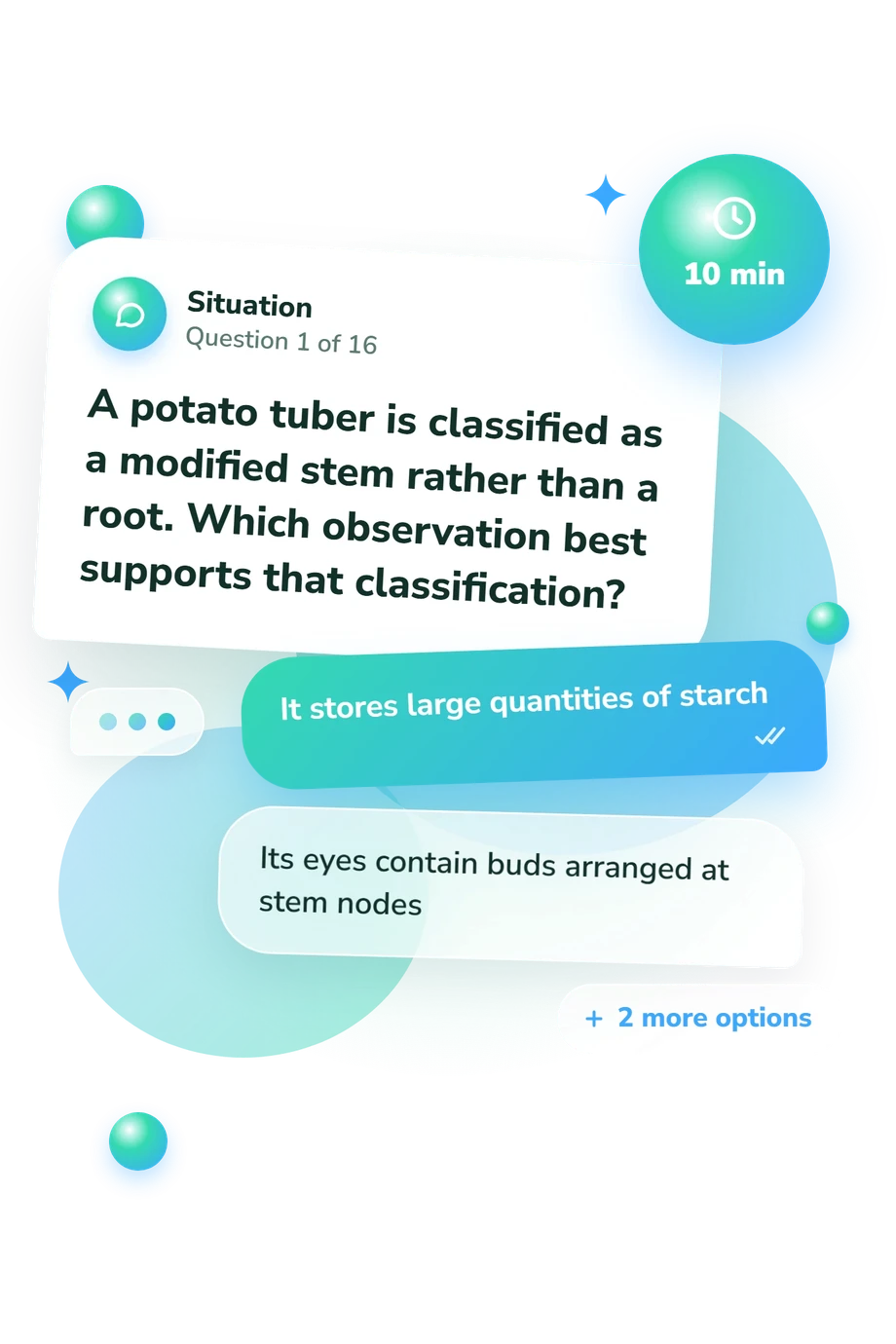
- It stores large quantities of starch
- Its eyes contain buds arranged at stem nodes
- It grows beneath the soil surface
- It can absorb some water through its surface
- Production of pollen within flowers
- Absorption of water and mineral ions from the soil
- Transport of sugars from leaves to roots
- Protection of the shoot's growing tip
- Epidermis inward and cork outward
- Pith inward and guard cells outward
- Root hairs inward and cortex outward
- Secondary xylem inward and secondary phloem outward
Botany Quiz - Description and methodology of the test
Students, educators, and readers who want to connect plant anatomy with visible growth processes can use this assessment as a focused knowledge check. The botany quiz indicates how confidently you distinguish tissues, organs, transport pathways, and developmental responses. Its result points toward topics that deserve closer review rather than simply rewarding memorized labels. A basic quiz on botany can provide a practical starting point before laboratory work, coursework, or independent study.
What This Assessment Explores
This assessment examines plant knowledge through structure-function reasoning. It suits learners who want to apply core concepts rather than recognize isolated vocabulary. Across the item set, this botany assessment's questions and answers connect choices with explanations, such as why root hairs support absorption or why a potato eye indicates a stem.
These content areas are brought together under the Botany Knowledge scale (0-16):
- Plant structures and classification show whether you identify organs and plant groups from visible traits.
- Tissues and transport show whether you distinguish xylem, phloem, meristems, and protective tissues by function.
- Water relations and gas exchange show how you connect turgor, stomata, and root hairs with plant responses.
- Growth and reproduction show how apical dominance, buds, ovules, and seeds relate to development.
Foundational (0-6), Developing (7-12), and Strong (13-16) describe increasing accuracy across these concepts.
Methodology and Scientific Basis
Each item presents a plant-biology situation with four answer choices. The result is expressed as the number of correct answers, reflecting performance on the concepts sampled rather than a personality profile. Questions ask learners to distinguish tissues, predict transport effects, classify structures, or connect a developmental change with its mechanism.
The content framework is conceptually consistent with Evert et al. (2013) and Evert (2006), which organize plant biology around anatomy, tissues, transport, growth, and reproduction. Cline (1991) supplies the relevant context for apical dominance. As a plant biology quiz, this assessment uses these established concepts without being a direct reproduction of the cited works; those sources support the subject matter, not psychometric norms for this online version.
Interpret the result as a focused learning snapshot. It can show whether review should prioritize anatomy, vascular function, water relations, or development, but performance may shift with prior coursework, guessing, attention, and current recall. The score works best alongside study or laboratory experience, especially when incorrect answers become specific review goals.
- Evert, Ray F., Susan E. Eichhorn, and Peter H. Raven. Raven Biology of Plants. 8th ed. W. H. Freeman and Company, 2013.
- Evert, Ray F. Esau's Plant Anatomy: Meristems, Cells, and Tissues of the Plant Body: Their Structure, Function, and Development. 3rd ed. Wiley-Interscience, 2006. 10.1002/0470047380
- Cline, Morris G. "Apical dominance." The Botanical Review 57, no. 4 (1991): 318-358. 10.1007/BF02858771
Updated: