
Am I Alternative Quiz
How the Scales are Structured
Who Usually Takes This Test?
See How You Compare
Below is a preview of how scores are typically distributed across each scale.
Example Questions From the Test
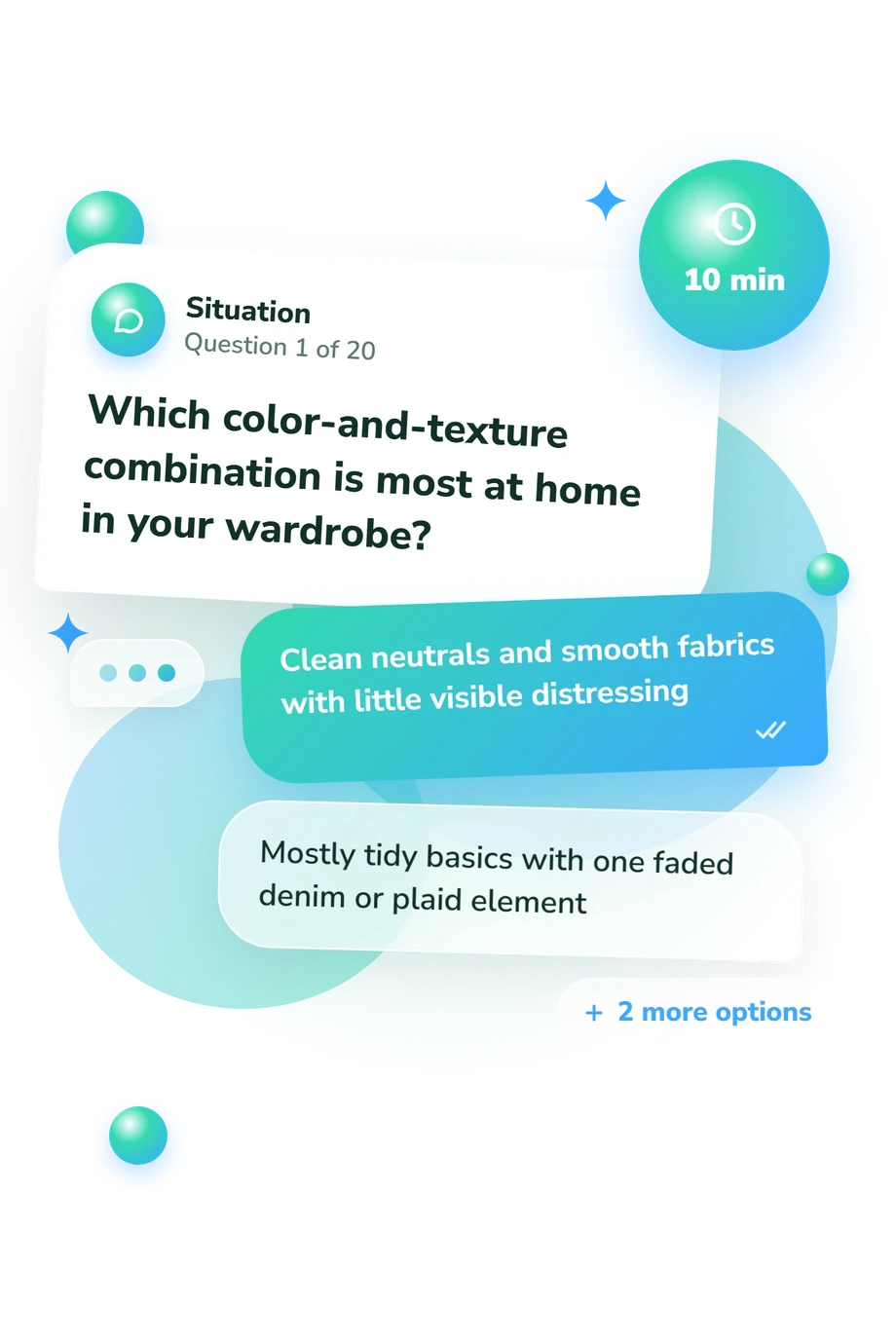
- Clean neutrals and smooth fabrics with little visible distressing
- Mostly tidy basics with one faded denim or plaid element
- Muted colors, plaid, old denim, heavy knits, and intentionally worn textures
- Earthy or washed-out shades mixed with a few rugged fabrics
- I engage with several of those influences and connect them to how I dress
- I appreciate the independent spirit but engage with it only occasionally
- They are not significant influences on my interests or style
- They regularly influence my playlists, creative choices, or appearance
- I admire them on others, but rarely choose them for myself
- They are recurring features of how I present myself
- My wardrobe generally follows a different visual direction
- I use one or two when the outfit or occasion suits them
Am I Alternative Quiz - Description and methodology of the test
People who are curious about how clothing, music, and visual mood shape their self-presentation can use the Am I Alternative Quiz to compare several style affinities. The result is useful for anyone whose taste crosses scenes or changes between understated and expressive looks. This assessment is an alternative style quiz that turns that mixed impression into a clearer profile without forcing one identity label.
What This Assessment Explores
Five overlapping affinities replace a single label. Scenarios cover color, texture, silhouette, hair, makeup, music, imagery, symbols, thrifted finds, customization, and subcultural settings. The questionnaire is an alternative quiz about current preferences rather than authenticity or community membership.
The result is organized into these dimensions:
- Emo Affinity (0-12) captures lyrical and expressive resonance: Light Connection (0-4), Emo-Leaning (5-8), or Strong Emo Affinity (9-12).
- Goth Affinity (0-12) captures dark and atmospheric appeal: Subtle Contrast (0-4), Gothic Leaning (5-8), or Strong Goth Affinity (9-12).
- Grunge Affinity (0-12) captures relaxed, worn, layered taste: Casual Trace (0-4), Grunge-Leaning (5-8), or Strong Grunge Affinity (9-12).
- Indie Affinity (0-12) captures eclectic discovery and independent influences: Selective Quirk (0-4), Indie-Leaning (5-8), or Strong Indie Affinity (9-12).
- Punk Affinity (0-12) captures DIY and visibly defiant expression: Occasional Edge (0-4), Punk-Leaning (5-8), or Strong Punk Affinity (9-12).
Methodology and Evidence Base
Each item presents a style-related situation with four response options. The options span mainstream or low-intensity preferences and stronger alternative signals. The respondent chooses the option that best matches usual taste, so the method captures preference patterns rather than factual knowledge.
The displayed results show five affinity outcomes. The highest score indicates the strongest affinity, while scores within one point indicate a blended profile. The comparison therefore maps overlap rather than assigning one fixed category, making this am i alt quiz useful for exploring whether someone is alt without treating style as a fixed identity judgment.
The conceptual frame is consistent with Hodkinson (2002) on goth identity and style and Rentfrow and Gosling (2003) on music preferences. It is conceptually consistent with these works, not an adaptation of them.
Interpret the outcome as a descriptive snapshot: self-report depends on context and self-awareness, so the profile may shift as taste changes rather than serving as a clinical or definitive identity judgment.
- Young, Robert, Nina Sproeber, Rebecca C. Groschwitz, Marthe Preiss, and Paul L. Plener. Why alternative teenagers self-harm: exploring the link between non-suicidal self-injury, attempted suicide and adolescent identity. BMC Psychiatry, 14(1), 137 (2014). 10.1186/1471-244X-14-137.
- Hodkinson, Paul. Goth: Identity, Style and Subculture. Oxford and New York: Berg Publishers, 2002.
- Rentfrow, Peter J., and Samuel D. Gosling. The do re mi's of everyday life: the structure and personality correlates of music preferences. Journal of Personality and Social Psychology, 84(6), 1236-1256 (2003). 10.1037/0022-3514.84.6.1236.
Updated: