
Who's Hotter Quiz
How the Scales are Structured
Who Usually Takes This Test?
See How You Compare
Below is a preview of how scores are typically distributed across each scale.
Example Questions From the Test
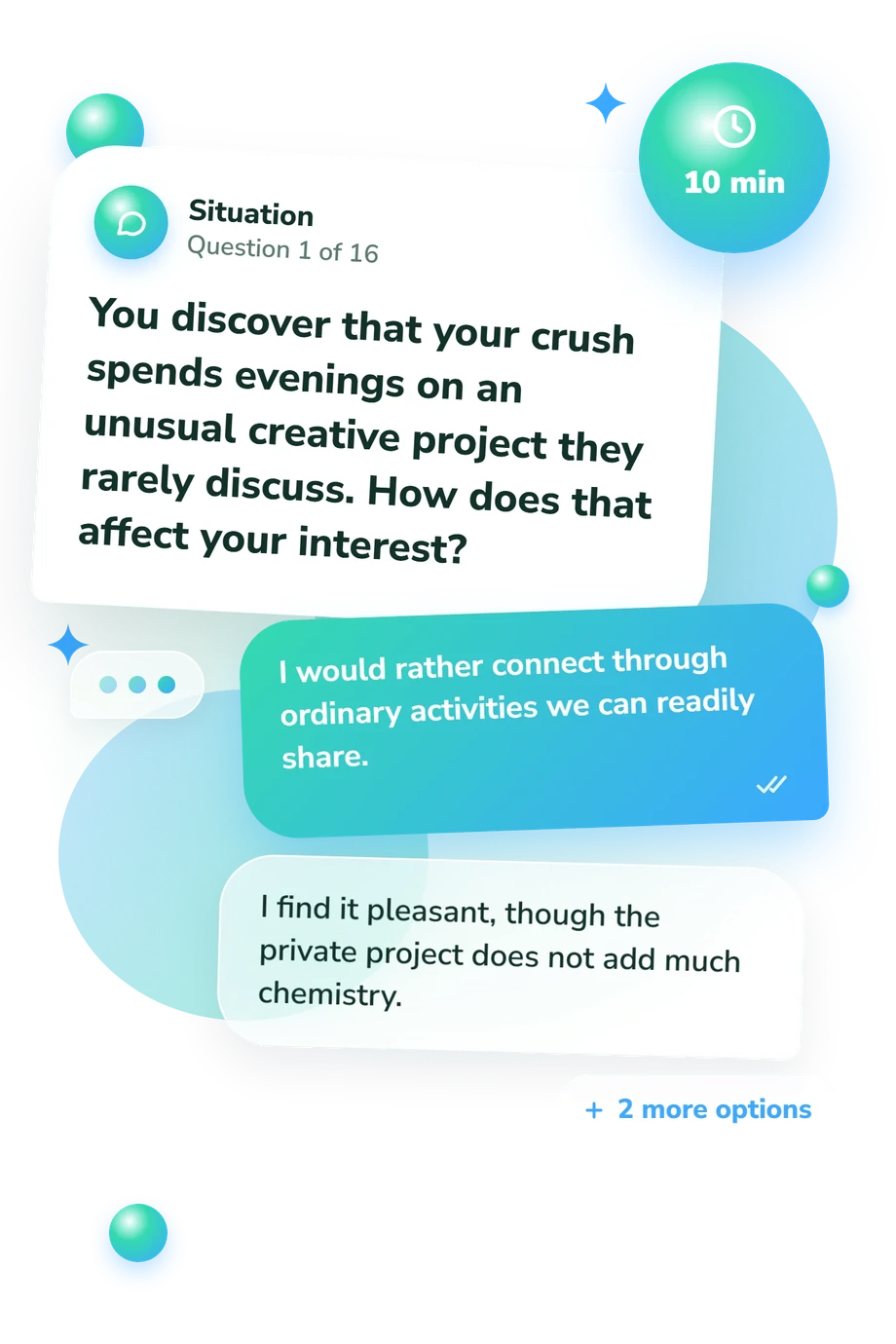
- I would rather connect through ordinary activities we can readily share.
- I find it pleasant, though the private project does not add much chemistry.
- I become curious about what motivates them and want to hear more.
- The combination of private passion and originality intensifies my attraction.
- They ask me to choose because they prefer following my lead.
- We calmly plan every part of the evening together.
- They offer two strong ideas and confidently ask me to pick one.
- They take initiative, handle the plan, and reveal an adventurous surprise.
- Simple, sincere conversation without much verbal play.
- A few light jokes that keep the mood comfortable.
- Quick back-and-forth banter with clever callbacks.
- A rapid, inventive exchange where we keep surprising each other.
Who's Hotter Quiz - Description and methodology of the test
For people who want to understand why different personalities create different kinds of attraction, the Whos Hotter Quiz turns a light comparison into a structured prompt for self-reflection. Comparing who is hotter in this quiz can help you notice why one personality stands out more than another. It suits curious daters and anyone reflecting on their own chemistry patterns.
What This Assessment Explores
Items explore visible confidence, initiative, decisiveness, adventurous energy, originality, artistic expression, unconventional choices, emotional attentiveness, inclusive behavior, quick humor, playful banter, and curiosity.
They distinguish sparks from valued qualities, showing which energies shape preferences.
To compare which guy is hotter, this quiz separates four dimensions of attraction:
- Bold Spark (0-12) captures visible confidence, initiative, decisiveness, and adventurous energy: Quiet Preference 0-4; Selective Spark 5-8; Boldly Drawn 9-12.
- Mysterious Creative (0-12) captures originality, artistic expression, unconventional choices, and personalities that reveal themselves gradually: Clarity First 0-4; Intrigued at Times 5-8; Drawn to the Enigma 9-12.
- Warm Charmer (0-12) captures kindness, emotional attentiveness, inclusive behavior, and openly affectionate warmth: Different Chemistry 0-4; Warmly Receptive 5-8; Heart-Led Attraction 9-12.
- Witty Mind (0-12) captures quick humor, playful banter, curiosity, and mentally stimulating conversation: Another Kind of Spark 0-4; Mindful Chemistry 5-8; Mentally Captivated 9-12.
Methodology and Evidence Base
Each scenario offers four response choices, letting you select the statement closest to your instinct. The situations cover creative projects, initiative, emotional support, teasing, group conversation, and social inclusion, so attraction is explored through recognizable dating and social interactions rather than a single abstract rating.
Methodologically, it is an online self-report preference questionnaire. Its themes are conceptually consistent with Sprecher and Regan (2002), who examined why some partner qualities appeal more than others, with Jonason, Webster, and Gesselman (2013) on mate preferences, and with Langley and Shiota (2025) on humor and creativity in romantic attraction. Its own scoring profile is separate from those published instruments.
Results compare the four outcome scores: the highest marks your strongest affinity, and scores within one point indicate a blended result. As a who's hotter test, it organizes self-reported chemistry into a readable pattern. The displayed bands are the profile labels used to interpret the scores, and responses can shift with mood, recent experiences, cultural expectations, and self-awareness.
- Sprecher, Susan, and Pamela C. Regan. (2002). Liking Some Things (in Some People) more than Others: Partner Preferences in Romantic Relationships and Friendships. Journal of Social and Personal Relationships, 19(4), 463-481. 10.1177/0265407502019004048
- Jonason, Peter K., Gregory D. Webster, and Amanda N. Gesselman. (2013). The Structure and Content of Long-Term and Short-Term Mate Preferences. Interpersona: An International Journal on Personal Relationships, 7(2), 167-179. 10.5964/ijpr.v7i2.125
- Langley, Erika B., and Michelle N. Shiota. (2025). Funny Date, Creative Mate? Unpacking the Effect of Humor on Romantic Attraction. Personality and Social Psychology Bulletin, 51(5), 759-774. 10.1177/01461672231202288
Updated: