
Fact and Opinion Quiz
How the Scales are Structured
Who Usually Takes This Test?
See How You Compare
Below is a preview of how scores are typically distributed across each scale.
Example Questions From the Test
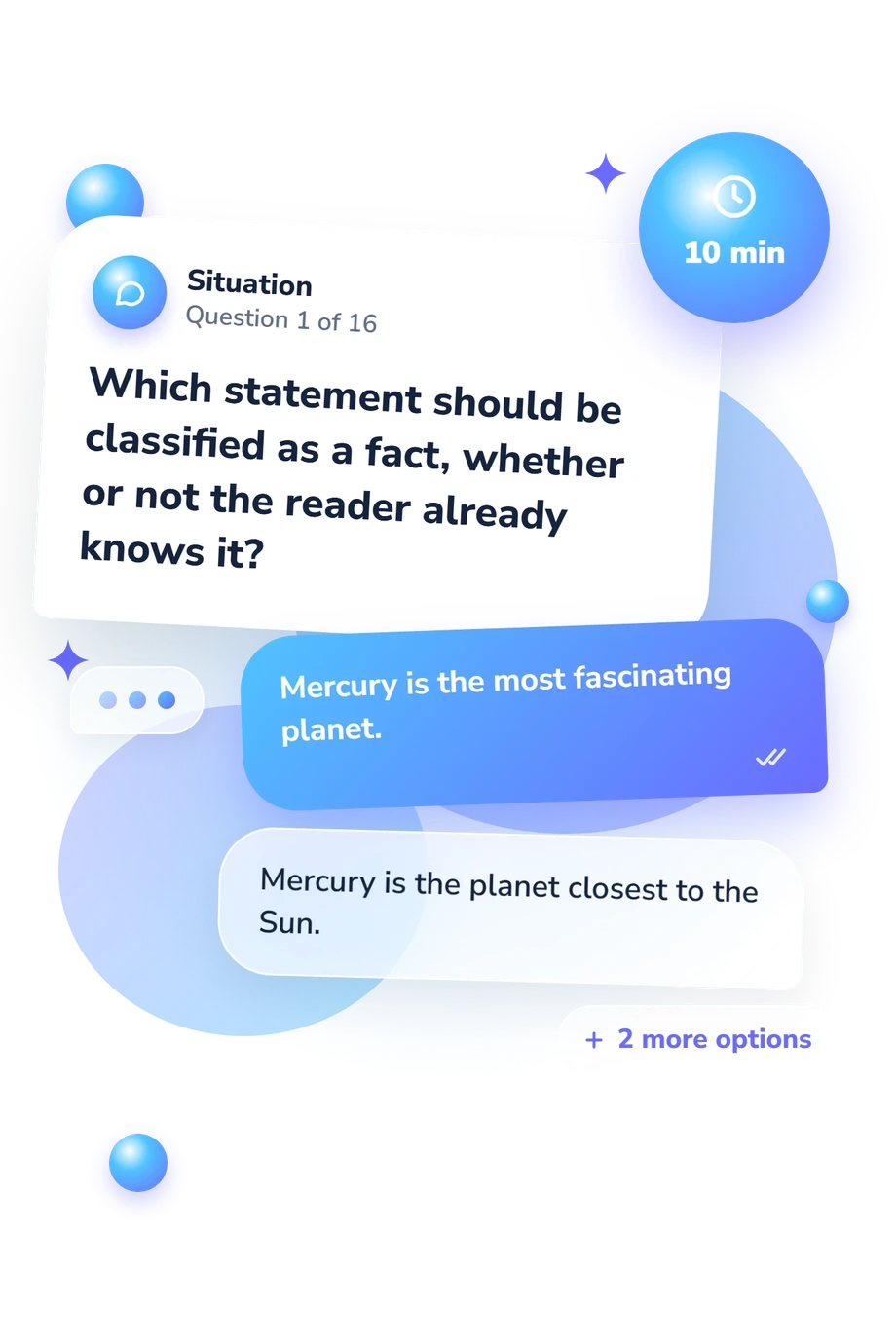
- Mercury is the most fascinating planet.
- Mercury is the planet closest to the Sun.
- Mercury would be the worst planet to visit.
- Mercury has a more appealing name than Mars.
- It refers to something served at a real school.
- It expresses a judgment that can vary with personal taste.
- It is too short to include factual information.
- It uses the present tense rather than the past tense.
- The novel’s ending is deeply satisfying.
- This edition of the novel contains 312 numbered pages.
- The main character is the author’s finest creation.
- The story becomes more meaningful with each reading.
Fact and Opinion Quiz - Description and methodology of the test
Readers who want to judge claims more carefully can use this fact and opinion quiz as a focused exercise in evidence-based reasoning. It suits anyone who encounters reports, arguments, reviews, or everyday statements and wants to separate observation from evaluation. This assessment, a fact or opinion quiz, can indicate general performance across the tested distinctions before a claim is accepted, repeated, or used to support a decision.
What This Assessment Measures
This assessment examines whether a reader can distinguish claims open to verification from statements expressing taste, judgment, interpretation, or prediction. This fact opinion quiz also asks whether a sentence combines factual detail with evaluation or needs clearer evidence.
Four abilities are tested:
- Identifying verifiable claims means recognizing information that can be checked against records, measurements, observations, or other evidence.
- Recognizing opinions means noticing language shaped by taste, priorities, interpretation, or value judgment.
- Separating predictions and mixed claims means treating an unconfirmed future event differently from an established fact and detecting blended statements.
- Choosing precise evidence means selecting support that directly addresses the claim rather than relying on reputation or impression.
The result is reported as Fact and Opinion Knowledge (0-16): Foundation to build (0-6), Developing distinction (7-12), or Strong distinction (13-16). These bands describe performance on this set of tasks.
Methodology and Evidence Base
Each item presents a short statement, scenario, or evidence question with four answer choices. The respondent may classify a claim, explain subjective wording, identify a mixed statement, select direct evidence, or revise a vague sentence into a testable one. The format assesses applied distinctions rather than memorized definitions.
Methodologically, the questionnaire is conceptually consistent with the analytical-thinking test developed by Thaneerananon and colleagues, whose tasks include distinguishing fact from opinion. This online version is not presented as a direct reproduction or validated adaptation; its displayed bands classify performance on this item set. The distinction also aligns with later work on how people classify factual and opinion claims in news, including research by Mettler and Mondak and an analysis from Pew Research Center.
The score condenses these response tasks into the displayed knowledge result. This fact and opinion online quiz is most useful for identifying claims or evidence that deserve more care. Language comprehension, education, attention, and familiarity with research conventions can influence performance, so one score cannot represent reasoning in every setting.
- Thaneerananon, Taveep, Wannapong Triampo, and Artorn Nokkaew. 2016. “Development of a Test to Evaluate Students’ Analytical Thinking Based on Fact versus Opinion Differentiation.” International Journal of Instruction 9 (2): 123-138. 10.12973/iji.2016.929a
- Mettler, Matthew, and Jeffery J. Mondak. 2024. “Fact-opinion differentiation.” Harvard Kennedy School Misinformation Review 5 (2). 10.37016/mr-2020-136
- Mitchell, Amy, Jeffrey Gottfried, Michael Barthel, and Nami Sumida. 2018. “Distinguishing Between Factual and Opinion Statements in the News.” Pew Research Center, June 18, 2018.
Updated: