
Am I Addicted to Caffeine Quiz
How the Scales are Structured
Who Usually Takes This Test?
See How You Compare
Below is a preview of how scores are typically distributed across each scale.
Example Questions From the Test
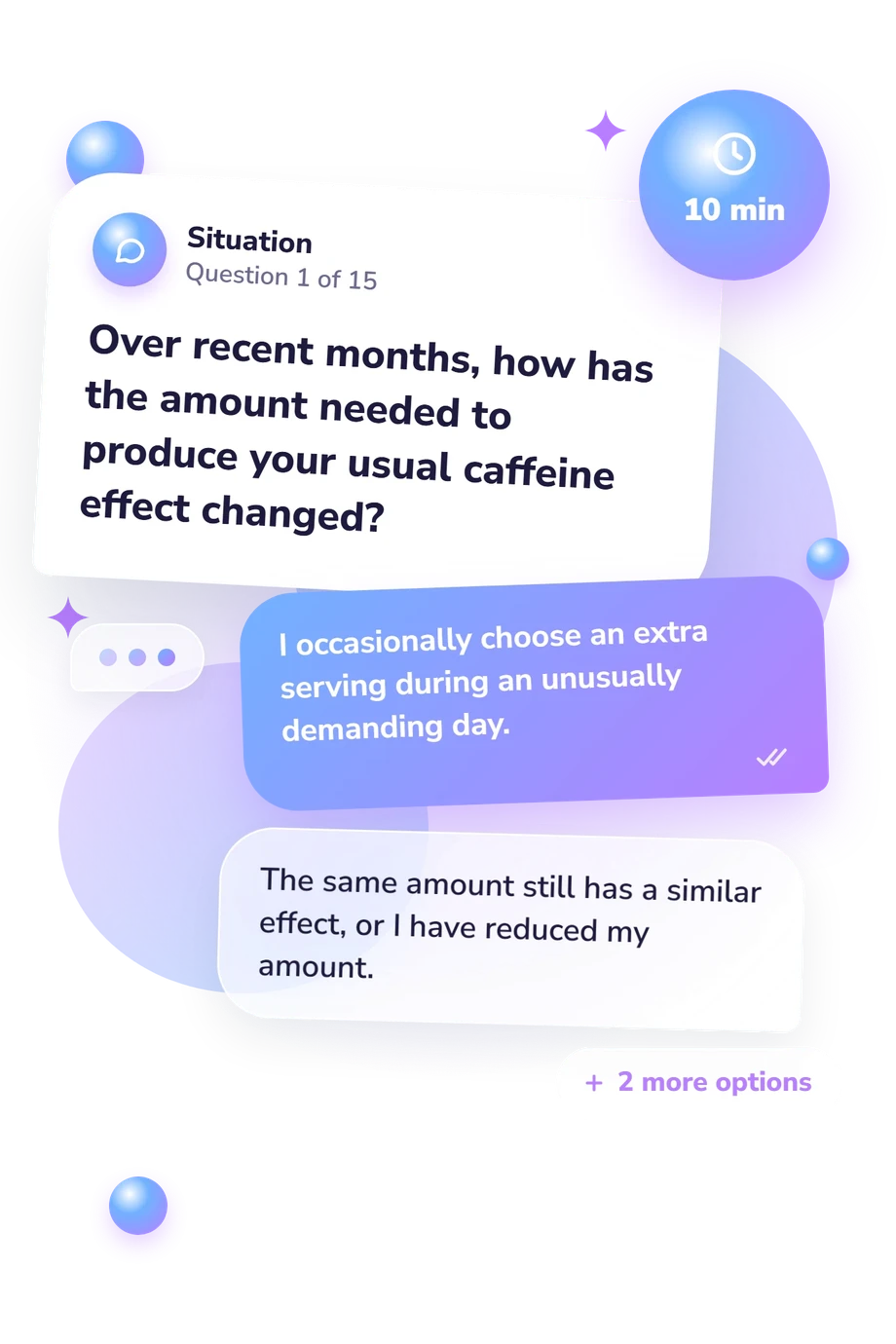
- I occasionally choose an extra serving during an unusually demanding day.
- The same amount still has a similar effect, or I have reduced my amount.
- My intake has risen sharply because previous amounts now seem to do very little.
- I routinely need more than I used to for comparable alertness or focus.
- I notice little or no physical or mental change.
- I feel mildly tired or less sharp, but it passes without much disruption.
- I commonly develop a clear headache, irritability, or trouble concentrating.
- The symptoms become intense enough to interrupt work, study, caregiving, or other plans.
- I keep consuming caffeine even after deciding not to, and the cycle repeatedly creates serious problems.
- I often choose more caffeine, although I had planned to stop earlier.
- I stop at the time I intended and adjust the task or schedule instead.
- I occasionally make a conscious exception for an unusual deadline.
Am I Addicted to Caffeine Quiz - Description and methodology of the test
Anyone trying to understand whether caffeine has become difficult to manage can use this self-report assessment. Coffee is one of the caffeine sources covered, making the profile useful for understanding coffee-related caffeine habits. The questions distinguish habit, loss of control, physical adaptation, and daily-life effects. The Am I Addicted to Caffeine Quiz gives a structured profile for reflection and helps the reader decide whether a change may be useful.
What This Assessment Measures
The questions examine harder-to-regulate patterns: needing more for the same effect, continuing despite consequences, feeling changes when intake is delayed, and struggling to cut back. They include coffee, tea, energy drinks, pre-workout products, soda, and medicines.
The profile also applies when energy drinks are the respondent’s main caffeine source, helping clarify energy-drink caffeine use. The profile has three dimensions:
- Control Over Caffeine Use (0-15) measures difficulty limiting or reducing intake; bands are No control difficulty signaled (0), Notable signal (1-2), and Action warranted (3-15).
- Daily Wellbeing and Safety Impact (0-15) measures sleep, functioning, physical comfort, and heart or breathing effects; bands are No daily-impact indicators (0), Notable signal (1-2), and Action warranted (3-15).
- Physical Adaptation (0-15) measures tolerance-like increases and withdrawal-like changes after reduction or delay; bands are Zero-score pattern (0), Notable signal (1-2), and Action warranted (3-15).
Methodology and Evidence Base
Each question offers four alternative patterns or levels of experience; displayed order does not indicate severity or scoring. This self-report format lets respondents choose the closest pattern.
The totals are organized across three dimensions. Their bands are unvalidated reflective summaries, not diagnostic, severity, or medical cutoffs. A concerning experience matters independently, and a single score-3 red-flag response overrides the total and should be acted on. Chest pain, fainting, severe breathing difficulty, confusion, seizure, or persistent racing or irregular heartbeat requires urgent help.
Conceptually, it is consistent with the Caffeine Use Disorder Questionnaire, proposed DSM-5 criteria, and symptom patterns examined in a 2018 study by Ágoston and colleagues and a 2020 study by Sweeney and colleagues. It is not an adaptation or validation of those works; they provide conceptual context, not psychometric validation of this questionnaire.
When soda is the main source, the questionnaire examines the resulting soda-related caffeine pattern rather than treating soda as a separate addiction test. Since responses depend on memory, honesty, current context, and self-awareness, use the result to notice patterns and decide what deserves attention.
- Ágoston, Csilla, Róbert Urbán, Mara J. Richman, and Zsolt Demetrovics. "Caffeine use disorder: An item-response theory analysis of proposed DSM-5 criteria." Addictive Behaviors 81 (2018): 109-116. 10.1016/j.addbeh.2018.02.012
- American Psychiatric Association. Diagnostic and Statistical Manual of Mental Disorders, Fifth Edition. Washington, DC: American Psychiatric Publishing, 2013.
- Sweeney, Mary M., Darian C. Weaver, Kathryn B. Vincent, Amelia M. Arria, and Roland R. Griffiths. "Prevalence and Correlates of Caffeine Use Disorder Symptoms Among a United States Sample." Journal of Caffeine and Adenosine Research 10, no. 1 (2020): 4-11. 10.1089/caff.2019.0020
Updated: