
What Poppy Playtime Character Are You Quiz
How the Scales are Structured
Who Usually Takes This Test?
See How You Compare
Below is a preview of how scores are typically distributed across each scale.
Example Questions From the Test
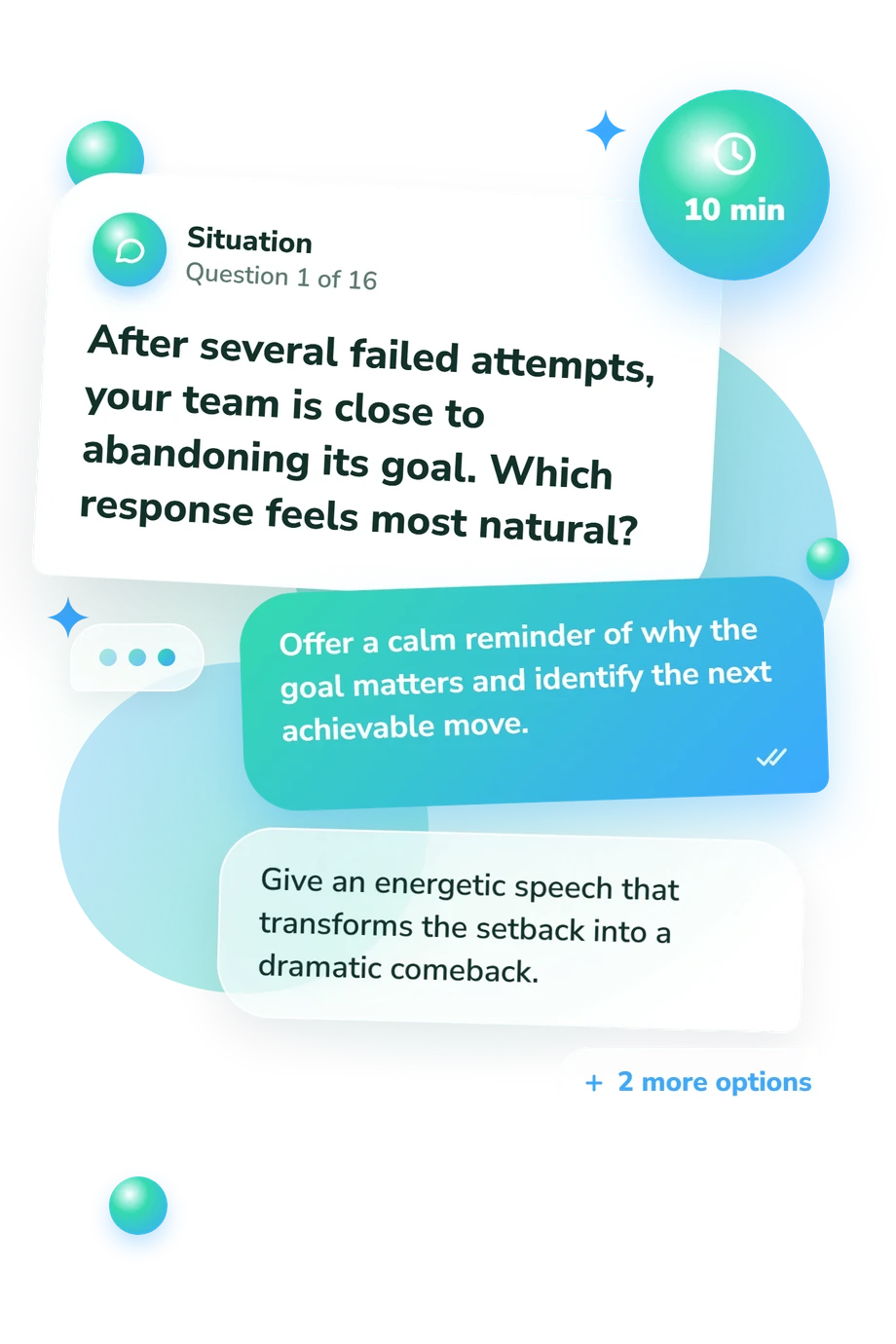
- Offer a calm reminder of why the goal matters and identify the next achievable move.
- Give an energetic speech that transforms the setback into a dramatic comeback.
- Take responsibility for the hardest remaining task and work on it yourself.
- Suggest pausing the effort and revisiting whether the original goal still fits.
- A dim, silent room where I can be completely alone for a while.
- A busy café where other people’s energy changes my focus.
- A quiet outdoor walk with one trusted companion.
- A familiar hobby at home with gentle music in the background.
- Use strength and leverage to force a direct path through it.
- Search nearby controls for a mechanical solution.
- Watch the door’s cycle and move at the moment it loosens.
- Gather several people and coordinate one combined attempt.
What Poppy Playtime Character Are You Quiz - Description and methodology of the test
Fans who enjoy Poppy Playtime can use this assessment to reflect on pressure, uncertainty, group decisions, and imaginative challenges. The What Poppy Playtime Character Are You Quiz suits readers curious about how these situations bring out their preferred style. Anyone wondering what Poppy Playtime character they might be can approach it as light fandom self-reflection.
What This Assessment Explores
Scenarios cover pressure, games, conflict, atmosphere, teamwork, disclosure, recovery, and disappointment. Their contrasts include observation versus action, restraint versus theatrical expression, and persistence versus flexible reassessment. Together, these situations create a Poppy Playtime character affinity profile organized around those contrasts.
The four displayed dimensions are:
- CatNap Affinity (0-12) measures quiet observation, patience, dreamlike atmosphere, and sustained devotion: Clear Daylight (0-4), Twilight Traits (5-8), Strong Affinity (9-12).
- Huggy Wuggy Affinity (0-12) measures stillness, watchfulness, directness, and relentless pursuit: Different Footsteps (0-4), Watchful Streak (5-8), Strong Affinity (9-12).
- Mommy Long Legs Affinity (0-12) measures theatricality, game control, emotional intensity, and rule-setting: Offstage Energy (0-4), Playful Command (5-8), Strong Affinity (9-12).
- Poppy Affinity (0-12) measures composure, guarded strategy, hope, and determination: Distant Echo (0-4), Shared Threads (5-8), Strong Affinity (9-12).
Methodology and Interpretation
Each item presents a brief situation with four response choices. Because the choices cover setbacks, rules, atmosphere, disclosure, pursuit, teamwork, and disappointment, this self-report format compares everyday preferences with fictional styles rather than factual personality statements.
The scoring compares four profile totals and identifies the highest as the strongest affinity. Profiles within one point of that score produce a blended result, with no hidden tie-breaker. It compares the respondent’s choices with fictional character styles, offering a playful answer to which Poppy Playtime character might fit rather than a judgment of personal worth.
The Poppy Playtime character profiles and the 2021 game provide fictional context for these interpretations; they do not establish psychological norms. General discussions by Paulhus and Vazire (2007) on self-report methods and by Paulhus (1991) on socially desirable responding offer context for interpreting any self-report tool; neither publication developed or validated this character-affinity questionnaire. As a self-report questionnaire, it can be influenced by mood, self-presentation, self-awareness, and the immediate situation, so its bands are entertainment-oriented prompts for reflection rather than diagnostic conclusions.
- MOB Entertainment. CatNap; Huggy Wuggy; Mommy Long Legs; and Poppy Playtime: Official character profiles. Poppy Playtime, n.d.
- Belanger, Zach, Seth Belanger, Zachary Preciado, Micah Preciado, and Isaac Christopherson. Poppy Playtime. Mob Entertainment, 2021.
- Paulhus, Delroy L., and Simine Vazire. The Self-Report Method. In Handbook of Research Methods in Personality Psychology, edited by Richard W. Robins, R. Chris Fraley, and Robert F. Krueger, 224-239. Guilford Press, 2007.
- Paulhus, Delroy L. Two-component models of socially desirable responding. Journal of Personality and Social Psychology 46, no. 3 (1984): 598-609. 10.1037/0022-3514.46.3.598
Updated: