
Major Scale Quiz
How the Scales are Structured
Who Usually Takes This Test?
See How You Compare
Below is a preview of how scores are typically distributed across each scale.
Example Questions From the Test
- G major
- D major
- A major
- C major
- A major
- E major
- D major
- B major
- G-flat
- F natural
- A natural
- G natural
Major Scale Quiz - Description and methodology of the test
Designed for learners who want to check their grasp of tonal fundamentals, the major scale quiz turns common notation and theory tasks into a focused self-assessment. Beginners consolidating classroom work, musicians refreshing key relationships, and anyone seeking a clear starting point for practice can use this quiz about music scales. The result gives an overall indication of major-scale knowledge.
What This Assessment Explores
The questionnaire tests practical major-scale knowledge rather than taste or performance fluency. Items connect key signatures with tonal centers, relative keys, note spelling, scale degrees, the whole-step/half-step pattern, transposition, and basic harmony.
Learners can use this scale quiz to review notation and key relationships, whether they are theory students, players checking notation habits, or composers reviewing written-key logic. It does not measure ear training or performance speed.
The single scale is Major Scale Knowledge (0-16): Foundations to Review (0-6) signals core ideas needing review; Developing Knowledge (7-12) reflects mostly secure concepts with gaps; Strong Knowledge (13-16) reflects accurate, flexible application.
The result examines these areas:
- Key signatures and tonal centers show how you infer a major key.
- Spelling and intervals show how you preserve note order and pitch distance.
- Transposition and harmony show how you apply patterns across keys.
Methodology and Evidence Base
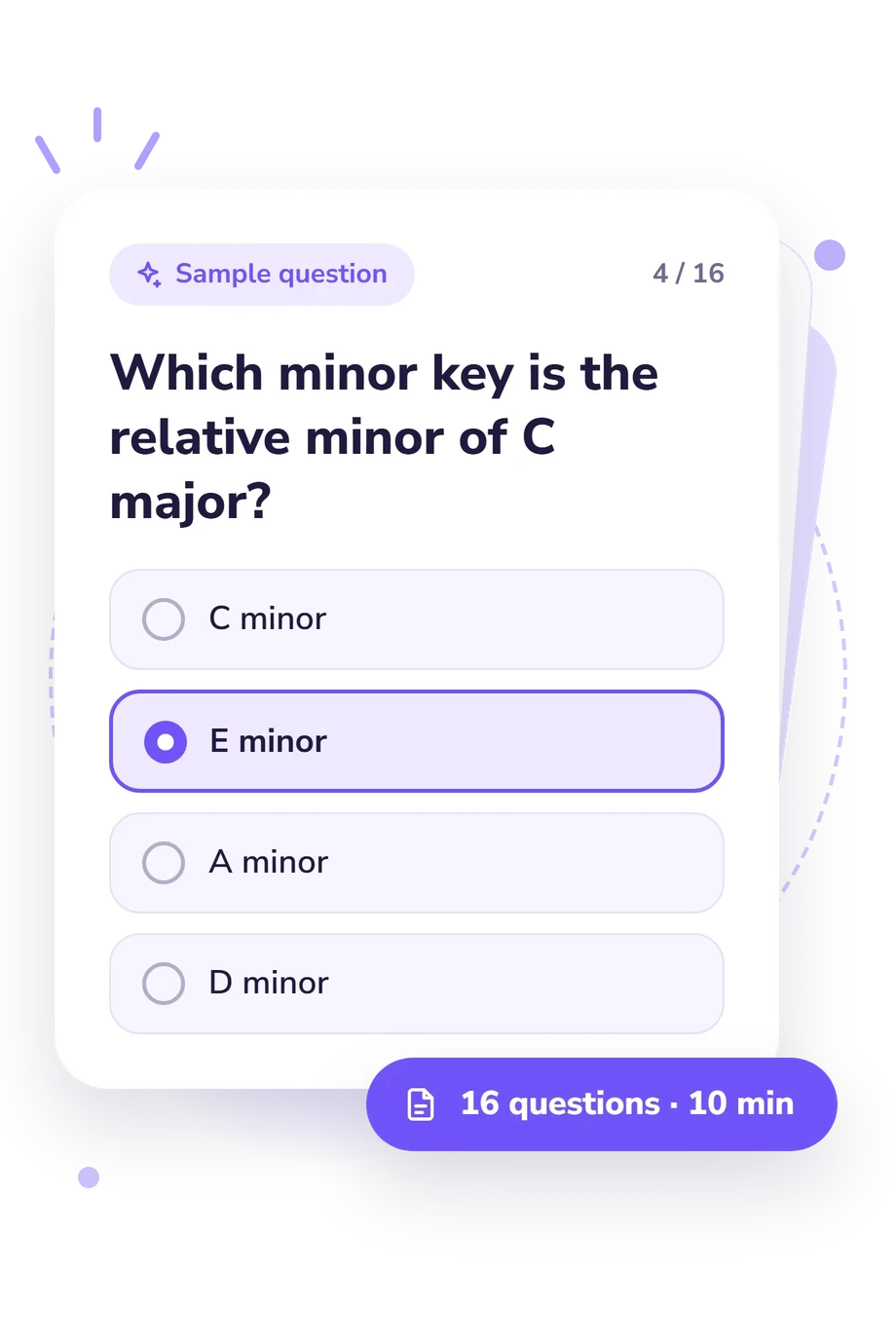
Each item gives a short theory situation with four answer choices. You identify a key from its signature, spell a scale, calculate a scale-degree relationship, or apply transposition. The format makes the major scale test a structured knowledge check rather than a preference survey.
The questionnaire presents one overall displayed result, with no separate subscale results or documented point-allocation rule. No population norms, reliability coefficients, or diagnostic cutoffs are stated, so the bands are descriptive study guidance: lower results point to review, while higher results suggest broader command of the tested conventions.
Content is conceptually consistent with Benward and Saker (2021), whose tonal-theory treatment covers major-scale construction, key signatures, intervals, and triadic relationships. Kostka, Payne, and Almén add a complementary account of tonal harmony, while Hook (2007) explains key signatures and enharmonic relationships within diatonic systems. This questionnaire is not presented as a standardized adaptation of those works.
Interpret the questionnaire score in light of attention, prior instruction, and familiarity with notation; these factors can affect results. Practice and theory assessment can broaden the picture of musicianship.
- Benward, Bruce, and Marilyn Saker. Music in Theory and Practice Volume 1. 10th ed. McGraw-Hill Education, 2021.
- Hook, Julian. “Enharmonic Systems: A Theory of Key Signatures, Enharmonic Equivalence and Diatonicism.” Journal of Mathematics and Music 1, no. 2 (2007): 99-120. 10.1080/17459730701374805
- Kostka, Stefan M., Dorothy Payne, and Byron Almén. Tonal Harmony: With an Introduction to Post-Tonal Music. 8th ed. McGraw-Hill Education, 2018.
Updated: