
Mole Quiz
How the Scales are Structured
Who Usually Takes This Test?
See How You Compare
Below is a preview of how scores are typically distributed across each scale.
Example Questions From the Test
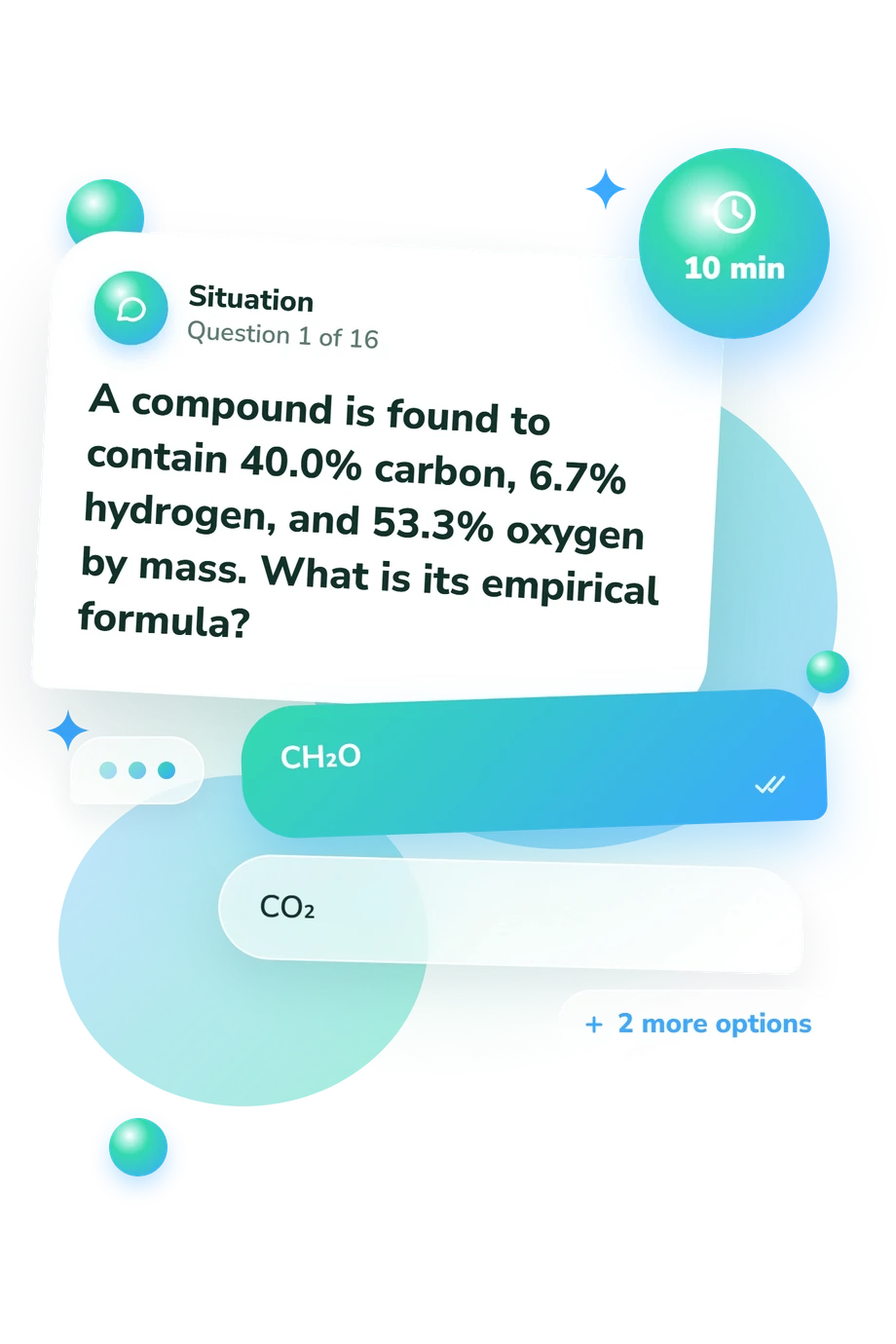
- CH₂O
- CO₂
- C₂H₄O₂
- CHO
- 20 × 10²⁴ molecules
- 01 × 10²³ molecules
- 02 × 10²³ molecules
- 30 × 10⁻²⁵ molecules
- 025 mol
- 040 mol
- 100 mol
- 5 mol
Mole Quiz - Description and methodology of the test
Students reviewing introductory chemistry and anyone checking their grasp of chemical quantities can use this mole quiz to identify secure skills and topics that need more practice. As a mole concept quiz, it tests the mole concept through translations among particles, moles, mass, volume, and reaction quantities. The result offers a practical study direction rather than a broad measure of chemistry ability.
What This Assessment Explores
These questions connect core situations rather than testing one calculation pattern. Together they move from formulas and particle counts to molar mass, solution concentration, gas variables, percent yield, and limiting reactants. Together, they show what the quiz on the mole covers: whether you can translate among particles, moles, mass, volume, and reaction quantities.
The main topic groups are:
- Particle, formula, and molar-mass problems show whether you can connect entities, symbols, composition, and grams.
- Solution and gas calculations show how you handle concentration, volume, pressure, temperature, and amount.
- Yield and reaction problems show whether you can compare stoichiometric requirements and identify the limiting reactant.
Mole Calculations Knowledge runs from 0-16 correct answers and measures these tasks. Its bands are Foundations to review 0-6, Developing fluency 7-12, and Strong command 13-16. The score concerns chemistry knowledge, not a skin mole or medical result.
Methodology and Scientific Basis
Each item uses four-option multiple choice. The learner selects the best response to a definition, conversion, equation, or reaction problem. The result records the number of correct answers on the displayed scale.
The content is conceptually consistent with Mole Concept Test (Krishnan & Howe, 1994), which treats mole understanding as more than recalling Avogadro’s number. This online questionnaire is not presented as an adaptation or standardized administration of that instrument. Its stoichiometry problems also connect with the difficulty patterns described by Gulacar et al. (2013), while its concentration tasks are consistent with issues examined by Raviolo et al. (2021).
This educational assessment checks mole calculation skills as a mole calculation quiz, asking learners to transfer among representations: symbolic formulas, numerical quantities, units, and chemical situations. The bands should be interpreted as study guidance, not population norms or a measure of complete chemistry mastery. A learner may be helped or hindered by arithmetic fluency, notation familiarity, guessing, or current concentration, and the result does not show laboratory technique or broader chemical reasoning beyond the tested content.
- Krishnan, Shanthi R., and Ann C. Howe. "The Mole Concept: Developing an Instrument To Assess Conceptual Understanding." Journal of Chemical Education 71, no. 8 (1994): 653-655. 10.1021/ed071p653
- Gulacar, Ozcan, Tina L. Overton, Charles R. Bowman, and Herb Fynewever. "A Novel Code System for Revealing Sources of Students' Difficulties with Stoichiometry." Chemistry Education Research and Practice 14, no. 4 (2013): 507-515. 10.1039/C3RP00029J
- Raviolo, Andrés, Andrea S. Farré, and Nayla Traiman Schroh. "Students' Understanding of Molar Concentration." Chemistry Education Research and Practice 22, no. 2 (2021): 486-497. 10.1039/D0RP00344A
Updated: