
Space Quiz Questions and Answers
How the Scales are Structured
Who Usually Takes This Test?
See How You Compare
Below is a preview of how scores are typically distributed across each scale.
Example Questions From the Test
- Iron-bearing minerals that have oxidized in its surface material
- Red light scattered by gases in its atmosphere
- Large areas of red vegetation
- A planet-wide layer of glowing lava
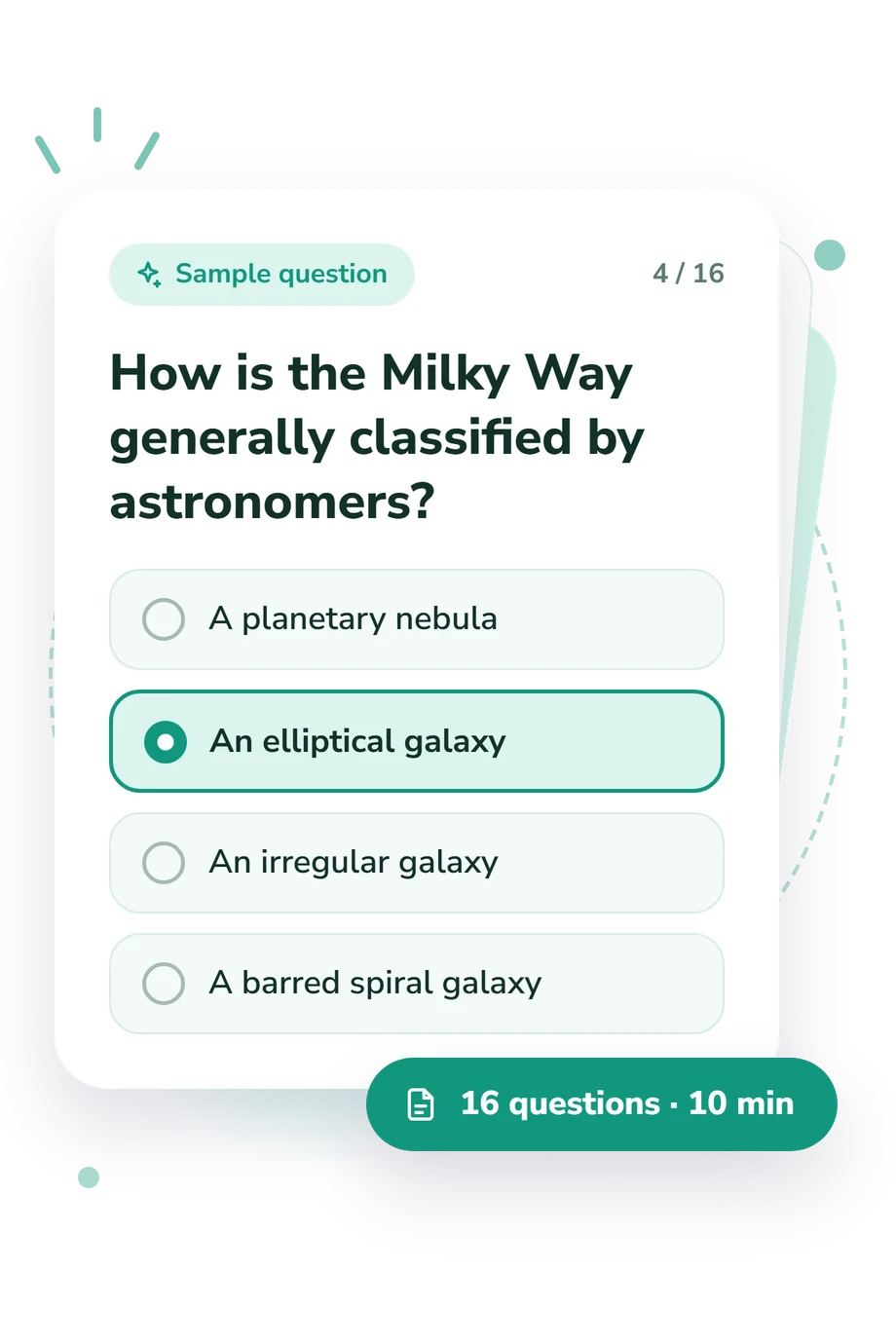
- A planetary nebula
- An elliptical galaxy
- An irregular galaxy
- A barred spiral galaxy
- Chemical burning of solar gases
- Nuclear fusion of hydrogen into helium
- Nuclear fission of heavy elements
- Friction between the Sun and surrounding space
Space Quiz Questions and Answers - Description and methodology of the test
People who want a compact check of foundational astronomy can use Space Quiz Questions and Answers PDF to examine how they reason about familiar space concepts rather than recall isolated facts. It suits learners, curious adults, and anyone revising for a class or informal challenge. The result gives a focused picture of strengths and topics worth revisiting. As an astronomy quiz questions and answers pdf, it links facts with applications involving motion, light, seasons, gravity, and observation.
What This Assessment Explores
The questions cover planets and moons, stellar objects, light, orbital motion, gravity, seasons, eclipses, and observation. A printable space quiz in this format asks the reader to connect facts with physical explanations, such as why Mars looks red or why a larger aperture reveals more detail. The intended result is a picture of demonstrated knowledge across linked topics, not a personality profile.
The result uses one Space Knowledge scale, with a score range of 0-16. Its displayed bands are:
- Launch Pad (0-6) indicates recognition of some space concepts while showing that core foundations need reinforcement.
- Orbital Progress (7-12) indicates solid general knowledge with selected topics still worth revisiting.
- Cosmic Command (13-16) indicates a strong grasp of astronomy facts and applied space reasoning.
Methodology and Evidence Base
Each question presents a short astronomy or space-science situation followed by four answer choices. The set combines direct identification with applications involving eclipses, axial tilt, inverse-square gravity, radio delay, transits, and telescope aperture. The space quiz PDF format can support later revision because the items link recall to explanation.
Responses are converted into the displayed result, but no weighting formula, item-level difficulty model, or norm table is supplied. The score is therefore a descriptive snapshot of performance on this set, not a percentile or calibrated estimate of general astronomy ability.
Its content is conceptually consistent with ASSCI (Sadler et al., 2010), which emphasizes astronomy concepts and reasoning, and it parallels the concept-focused Astronomy Diagnostic Test discussed by Hufnagel et al. (2000). The quiz is not presented as a standardized adaptation or validated administration of either instrument.
Interpretation should account for prior study, guessing, language, and test familiarity. A strong band suggests successful handling of the sampled concepts; a lower band points to topics worth revisiting.
- Sadler, Philip M., Harold Coyle, Jaimie L. Miller, Nancy Cook-Smith, Mary Dussault, and Roy R. Gould. "The Astronomy and Space Science Concept Inventory: Development and Validation of Assessment Instruments Aligned with the K-12 National Science Standards." Astronomy Education Review 8, no. 1 (2010): 010111. 10.3847/AER2009024
- Hufnagel, Beth, Timothy Slater, Grace Deming, Jeff Adams, Rebecca L. Adrian, Christine Brick, and Michael Zeilik. "Pre-course Results from the Astronomy Diagnostic Test." Publications of the Astronomical Society of Australia 17, no. 2 (2000): 152-155. 10.1071/AS00152
Updated: