
Electronics Quiz
How the Scales are Structured
Who Usually Takes This Test?
See How You Compare
Below is a preview of how scores are typically distributed across each scale.
Example Questions From the Test
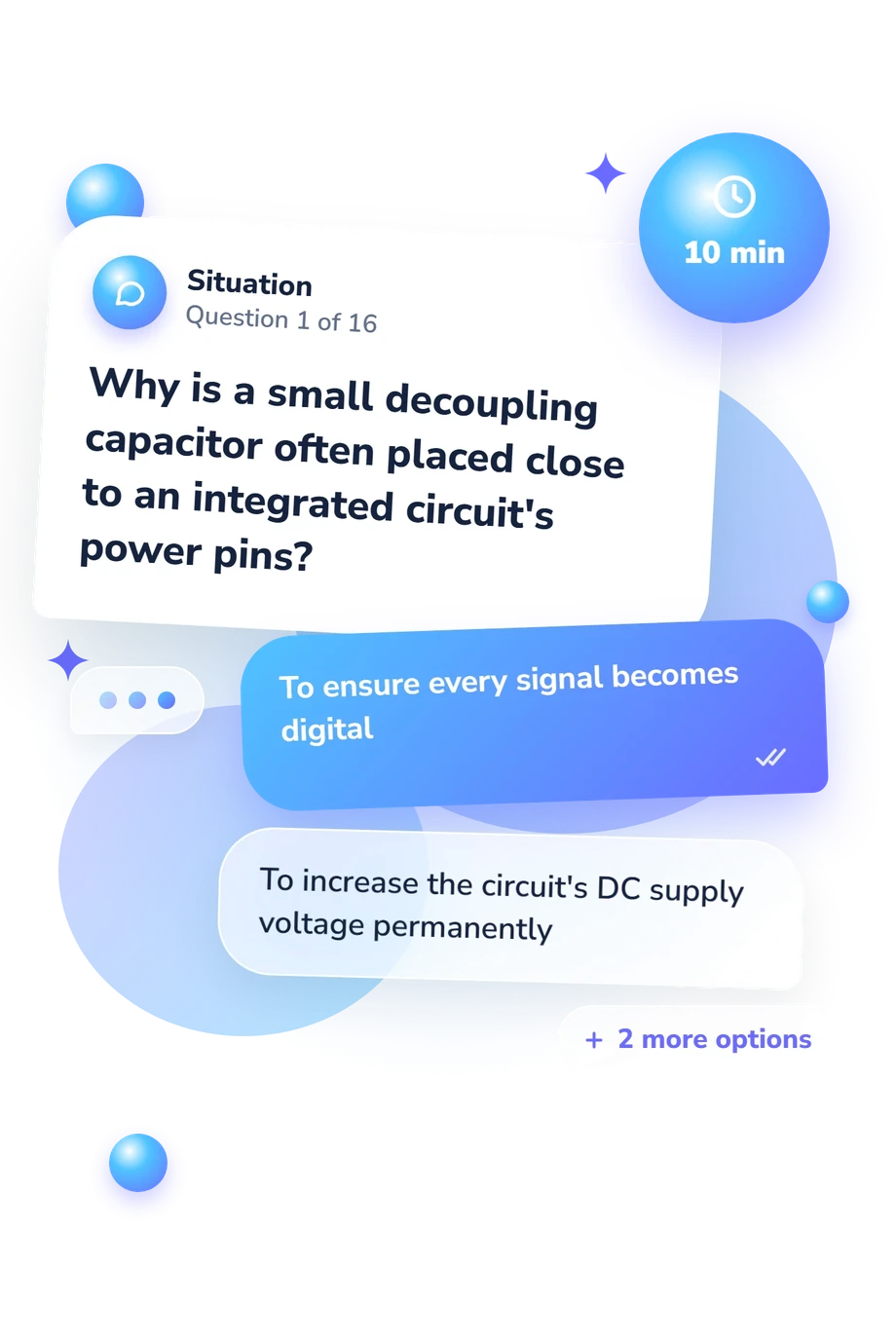
- To ensure every signal becomes digital
- To increase the circuit's DC supply voltage permanently
- To supply brief local current demands and reduce supply noise
- To replace the need for a ground connection
- Only when both inputs are high
- When either input is high, including when only one is high
- Only when both inputs are low
- Whenever the two inputs are different
- 100 Ω
- 1 kΩ
- 10 kΩ
- 1 MΩ
Electronics Quiz - Description and methodology of the test
Intended for learners, hobbyists, and anyone revising core circuit ideas, this electronics quiz helps you check whether your working knowledge is ready for further study or practical projects. A quiz about basic electronics can reveal how comfortably you connect laws, component behavior, measurements, and troubleshooting decisions, while showing which areas deserve focused review rather than leaving your result as a bare percentage.
What This Assessment Measures
At its core, the assessment examines whether a learner can connect components, circuit laws, mathematical relationships, and practical measurement choices. The quiz questions on electronics cover recognition and application: identifying component behavior, predicting circuit outcomes, choosing safe connections, and calculating current, power, gain, frequency, and peak voltage.
The main areas represented in the questions are:
- Circuit principles show whether you can apply voltage, current, resistance, series and parallel behavior, and Kirchhoff's current law.
- Components and devices indicate how well you understand resistors, capacitors, diodes, LEDs, transistors, logic gates, and op-amps in common roles.
- Measurement and calculation reveal whether you can interpret resistor codes, RMS values, multimeter connections, oscilloscope periods, and basic formulas.
- Safety and troubleshooting show whether you can reason about fuses, open circuits, decoupling, current paths, and consequences of incorrect intervention.
Together, these themes describe practical foundational knowledge across mixed situations.
Methodology and Evidence Base
Methodologically, the assessment uses four-option multiple-choice items: the respondent selects the alternative that best completes each technical situation. The assessment's questions with answer choices test basic electronics through conceptual recognition, numerical calculation, component identification, measurement practice, and troubleshooting. Performance is reported on the Electronics Knowledge scale, with a range of 0-16. The displayed bands are Foundation Building (0-6), Developing Knowledge (7-12), and Strong Knowledge (13-16), describing increasing command of foundational electronics rather than clinical categories.
The content is conceptually consistent with the Basic Electronics Knowledge assessment (Steinberg et al., 2020). Scherz and Monk, together with Agarwal and Lang, provide technical grounding for the practical, analog, and digital principles represented by the items. This questionnaire is not presented as an adaptation or standardized administration of those works, and no norm group, reliability estimate, or independent validation is supplied for this online version.
Results are therefore best used to target study and practice. Guessing, wording, calculation slips, and current study context can affect performance, while a fixed-choice score cannot fully capture hands-on skill or engineering competence.
- Steinberg, Jonathan, Jessica Andrews-Todd, Carolyn Forsyth, John Chamberlain, Paul Horwitz, Al Koon, Andre Rupp, and Laura McCulla. "The Development of a Content Assessment of Basic Electronics Knowledge." ETS Research Report Series, 2020, no. 1, pp. 1-19. 10.1002/ets2.12311.
- Scherz, Paul, and Simon Monk. Practical Electronics for Inventors, Fourth Edition. New York: McGraw-Hill Education, 2016. ISBN 9781259587559.
- Agarwal, Anant, and Jeffrey H. Lang. Foundations of Analog and Digital Electronic Circuits. San Mateo, CA: Morgan Kaufmann, 2005. ISBN 9781558607354.
Updated: