
Should I Be a Speech Pathologist Quiz
How the Scales are Structured
Who Usually Takes This Test?
See How You Compare
Below is a preview of how scores are typically distributed across each scale.
Example Questions From the Test
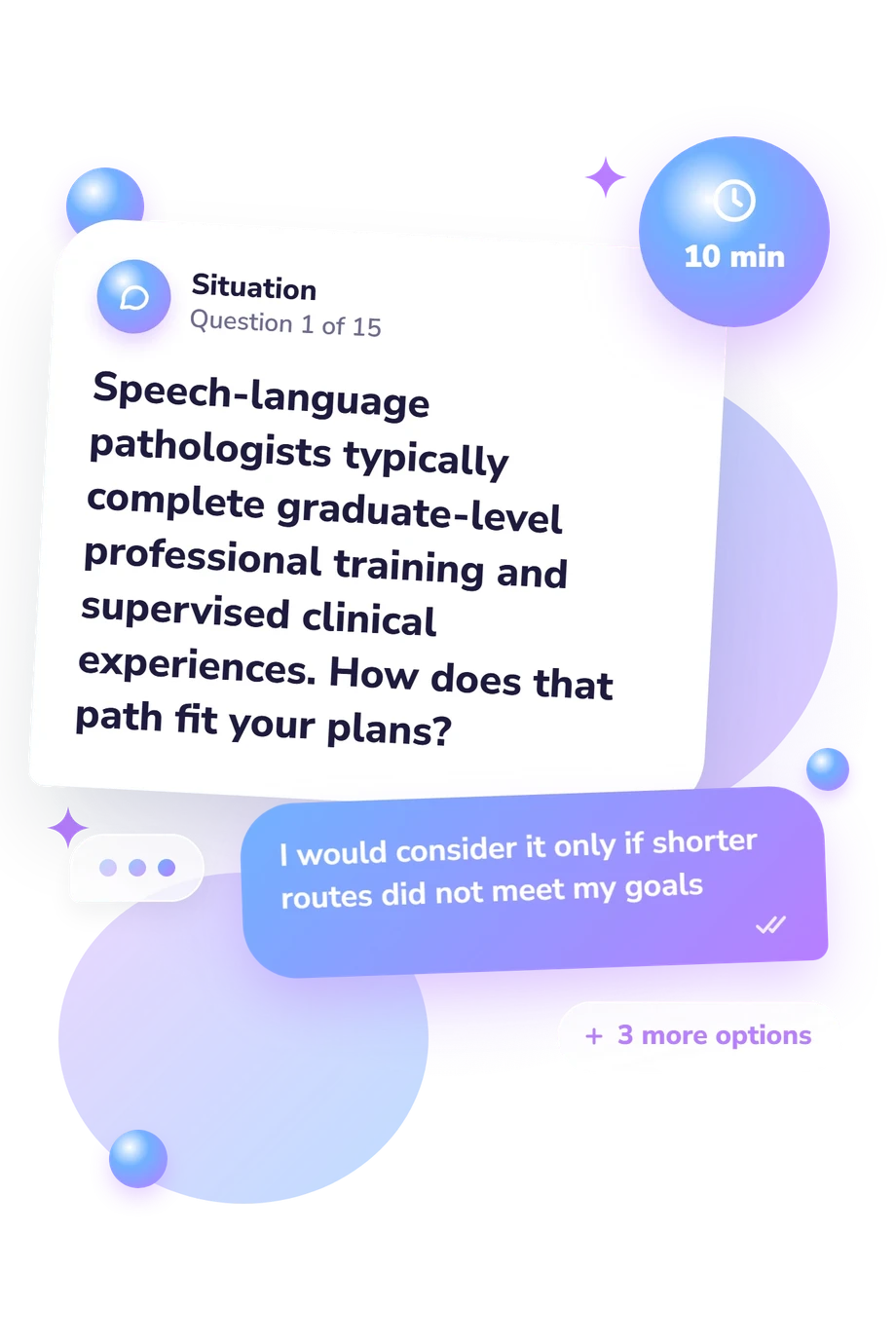
- I would consider it only if shorter routes did not meet my goals
- The extended preparation feels worthwhile for the work I want to do
- I am interested, but I need to investigate cost, prerequisites, and timing carefully
- A career requiring substantially less formal preparation fits me better
- Tracking small functional gains and adjusting the plan as new information appears
- Setting a firm point at which a different goal must replace the current one
- Balancing long-term goals with shorter milestones that provide momentum
- Moving to work where results are usually faster and easier to predict
- Delivering a polished presentation to a large audience
- Using a new strategy to express a need more independently
- Learning information efficiently without much discussion
- Becoming more confident in everyday conversations
Should I Be a Speech Pathologist Quiz - Description and methodology of the test
People weighing graduate preparation for speech-language pathology can use the Should I Be a Speech Pathologist Quiz to consider whether extended study and the profession’s recurring work pattern suit their preferences. It is useful when comparing study commitments, client-facing routines, and the sustained attention that daily practice requires. The Is Speech Pathology for Me Quiz makes these expectations more concrete for prospective students considering them together.
What This Assessment Explores
Speech-language pathology combines communication science, practice, documentation, and teamwork. Questions sample observation, uneven progress, adaptable explanations, and preparation. They help people considering whether to become a speech pathologist compare preferences with demands. These dimensions describe fit:
- Clinical Problem Solving (0-15) measures structured, evidence-guided observation: Broader-Pattern Thinker (0-5) favors broader ideas; Developing Investigator (6-10) shows interest; Strong Investigator (11-15) reflects hypothesis-building and tracking change.
- Communication Attunement (0-15) measures adaptable, person-centered communication: Different Communication Style (0-5) favors predictable exchanges; Emerging Attunement (6-10) shows fit; Strong Attunement (11-15) reflects adapting to people.
- Professional Path Fit (0-15) measures preferences against training demands and work patterns: Explore Alternatives (0-5) signals conflicting priorities; Conditional Fit (6-10) flags details to investigate; Strong Path Alignment (11-15) reflects training, collaboration, and documentation.
Methodology and Evidence Base
Each prompt presents a work or learning situation with four possible reactions. Scenarios cover preparation, uneven progress, speech analysis, adaptable explanations, repeated practice, collaboration, and documentation, so the format samples work demands, not factual knowledge.
Responses are summarized across the three displayed scales. The questionnaire does not state how individual choices are weighted or converted into points; the ranges therefore show result intervals, not an answer-by-answer scoring rule.
The evidence base is conceptually related to Katz et al. (2013), a study of career motives and workplace preferences among speech-language pathologists. Keshishian and McGarr (2012) address motivations in communication sciences and disorders; Brodsky and Cooke (2000) examine career decisions in speech-language pathology and audiology.
Read the results together: similar patterns can support comparison of programs and settings, while a lower result can identify a demand to investigate through prerequisite review, observation, or conversations with practitioners. When weighing a career as a speech pathologist, this assessment can organize that research.
Because the scores are reflective indicators of current preferences rather than measures of clinical competence or admission prospects, self-report, current context, self-awareness, and impression management may shape them; they do not guarantee job satisfaction.
- Katz, N., Gilad Izhaky, S., & Freier Dror, Y. (2013). Reasons for choosing a career and workplace among occupational therapists and speech language pathologists. Work, 45(3), 343-348. 10.3233/WOR-121532
- Keshishian, F., & McGarr, N. S. (2012). Motivating factors influencing choice of major in undergraduates in communication sciences and disorders. International Journal of Speech-Language Pathology, 14(2), 174-182. 10.3109/17549507.2011.645250
- Brodsky, M. B., & Cooke, P. A. (2000). Influences in the Decision-Making Process for Careers As a Speech-Language Pathologist or an Audiologist. Journal of Employment Counseling, 37(3), 178-189. 10.1002/j.2161-1920.2000.tb00484.x
Updated: