
Reinforcement and Punishment Quiz
How the Scales are Structured
Who Usually Takes This Test?
See How You Compare
Below is a preview of how scores are typically distributed across each scale.
Example Questions From the Test
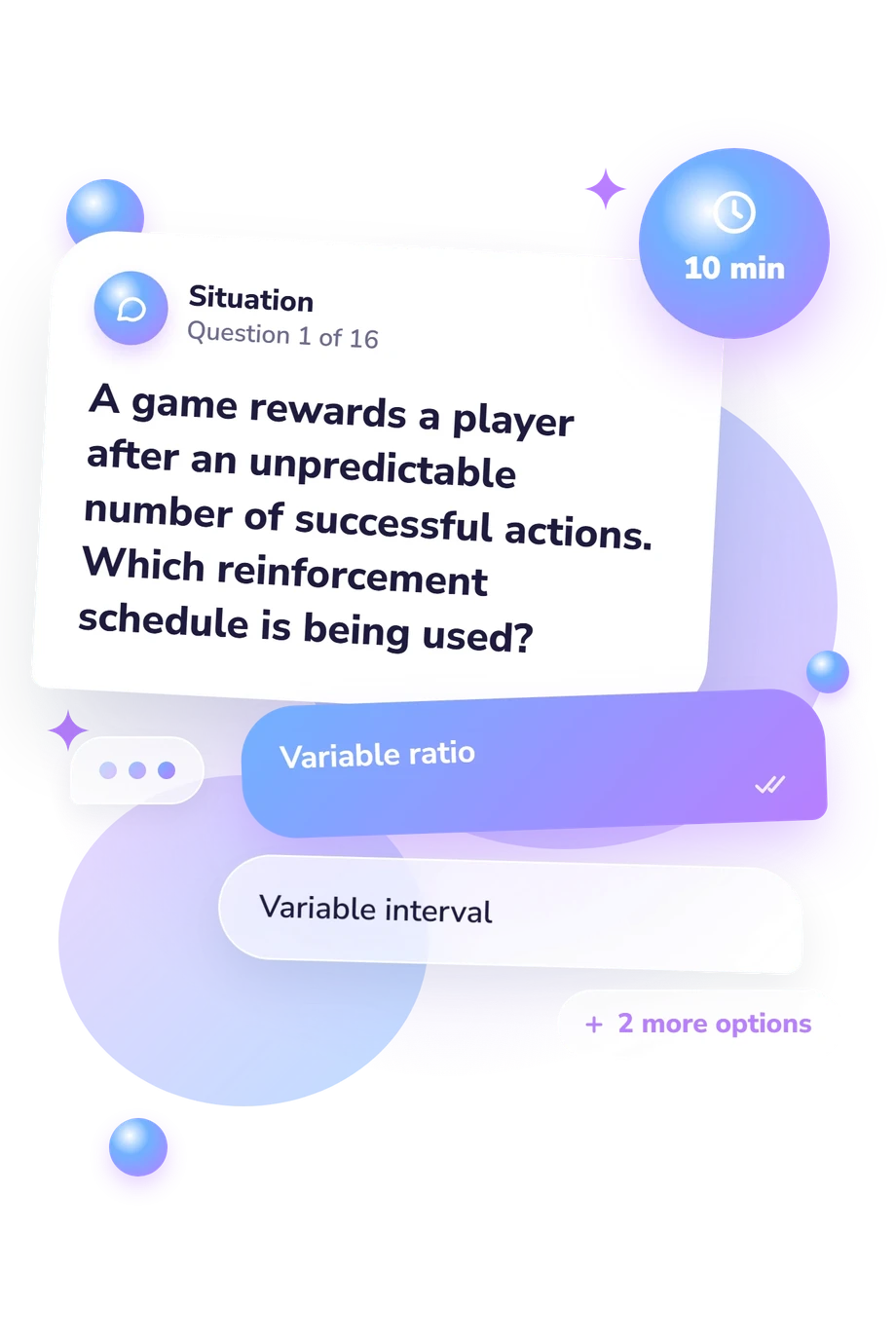
- Variable ratio
- Variable interval
- Fixed ratio
- Fixed interval
- It is delivered immediately after any behavior.
- It feels pleasant to the person receiving it.
- It increases the future likelihood of the behavior it follows.
- It removes an unwanted behavior from a situation.
- Negative punishment
- Positive punishment
- Positive reinforcement
- Negative reinforcement
Reinforcement and Punishment Quiz - Description and methodology of the test
For learners who want to check how well they distinguish consequences that strengthen or weaken behavior, the reinforcement and punishment quiz offers a focused knowledge check of operant-conditioning principles. It suits students, educators, and curious readers who want to connect definitions with everyday examples. This operant conditioning quiz helps learners locate confusion between reinforcement and punishment, positive and negative consequences, and schedules based on responses versus time.
What This Assessment Explores
This questionnaire asks respondents to identify how consequences affect later behavior and whether something is added or removed. It separates reinforcement from punishment, and positive from negative, through definitions and short scenarios. The reinforcement vs punishment quiz checks conceptual precision, not personal opinion.
The questions cover four connected areas:
- Schedules show whether consequences depend on responses or elapsed time.
- Definitions show whether behavior increases or decreases after something is added or removed.
- Procedures identify extinction, shaping, response cost, and time-out.
- Stimulus control and learned value distinguish cues, conditioned reinforcers, escape, and avoidance.
The result uses one scale, Reinforcement and Punishment Knowledge: 0-16. Foundation Building (0-6) indicates that core consequence logic needs review; Developing Knowledge (7-12) indicates understanding of many distinctions but a need for practice with schedules or related processes; Strong Knowledge (13-16) indicates consistent recognition and application of major principles.
Methodology and Scientific Basis
Each item gives a definition or short scenario with four answer choices. Choose the principle that best explains the described change in behavior. The raw total counts correct answers; it reflects performance on this set of concepts, not how often someone applies them outside the questionnaire.
The assessment follows a behavioral learning approach in which consequences are classified by their effects on future responding. The reinforcement schedule quiz questions ask readers to distinguish response-based patterns from time-based ones in short scenarios. Ferster and Skinner (1957) is the closest conceptual source for those schedule distinctions. Skinner (1953) provides the broader operant framework, while Azrin and Holz (1966) supports the discussion of punishment and its behavioral effects.
This questionnaire is conceptually consistent with those works, particularly in its questions about consequences, schedules, and punishment procedures. Its displayed bands describe performance on this item set rather than population norms, helping readers locate areas for study. Scores can also reflect attention, wording familiarity, and current understanding, so the result is best read as a focused learning signal rather than a complete measure of behavioral knowledge.
- Ferster, C. B., & Skinner, B. F. (1957). Schedules of reinforcement. New York: Appleton-Century-Crofts. 10.1037/10627-000
- Skinner, B. F. (1953). Science and human behavior. New York: Macmillan.
- Azrin, N. H., & Holz, W. C. (1966). Punishment. In W. K. Honig (Ed.), Operant Behavior: Areas of Research and Application (pp. 380-447). New York: Appleton-Century-Crofts.
Updated: