
Present Perfect Progressive Quiz
How the Scales are Structured
Who Usually Takes This Test?
See How You Compare
Below is a preview of how scores are typically distributed across each scale.
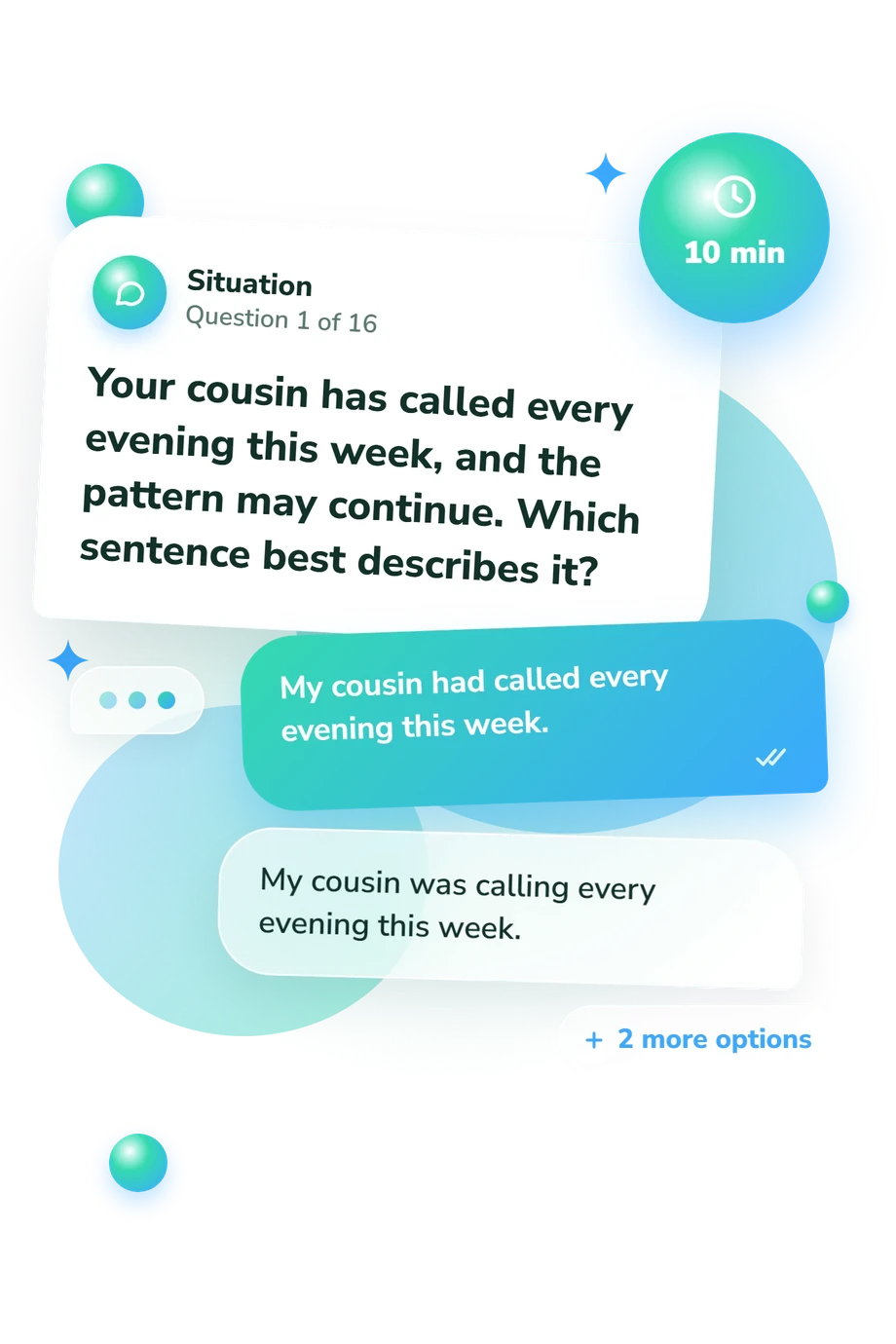
Example Questions From the Test
- My cousin had called every evening this week.
- My cousin was calling every evening this week.
- My cousin is called every evening this week.
- My cousin has been calling every evening this week.
- is studying
- was studying
- has been studying
- had studied
- Nina has been completing the forms.
- Nina is completing all ten forms.
- Nina has completed all ten forms.
- Nina had been completing ten forms.
Present Perfect Progressive Quiz - Description and methodology of the test
For learners checking whether they can choose the right English tense in context, this assessment offers a focused way to examine form, meaning, and time reference. The present perfect progressive quiz indicates an overall knowledge level and a general direction for practice. Its result can guide present perfect progressive practice by showing whether further review of the tense may be useful.
What This Assessment Explores
Rather than testing vocabulary broadly, the questionnaire examines how a learner connects verb form, meaning, and time reference. The quiz present perfect continuous format focuses on continuing activity, recent evidence, temporary repetition, and contrasts with completed or non-progressive states. It suits learners checking practical tense control in everyday sentences.
The item groups represent the decisions behind the result:
- Form and auxiliaries show whether the learner can build have or has been plus -ing in statements, questions, negatives, and plural subjects.
- Duration expressions show whether since and for match a starting point or a length of time.
- Context shows whether the tense presents continuation, repetition, or recent evidence, and whether a completed or non-progressive form is required instead.
- Tense contrast shows whether another form is more suitable when progressive meaning does not fit.
Methodology and Evidence Base
Each item presents a sentence or situation with four answer choices. The respondent selects the form that best matches the intended time relationship, grammar, or meaning. Distractors target errors involving auxiliaries, participles, time markers, and related tenses. As a present perfect progressive tense quiz, it emphasizes recognition and selection rather than extended writing.
The result uses the Present Perfect Progressive Knowledge scale, 0-16. Its displayed bands are Foundations to Review 0-6, Developing Command 7-12, and Strong Command 13-16. The band gives a broad indication of overall command and general practice direction.
Grammar distinctions are conceptually consistent with Declerck, Reed and Cappelle (2006) on tense and aspect, while Huddleston and Pullum (2002) offer a complementary account of English verb-phrase structure. These references provide the tense-and-aspect framework; the questionnaire is not claimed to be an adaptation or validation of either work.
Interpret the band as a broad indication of command: instruction, recent exposure, attention, guessing, and current confidence can affect performance, so the score describes these grammar decisions rather than English ability as a whole.
- Declerck, Renaat, in collaboration with Susan Reed and Bert Cappelle. The Grammar of the English Verb Phrase, Volume 1: The Grammar of the English Tense System: A Comprehensive Analysis. Mouton de Gruyter, 2006. 10.1515/9783110199888
- Huddleston, Rodney, and Geoffrey K. Pullum. The Cambridge Grammar of the English Language. Cambridge University Press, 2002. 10.1017/9781316423530
Updated: