
Porn Addiction Test
How the Scales are Structured
Who Usually Takes This Test?
See How You Compare
Below is a preview of how scores are typically distributed across each scale.
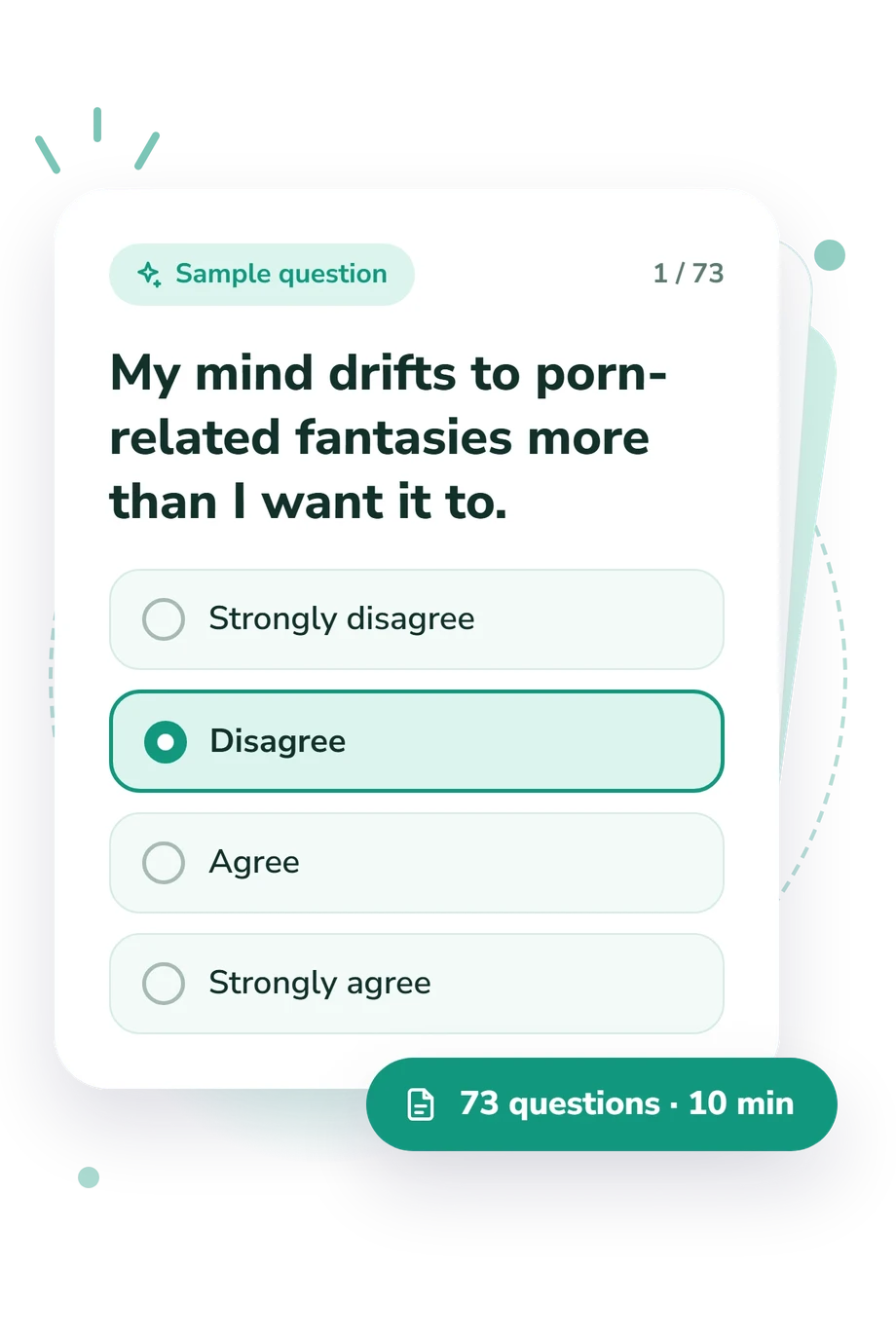
Example Questions From the Test
- Strongly disagree
- Disagree
- Agree
- Strongly agree
- Strongly disagree
- Disagree
- Agree
- Strongly agree
- Strongly disagree
- Disagree
- Not sure
- Agree
Porn Addiction Test - Description and methodology of the test
People who feel that porn use is taking more time, attention, or control than they intend can use this porn addiction test to organize those concerns. It is designed for anyone reflecting on recurring habits, failed attempts to cut down, mood-based use, or consequences in daily life. This porn addiction quiz can point to patterns worth examining without reducing a complex experience to one label.
What This Assessment Explores
The questionnaire examines control, preoccupation, coping, escalation, and consequences in personal porn use. It suits anyone reviewing repeated attempts to stop, longer sessions, secrecy, sleep disruption, relationship tension, or reduced focus. For someone asking whether porn use feels difficult to manage, the result highlights prominent patterns rather than answering an addiction question directly.
The result is organized into three dimensions:
- Loss of Control (0-20) shows difficulty stopping, cutting down, or keeping self-set limits. Low 0-6; Moderate 7-13; High 14-20.
- Negative Impact & Coping (0-20) reflects mood-based use and continuing despite harm. Low impact 0-6; Moderate impact 7-13; High impact 14-20.
- Preoccupation & Escalation (0-20) captures mental focus, time spent, and increasingly novel or intense use. Low 0-6; Moderate 7-13; High 14-20.
Methodology and Scientific Basis
The representative items are first-person statements about thoughts, urges, control attempts, coping, and consequences. Their response choices vary: some run from strongly disagree to strongly agree, while others include Not sure and omit strongly agree. The questionnaire reports three scale results with the displayed bands, so the profile can show different levels rather than one all-or-nothing answer.
The questionnaire's themes are conceptually consistent with the Problematic Pornography Consumption Scale (Bőthe et al., 2018), which addresses impaired control, conflict, mood regulation, and escalation. The same themes are also conceptually consistent with the Problematic Pornography Use Scale (Kor et al., 2014) and Brief Pornography Screen (Kraus et al., 2020). The online questionnaire is not an adaptation or independently validated form of those instruments. As a porn use self-assessment, it organizes self-reported patterns.
Published studies provide an evidence base for the related constructs, but they do not establish norms or clinical cutoffs for this exact questionnaire. Results can also be affected by current stress, memory, privacy, and willingness to answer frankly, so a higher band signals more pronounced self-reported concerns rather than a diagnosis.
- Bőthe, Beáta; Tóth-Király, István; Zsila, Ágnes; Griffiths, Mark D.; Demetrovics, Zsolt; Orosz, Gábor. "The Development of the Problematic Pornography Consumption Scale (PPCS)." The Journal of Sex Research, 2018, 55(3), 395-406. 10.1080/00224499.2017.1291798
- Kor, Ariel; Zilcha-Mano, Sigal; Fogel, Yehuda A.; Mikulincer, Mario; Reid, Rory C.; Potenza, Marc N. "Psychometric development of the Problematic Pornography Use Scale." Addictive Behaviors, 2014, 39(5), 861-868. 10.1016/j.addbeh.2014.01.027
- Kraus, Shane W.; Gola, Mateusz; Grubbs, Joshua B.; Kowalewska, Ewelina; Hoff, Rani A.; Lew-Starowicz, Michał; Martino, Steve; Shirk, Steven D.; Potenza, Marc N. "Validation of a Brief Pornography Screen across multiple samples." Journal of Behavioral Addictions, 2020, 9(2), 259-271. 10.1556/2006.2020.00038
Updated: