
Paragraph Quiz
How the Scales are Structured
Who Usually Takes This Test?
See How You Compare
Below is a preview of how scores are typically distributed across each scale.
Example Questions From the Test
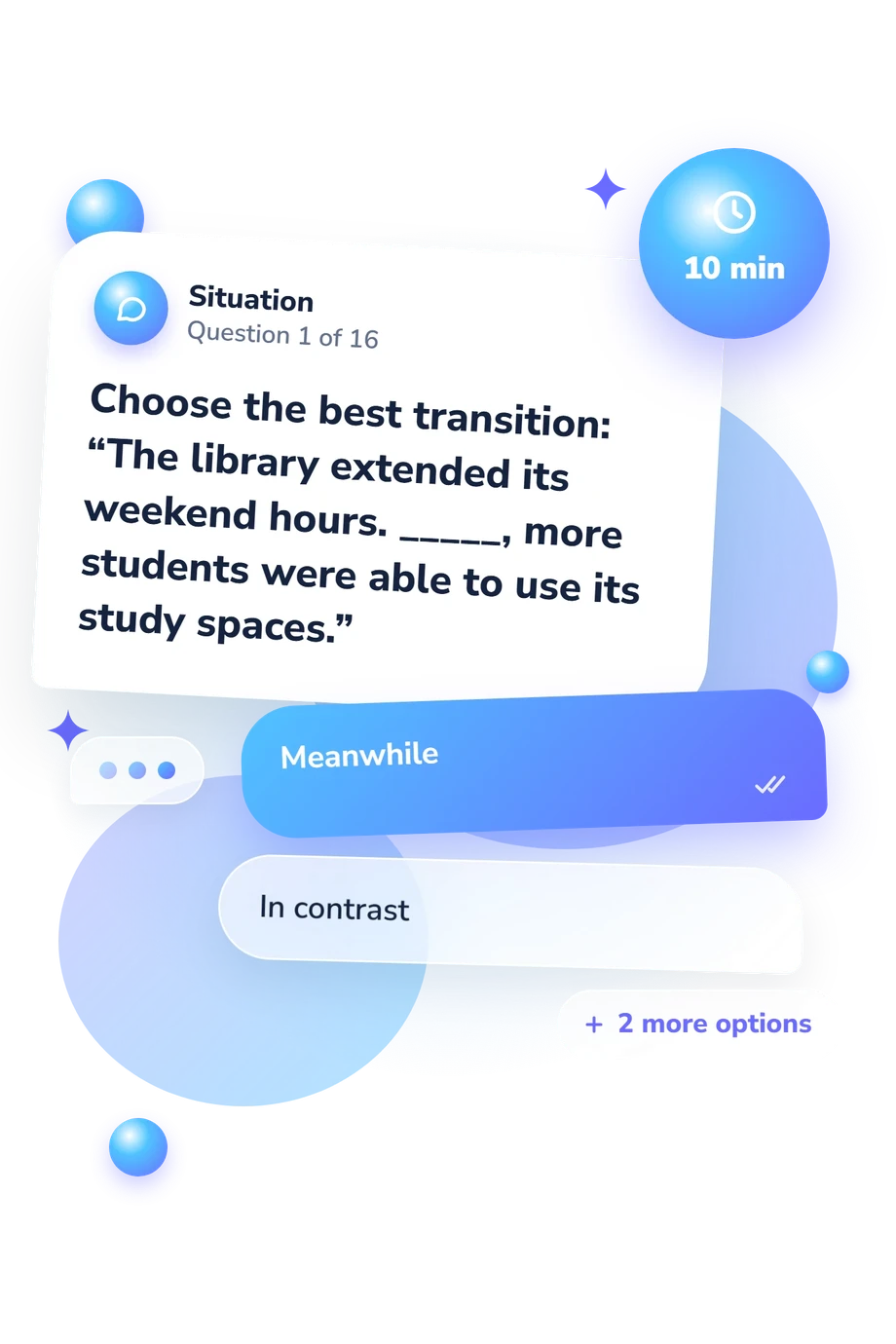
- Meanwhile
- In contrast
- For example
- As a result
- To repeat the essay title in a complete sentence
- To list every fact that will appear in the paragraph
- To state the paragraph’s central point or controlling idea
- To provide the paragraph’s most detailed evidence
- Cycling can add regular physical activity to a commuter’s day.
- A bicycle may cost less to maintain than a car.
- Replacing short car trips with bicycle trips can reduce fuel use.
- Many professional cycling races include mountain stages.
Paragraph Quiz - Description and methodology of the test
Readers deciding whether to revisit academic writing skills can use this paragraph quiz to gauge whether their current understanding is ready for more advanced practice. For learners, writers, and teachers, this paragraph writing quiz offers a concise educational snapshot that can inform whether independent review or more guided instruction is the sensible next step. The result gives that decision a starting point without claiming to represent every writing ability.
What This Assessment Explores
The assessment examines paragraph knowledge through choices about focus, support, cohesion, and order. Questions ask readers to identify a controlling idea, match evidence to a claim, remove irrelevant material, clarify references, and arrange information logically. Together, these tasks show how a paragraph becomes unified and easy to follow.
The questions sample four areas:
- Focus shows whether a paragraph has a clear central point.
- Support shows whether examples and explanations develop that point.
- Cohesion shows how references, repeated terms, and transitions link sentences.
- Organization shows whether ideas progress logically through time, steps, or space.
The result is reported as Paragraph Knowledge (0-16): Foundations to strengthen (0-6), Developing knowledge (7-12), or Strong knowledge (13-16). It reflects performance on these questions, not every aspect of writing skill. The result can guide review of paragraph structure, showing which principles need attention after completing this paragraph structure quiz.
Methodology and Scientific Basis
Each of the 16 items uses four-option multiple choice. The respondent chooses the best transition, revision, supporting sentence, topic sentence, reference, or sequence for a short writing situation. The score summarizes performance across these selected-response tasks; its bands describe recognized paragraph-building principles, not guaranteed writing success.
Content is conceptually consistent with Siekmann, Parr, and Busse (2022), whose work treats structure and coherence as important aspects of text quality. It also aligns with Otani’s emphasis on topic sentences and with Halliday and Hasan’s account of cohesion through reference, conjunction, and lexical links. The questionnaire is an educational quiz built around these writing concepts, not a standardized adaptation of any one cited instrument.
The items direct review toward paragraph organization, so the result points to a specific next area of practice. A stronger result indicates accurate recognition in the tested examples, while a lower result may show which principles need more attention. The displayed bands reflect performance on these questions rather than every aspect of writing skill. Since respondents select answers rather than compose and revise paragraphs, it cannot capture every aspect of actual writing performance.
- Siekmann, Lea, Judy M. Parr, and Vera Busse. "Structure and coherence as challenges in composition: A study of assessing less proficient EFL writers’ text quality." Assessing Writing, vol. 54, 2022, article 100672. 10.1016/j.asw.2022.100672
- Otani, Kayoko. "English Paragraph Writing Instruction with Emphasis on the Topic Sentence." Yamano aesthetic archives, vol. 8, 2000, pp. 25-33. 10.24714/yca.8.0_25
- Halliday, Michael A. K., and Ruqaiya Hasan. Cohesion in English. Longman, 1976. 10.4324/9781315836010
Updated: