
Naughty Quiz
How the Scales are Structured
Who Usually Takes This Test?
See How You Compare
Below is a preview of how scores are typically distributed across each scale.
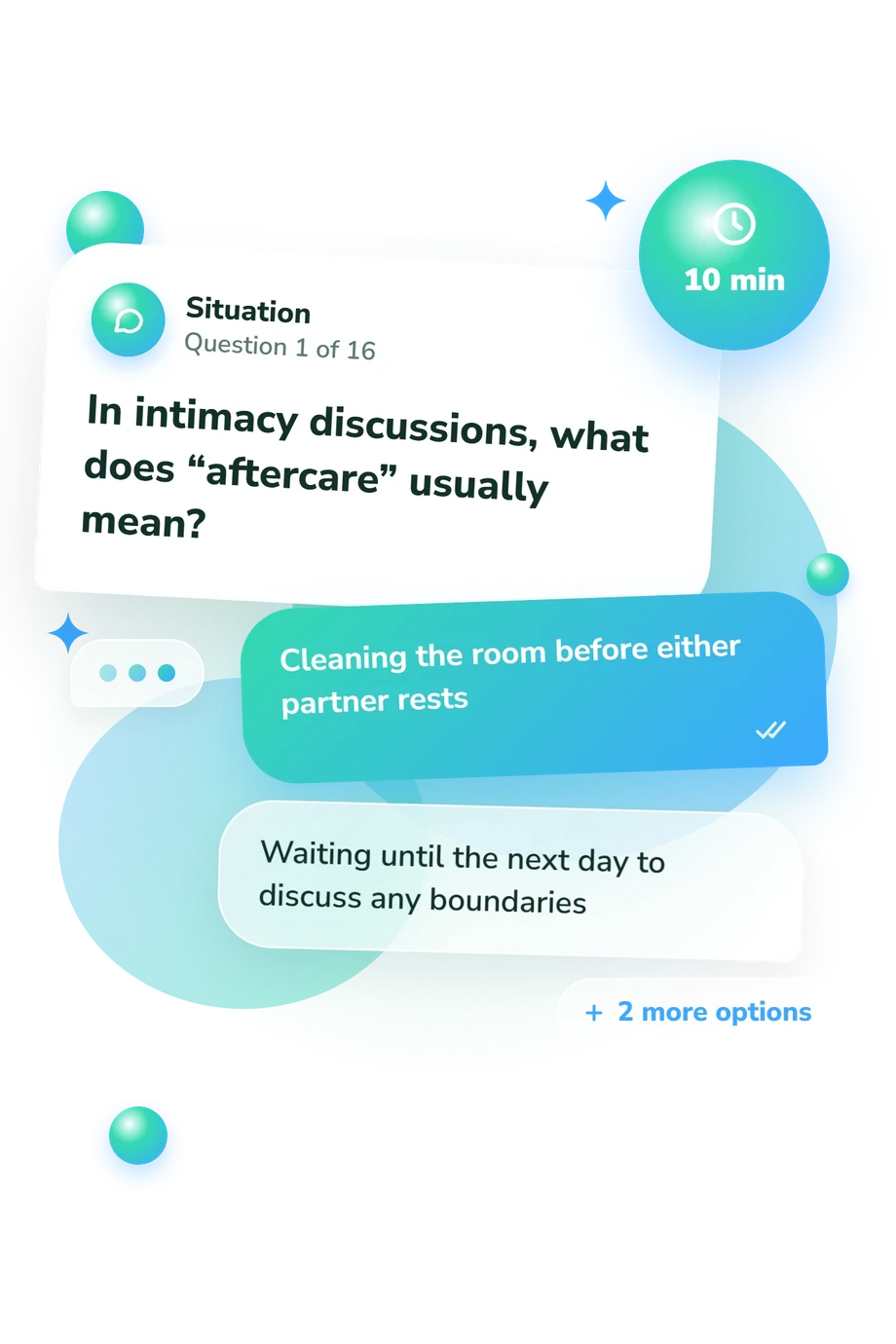
Example Questions From the Test
- Remove their name so permission is unnecessary
- Get the sender's explicit permission
- Wait a few days and then assume it is acceptable
- Share it only with someone who promises not to save it
- Oil-based body lotion
- Plain water-based lubricant
- A lubricant labeled as compatible with latex
- A small amount of silicone-based lubricant
- It refers only to the small external tip that can be seen
- It is another name for the vaginal opening
- Much of its structure extends internally beyond the visible glans
- Its primary anatomical role is controlling urination
Naughty Quiz - Description and methodology of the test
People seeking a practical check of sexual-health knowledge can use this naughty quiz to explore consent, anatomy, safer intimacy, communication, desire, and pleasure. It is intended for readers who want a learning snapshot, with results that highlight concepts to review rather than label experience or personality. Framed around whether you are naughty, the quiz treats “naughty” as informed, respectful knowledge rather than character.
What This Assessment Explores
The questionnaire measures sexual-health knowledge through situations involving consent, boundaries, anatomy, safer sex, desire, arousal, fantasy, and relationship context. It asks whether respondents recognize accurate principles, not whether they have particular experiences or preferences.
Viewed as a how naughty are you quiz, this questionnaire gives readers a knowledge profile focused on sexual-health knowledge. Correct answers show topics understood, while missed answers identify areas to review. The sole displayed scale is Naughty Knowledge (0-16). The score uses these result bands:
- Curious Starter (0-6) indicates that foundational concepts may need more attention.
- Savvy Explorer (7-12) indicates useful knowledge alongside some gaps or misconceptions to revisit.
- Naughty-Knowledge Ace (13-16) indicates strong understanding across communication, pleasure, and safer choices.
The labels describe performance on this educational questionnaire, not sexual experience, maturity, or personal worth.
Methodology and Scientific Basis
Each item presents a scenario or factual question with four answer choices. The format tests recognition of a best-supported answer: consent depends on active agreement, image sharing requires permission, and safer choices depend on context. The total is the number of correct answers, creating a transparent knowledge score rather than a weighted personality profile.
As a short naughty knowledge quiz about sexual health, the test is conceptually consistent with the Acquired Sexual Knowledge Questionnaire (Mainella et al., 2026), but it is not presented as an adaptation of that instrument. Its content also fits the approach used in sexuality-knowledge questionnaires examined by Sanz-Martos et al. (2019) and Acharya et al. (2016), which use structured items to assess understanding of sexual-health concepts.
The displayed categories are fixed, test-specific result ranges that organize correct-answer totals into descriptive levels; they are not clinical cutoffs or population norms. Results may reflect guessing, wording, prior education, cultural context, and current recall. Missed items are best treated as prompts for reliable learning, while the score remains a limited snapshot of sexual-health knowledge relevant to decision-making and communication.
- Mainella, Alexandra Kriofske, Craig Miller, Bianca Tocci, and Callie Koziol. "Development and Evaluation of the Acquired Sexual Knowledge Questionnaire: A Pilot of a New Measure of Sexual Health Knowledge." American Journal of Sexuality Education, 21(1), 34-50, 2026. 10.1080/15546128.2024.2429425
- Sanz-Martos, Sebastian, Isabel M. López-Medina, Cristina Álvarez-García, and Carmen Álvarez-Nieto. "Sexuality and contraceptive knowledge in university students: instrument development and psychometric analysis using item response theory." Reproductive Health, 16, 127, 2019. 10.1186/s12978-019-0791-9
- Acharya, Dev Raj, Malcolm Thomas, and Rosemary Cann. "Validation of a questionnaire to measure sexual health knowledge and understanding (Sexual Health Questionnaire) in Nepalese secondary school: A psychometric process." Journal of Education and Health Promotion, 5, 1-10, 2016. 10.4103/2277-9531.184560
Updated: