
Musculoskeletal Anatomy Quiz
How the Scales are Structured
Who Usually Takes This Test?
See How You Compare
Below is a preview of how scores are typically distributed across each scale.
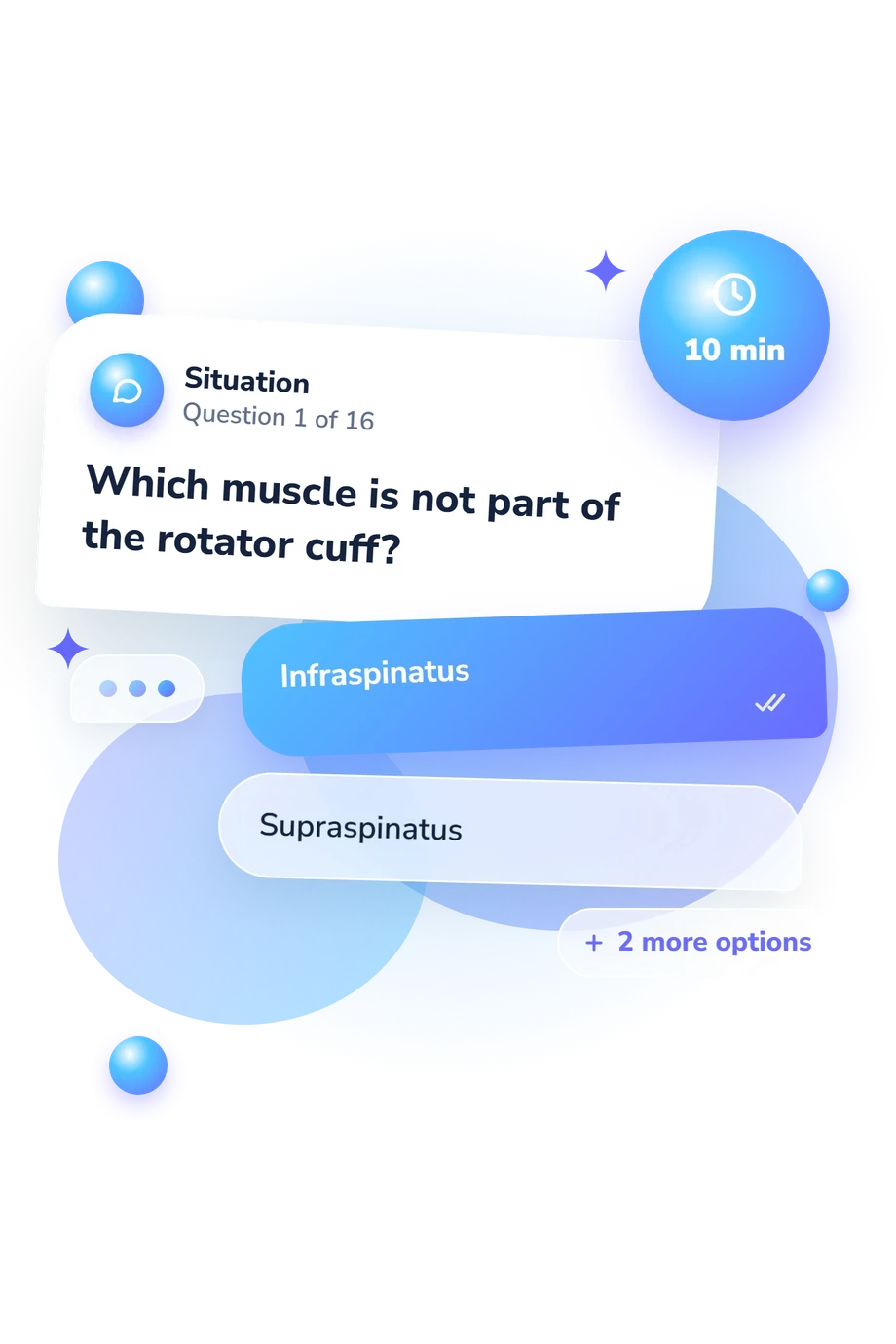
Example Questions From the Test
- Infraspinatus
- Supraspinatus
- Subscapularis
- Teres major
- Tibialis posterior and flexor digitorum longus
- Gastrocnemius and soleus
- Fibularis longus and fibularis brevis
- Popliteus and plantaris
- Quadriceps femoris
- Hip adductors
- Triceps surae
- Hamstrings
Musculoskeletal Anatomy Quiz - Description and methodology of the test
Students, trainees, educators, and curious learners can use this assessment to check how accurately they identify and connect anatomical structures with movement and clinical-style scenarios. The musculoskeletal anatomy quiz is useful when you want a focused snapshot before revising regional anatomy. As a musculoskeletal system quiz, it helps identify strengths and topics that deserve closer study.
What This Assessment Explores
Questions examine the skeleton, muscle actions, joints, connective tissues, and nerve relationships. They often link a structure with movement, attachment, innervation, or injury, combining recall with functional understanding. The musculoskeletal quiz suits anatomy review and checks whether core relationships are secure.
The question themes can be understood through four areas:
- Bone organization shows whether you can distinguish axial and appendicular structures and key articulations.
- Muscle function shows whether you can match actions, tendons, insertions, and regional anatomy.
- Joint and connective-tissue knowledge shows whether you recognize joint types, cartilage, ligaments, and disc structures.
- Nerve and injury relationships show whether you can link a movement problem or lesion with the likely structure.
Results use Musculoskeletal Anatomy Knowledge (0-16): Foundations to review (0-6), Developing knowledge (7-12), or Strong knowledge (13-16). These are educational practice bands, not professional competency ratings.
Methodology and Scientific Basis
Each item presents four multiple-choice options. Some questions ask for direct identification, while others use movement, tendon, nerve, joint, or injury scenarios. This format checks both recall and the ability to apply anatomical relationships in a short clinical-style context.
The displayed output is one overall scale, summarizing performance across the tested structures, actions, and relationships. As a short MSK quiz, it provides a compact knowledge check: a stronger band suggests broader command of the tested relationships, while a lower band identifies topics to revisit.
Its closest research reference is the MSK anatomy knowledge test (Hulme et al., 2020), which examined retention of musculoskeletal limb knowledge in chiropractic education. This questionnaire is conceptually consistent with that work, not an adaptation of the published test. Gray's and Moore's anatomy textbooks supply reference points for the structures, actions, joints, and clinical correlations assessed here. Interpret the result as a study guide for these tested topics and a prompt for continued review, rather than a measure of professional readiness; performance may also vary with revision, attention, guessing, and self-awareness.
- Hulme AK, Luo K, Štrkalj G. Musculoskeletal Anatomy Knowledge Retention in the Macquarie University Chiropractic Program: A Cross-Sectional Study. Anatomical Sciences Education. 2020;13(2):182-191. 10.1002/ase.1879
- Drake RL, Vogl AW, Mitchell AWM. Gray's Anatomy for Students. 5th ed. Elsevier; 2023.
- Moore KL, Dalley AF II, Agur AMR. Moore's Clinically Oriented Anatomy. 9th ed. Wolters Kluwer; 2023.
Updated: