
Logical Reasoning Quiz
How the Scales are Structured
Who Usually Takes This Test?
See How You Compare
Below is a preview of how scores are typically distributed across each scale.
Example Questions From the Test
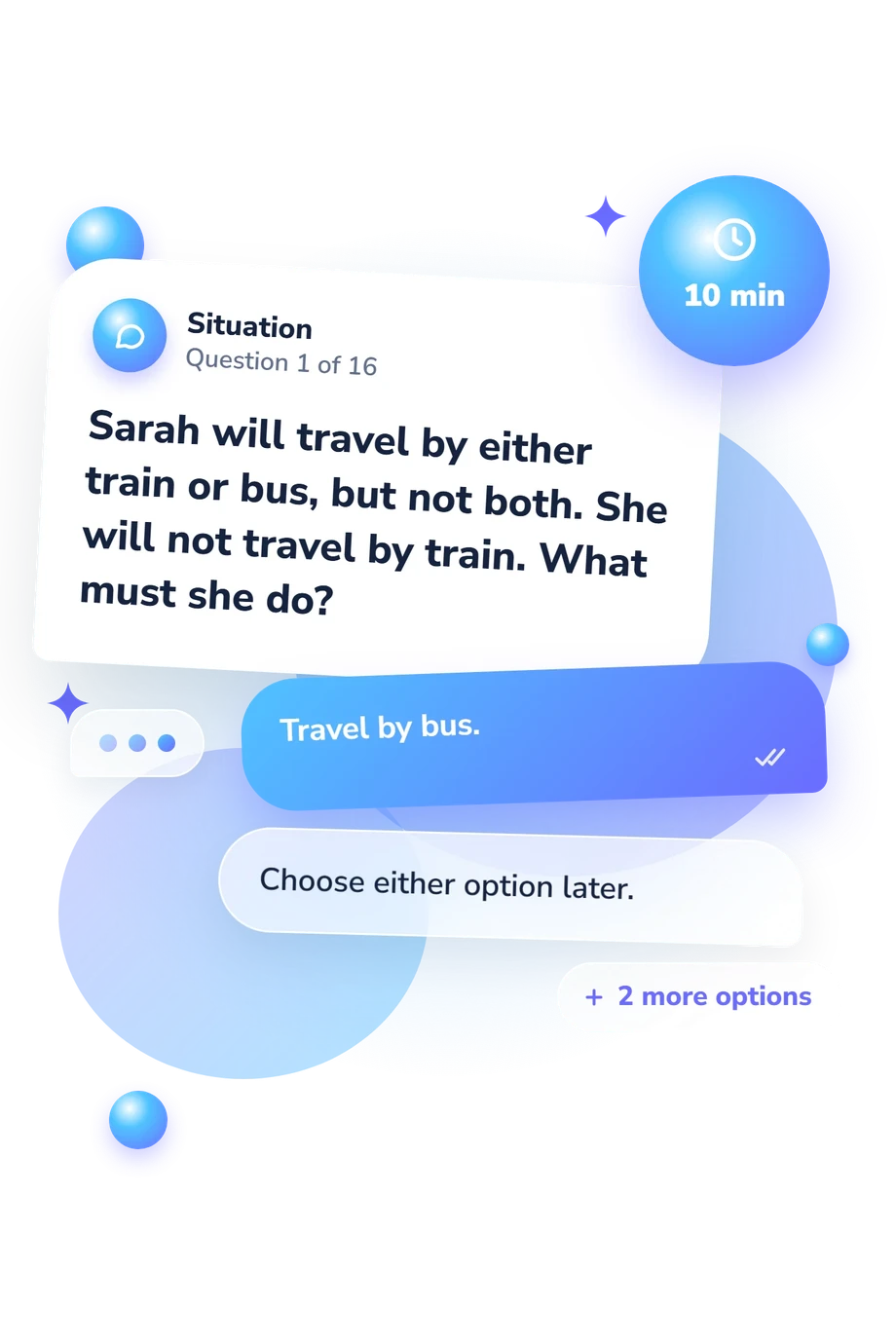
- Travel by bus.
- Choose either option later.
- Travel by both methods on different legs.
- Cancel the journey.
- A red token that is small
- A blue token that is small
- A square token that is large
- A non-red token that is square
- The order of Ana and Cara cannot be determined.
- Ana finished before Cara.
- Ben finished after Cara.
- Cara finished before Ana.
Logical Reasoning Quiz - Description and methodology of the test
Readers who want to examine how they draw conclusions from rules, categories, and evidence can use this logical reasoning quiz as a focused learning exercise. It suits anyone curious about the use of logical principles in everyday judgments, classroom problems, or workplace decisions. A quiz about reasoning can make strengths and less secure areas easier to notice, giving you a practical starting point for deliberate practice.
What This Assessment Measures
The questions focus on short logical situations rather than personal history. They ask what must follow, what cannot coexist, how statements relate, and when evidence supports only a cautious conclusion. The main result is organized around these themes:
- Conditional rules show whether you track what follows from if-then and if-and-only-if statements.
- Set relations show how you handle all, no, and some claims, including impossible combinations.
- Ordering tasks show whether necessary before-after and older-younger relations remain intact.
- Argument evaluation shows whether you distinguish deduction, induction, correlation, causation, and common fallacies.
These themes feed Logical Reasoning Knowledge, a 0-16 scale with Foundations (0-6), Developing (7-12), and Strong (13-16) bands. In an online reasoning quiz, this result can highlight the principles you handle confidently and the distinctions worth revisiting, while remaining an educational snapshot rather than a standardized intelligence or cognitive-ability test.
Methodology and Evidence Base
Each item presents a short scenario, rule, ordering problem, or argument with four answer choices. You select the conclusion best supported by the wording, not the most plausible everyday guess. Responses produce the single displayed knowledge result, which is interpreted through the named band.
Its demands are conceptually aligned with the related deductive-reasoning demands in GSR-V (Rahayu & Seniati, 2024), but this questionnaire is not presented as an adaptation of that instrument. Reverberi et al. (2010) helps frame its conditional and syllogistic tasks, while Johnson-Laird (2010) explains deduction through the construction and testing of mental models. These sources support emphasis on premise integration, necessary conclusions, and invalid inferences.
The result works as a logic skills assessment for self-checking and practice. Performance can shift with concentration, familiarity with formal wording, and careful attention to qualifiers such as all, no, some, or only, especially when several premises must be combined. No normative comparison is provided, so the result describes performance on the assessed principles within this questionnaire.
- Rahayu, Dwi Ayu Puji, and Ali Nina Liche Seniati. “Psychometric Properties of The General Sequential Reasoning Verbal Test (GSR-V): Deductive Reasoning Ability Test.” Psikostudia: Jurnal Psikologi, 13(2), 2024, 283-291. 10.30872/psikostudia.v13i2.15117
- Reverberi, Carlo, Paolo Cherubini, Richard SJ Frackowiak, Carlo Caltagirone, Eraldo Paulesu, and Emiliano Macaluso. “Conditional and syllogistic deductive tasks dissociate functionally during premise integration.” Human Brain Mapping, 31(9), 2010, 1430-1445. 10.1002/hbm.20947
- Johnson-Laird, Philip N. “Deductive reasoning.” WIREs Cognitive Science, 1(1), 2010, 8-17. 10.1002/wcs.20
Updated: