
Is My Friend Toxic Quiz
How the Scales are Structured
Who Usually Takes This Test?
See How You Compare
Below is a preview of how scores are typically distributed across each scale.
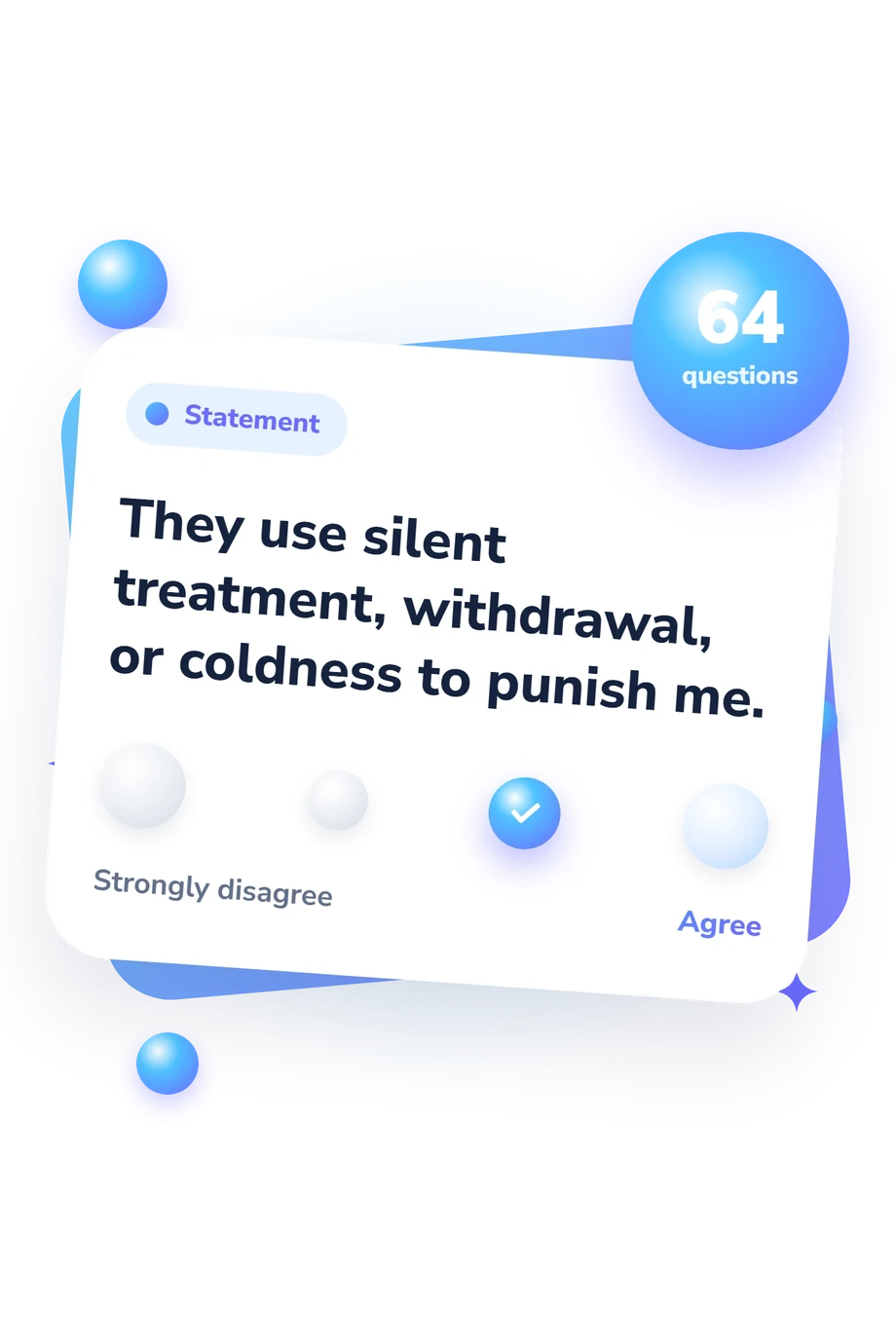
Example Questions From the Test
- Strongly disagree
- Disagree
- Not sure
- Agree
- Strongly disagree
- Disagree
- Not sure
- Agree
- Strongly disagree
- Disagree
- Not sure
- Agree
Is My Friend Toxic Quiz - Description and methodology of the test
Anyone questioning whether a friendship feels safe, reciprocal, or increasingly difficult may use the Is My Friend Toxic Quiz to organize experiences that are easy to minimize. It is intended for someone reflecting on one specific friendship, especially when pressure, guilt, criticism, or emotional unease has become hard to explain. With one friendship in view, this toxic friendship quiz organizes experiences so a recurring pattern is easier to reflect on.
What This Assessment Explores
The assessment examines recurring patterns around boundaries, emotional safety, reciprocity, and conflict. Questions address pressure to disclose, withdrawal as punishment, jealousy, control, criticism, guilt, and responsibility for another person’s emotions. Other items ask about listening, empathy, accountability, repair, celebrating success, and dependable support. Framed as a quiz about signs of a toxic friend, it considers harmful experiences alongside qualities that may protect a friendship.
These are the three result dimensions:
- Boundary Strain (0-30) measures difficulty setting, communicating, and maintaining limits: Low strain 0-10; Moderate strain 11-20; High strain 21-30.
- Support & Respect (0-40) reflects mutual care, accountability, empathy, reciprocity, and repair: Low Support 0-19; Mixed Support 20-29; Strong Support 30-40.
- Toxicity Red Flags (0-40) reflects frequent or intense harmful patterns, including manipulation, violations, jealousy, negativity, and one-sided effort: Low red flags 0-13; Moderate red flags 14-26; High red flags 27-40.
Methodology and Scientific Basis
The sample uses four choices-Strongly disagree, Disagree, Not sure, or Agree-and asks respondents to judge one friendship. This self-report format captures perceived patterns, so results depend on how the person understands and recalls interactions.
Responses combine into displayed scales; higher strain and red-flag scores indicate more difficulty or harm, while higher supportive scores indicate protective qualities. The questionnaire displays bands as interpretive ranges for each scale.
The closest reference is the Friendship Victimization Scale for Adolescents (Dryburgh et al., 2025). It is conceptually consistent with research on harmful friendship experiences, not an adaptation of that instrument. The 2023 friendship-victimization measure for emerging adults and the Friendship Qualities Scale (Bukowski, Hoza, and Boivin, 1994) support considering both victimization and positive qualities. As a quiz about signs of a toxic friendship, this questionnaire is conceptually consistent with the cited constructs, not presented as an adaptation or validated online version of those instruments.
Interpret the profile as a pattern, not a fixed label. Context, memory, self-awareness, and favorable self-presentation can influence answers; use the result to clarify boundaries, reciprocity, and next steps.
- Nicole S. J. Dryburgh, Alexa Martin-Storey, Wendy M. Craig, Brett Holfeld, and Melanie A. Dirks. (2025). Quantifying Toxic Friendship: A Preliminary Investigation of a Measure of Victimization in the Friendships of Adolescents. Journal of Interpersonal Violence, 40(7-8), 1800-1823. 10.1177/08862605241265418
- Nicole S. J. Dryburgh, Alexa Martin-Storey, Wendy M. Craig, and Melanie A. Dirks. (2023). The Development and Preliminary Validation of a Measure of Victimization within the Friendships of Emerging Adults. Journal of Social and Personal Relationships, 40(7), 2204-2226. 10.1177/02654075221142631
- William M. Bukowski, Betsy Hoza, and Michel Boivin. (1994). Measuring Friendship Quality During Pre- and Early Adolescence: The Development and Psychometric Properties of the Friendship Qualities Scale. Journal of Social and Personal Relationships, 11(3), 471-484. 10.1177/0265407594113011
Updated: