
Is He Secretly in Love with Me Quiz
How the Scales are Structured
Who Usually Takes This Test?
See How You Compare
Below is a preview of how scores are typically distributed across each scale.
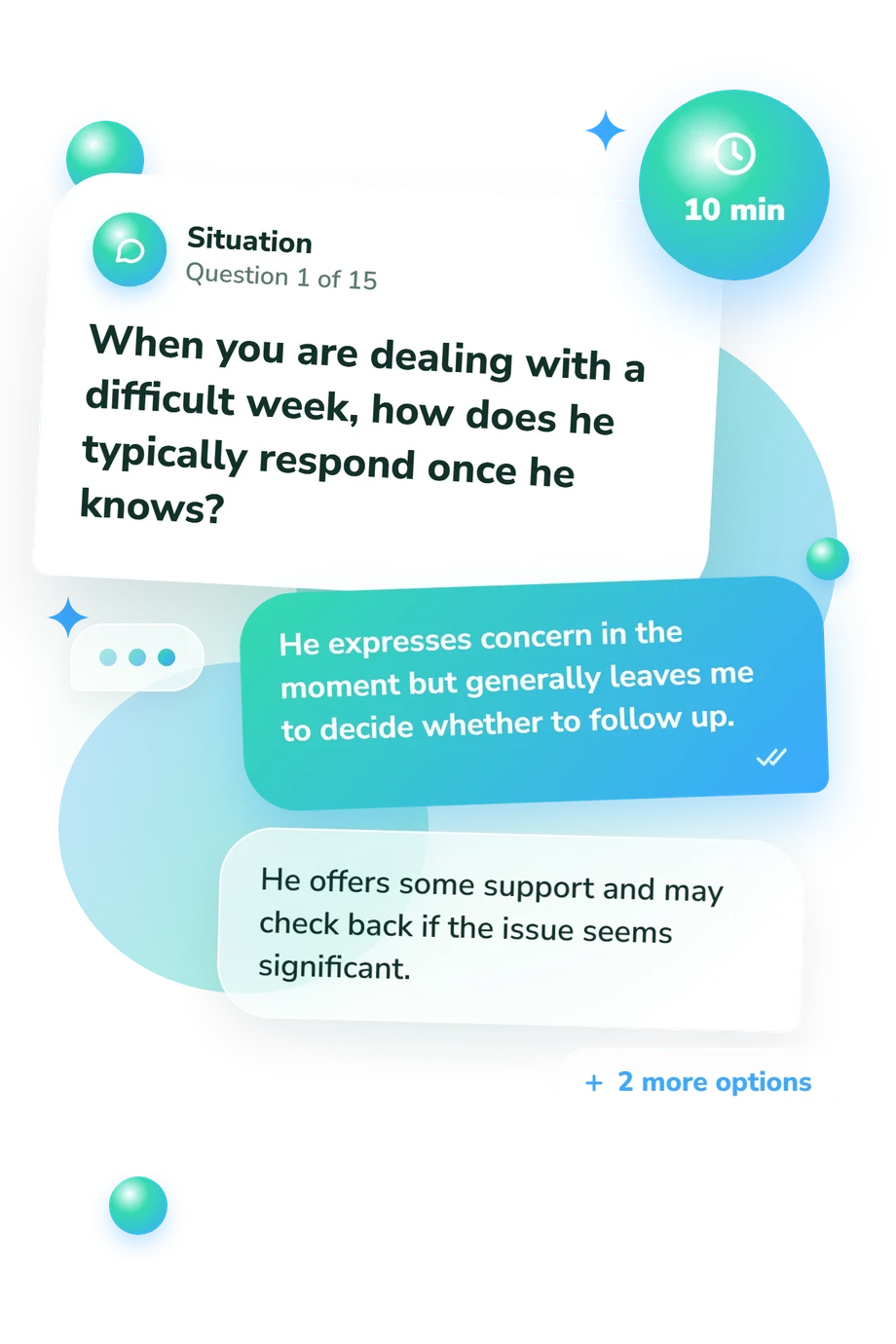
Example Questions From the Test
- He expresses concern in the moment but generally leaves me to decide whether to follow up.
- He offers some support and may check back if the issue seems significant.
- He acknowledges it politely, much as he would for a casual acquaintance.
- He makes a sustained effort to listen, help, or check on me in ways that fit what I need.
- He may remember if the topic comes up again, but usually does not refer to it himself.
- He often remembers and follows up or uses the detail in a thoughtful way.
- He remembers important details more reliably than minor ones.
- He generally seems not to retain personal details I share.
- Regularly, including simply to share something or spend time together.
- Sometimes, but initiation is fairly balanced or inconsistent.
- Occasionally, usually when something specific reminds him of me.
- Rarely; most contact begins with me or with a practical reason.
Is He Secretly in Love with Me Quiz - Description and methodology of the test
For someone facing uncertainty about a complicated connection, the Is He Secretly in Love with Me Quiz offers a structured look at his behavior. Possible signs of romantic interest are examined through his attention, openness, and plans rather than treated as proof that he is secretly in love with me. The result creates a three-part profile of investment, intimacy, and romantic direction.
What This Assessment Explores
Questions examine effort, personal detail, emotional disclosure, repair, future planning, and romantic framing. They suit someone assessing an existing connection, not one isolated interaction.
Within a does he secretly have a crush on me quiz, closeness and investment are considered alongside romantic clues.
These scales describe the result:
- Consistent Investment (0-15) shows occasional, mixed, or strong follow-through; bands are Limited pattern 0-5, Mixed investment 6-10, and Strong investment 11-15. The highest band signals importance, not proof of love.
- Emotional Intimacy (0-15) shows guarded, growing, or deep sharing; bands are Guarded connection 0-5, Growing closeness 6-10, and Deep closeness 11-15. The highest band can also describe friendship.
- Romantic Direction (0-15) shows undefined, ambiguous, or clear romantic movement; bands are Undefined direction 0-5, Ambiguous possibility 6-10, and Clear romantic direction 11-15. The highest band suggests intent, not love.
Methodology and Evidence Base
Each item presents a relationship situation with four response options. The respondent selects the description that best matches his typical behavior, so the result draws on patterns across support, contact, vulnerability, conflict, plans, and attraction rather than one memorable moment.
Answers produce three displayed scale scores, but the questionnaire does not specify how options map to points. Read each band as given rather than reverse-engineering it.
Place et al. (2009) offer the closest conceptual comparison: people can judge another person's romantic interest, but such judgments are not confirmation. The intimacy content is conceptually consistent with Laurenceau et al. (1998), which emphasizes self-disclosure, partner disclosure, and perceived responsiveness. Its focus on closeness also aligns with Berscheid, Snyder, and Omoto (1989). This questionnaire is conceptually consistent with these works, not an adaptation of them.
The central question-does he have feelings for me-is examined through observable behavior, not private motives. This questionnaire has no stated norms or standardized scoring. The respondent's observations and interpretations of his behavior may reflect context, selective attention, wishful interpretation, and limited self-awareness; conversation may add information the items cannot.
- Place, Skyler S., Peter M. Todd, Lars Penke, and Jens B. Asendorpf. (2009). The Ability to Judge the Romantic Interest of Others. Psychological Science, 20(1), 22-26. 10.1111/j.1467-9280.2008.02248.x
- Laurenceau, Jean-Philippe, Lisa Feldman Barrett, and Paula R. Pietromonaco. (1998). Intimacy as an Interpersonal Process: The Importance of Self-Disclosure, Partner Disclosure, and Perceived Partner Responsiveness in Interpersonal Exchanges. Journal of Personality and Social Psychology, 74(5), 1238-1251. 10.1037/0022-3514.74.5.1238
- Berscheid, Ellen, Mark Snyder, and Allen M. Omoto. (1989). The Relationship Closeness Inventory: Assessing the Closeness of Interpersonal Relationships. Journal of Personality and Social Psychology, 57(5), 792-807. 10.1037/0022-3514.57.5.792
Updated: