
How Smart Is My Cat Quiz
How the Scales are Structured
Who Usually Takes This Test?
See How You Compare
Below is a preview of how scores are typically distributed across each scale.
Example Questions From the Test
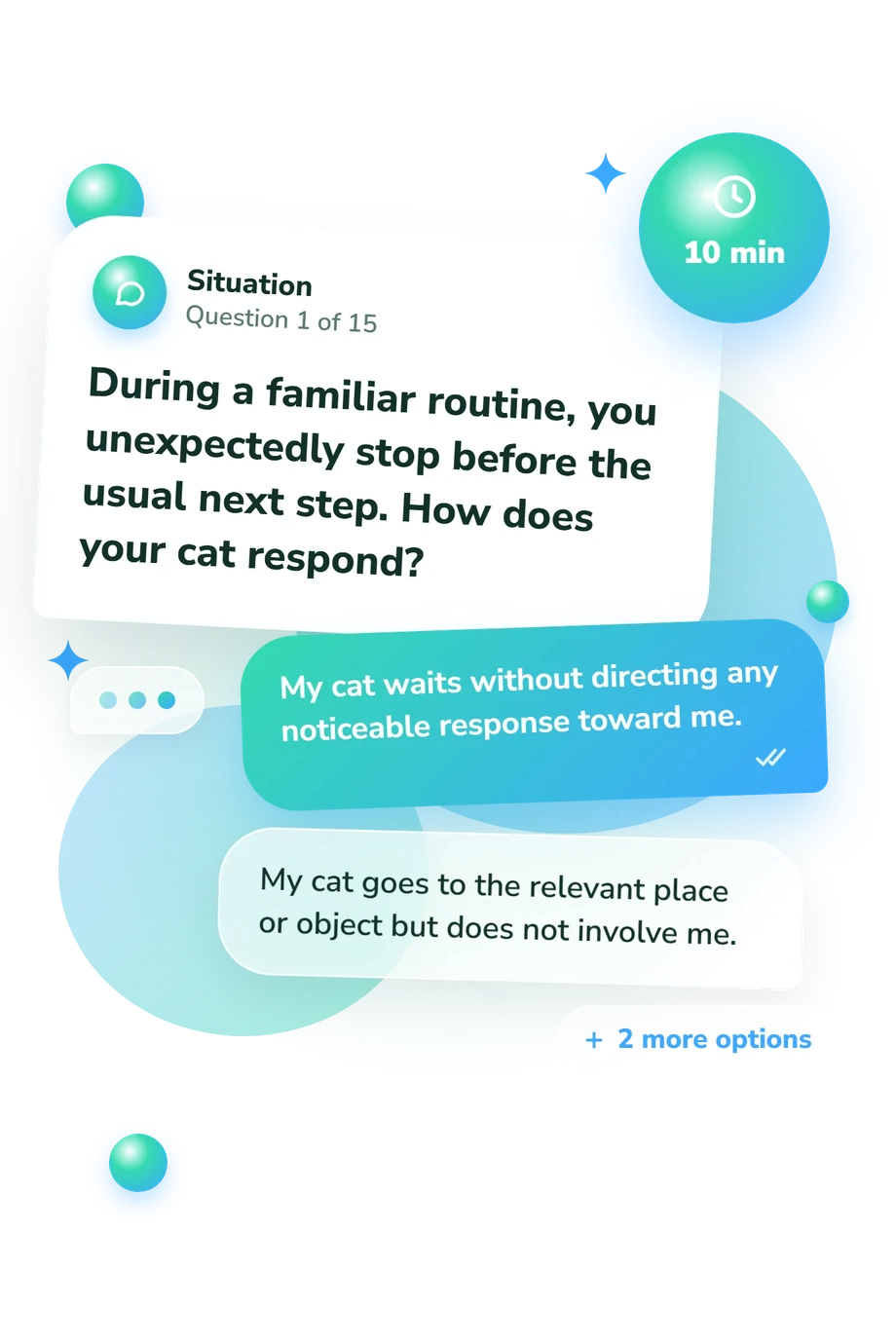
- My cat waits without directing any noticeable response toward me.
- My cat goes to the relevant place or object but does not involve me.
- My cat looks between me and the relevant place or object.
- My cat uses a targeted signal and adjusts it if I do not respond.
- A consistent name-specific response, such as an ear turn, head turn, gaze, or approach.
- A response mainly when other cues, such as food preparation, are present.
- No reliable response to either the name or surrounding speech.
- A stronger response to the name than to most other words, though not every time.
- Tries the familiar path repeatedly, then settles somewhere else.
- Quickly chooses another route or safely moves around the obstacle.
- Pauses until the path is restored, without showing much interest in another route.
- Explores the obstacle and finds an alternative after some trial and error.
How Smart Is My Cat Quiz - Description and methodology of the test
For cat owners curious about everyday behavior, the How Smart Is My Cat Quiz offers a structured way to turn repeated observations into a clearer profile of a familiar companion. It suits readers who want a practical cat IQ quiz for noticing patterns and supporting more attentive interaction, without reducing an animal to a single number. The result can guide reflection on how a cat responds to people, routines, and changing situations.
What This Assessment Explores
These items use familiar home situations to examine how a cat reads people, learns from outcomes, remembers useful patterns, and adjusts when routines or surroundings change. They are intended for owners who can report repeated behavior, not isolated performances.
The profile summarizes observed behavior across these three dimensions rather than assigning a fixed intelligence ranking. This cat cognition assessment describes patterns, not overall intelligence. Its three dimensions are:
- Communication & Social Reading (0-15) shows attention to people and signals: Subtle signals (0-5), Clear in familiar contexts (6-10), Strong social reading (11-15).
- Learning & Problem-Solving (0-15) shows experimentation and workable strategies: Subtle evidence (0-5), Situational learner (6-10), Strong observed problem-solving (11-15).
- Memory & Flexible Adaptation (0-15) shows retained patterns and adjustment: Familiarity-focused (0-5), Context-dependent adaptation (6-10), Strong observed flexibility (11-15).
Methodology and Evidence Base
Each item presents a familiar scenario with four response choices describing distinct reactions, including visible response, anticipation, exploration, or adaptation. Thematic answers are combined into the three displayed scale totals. Results are presented as three structured summaries of reported behavior, without population norms or a validated intelligence ranking.
Its owner-report method connects everyday observation with cat cognition research. The review by Vitale Shreve and Udell (2015) provides background on cat-cognition research; related themes align conceptually with human-gaze findings from Pongrácz, Szapu, and Faragó (2019), memory research by Takagi et al. (2017), and problem-solving work by Foerder and Howard (2024). This questionnaire is conceptually consistent with those cited studies, not a reproduction or adaptation of them.
Owners interested in cat problem-solving behavior can use the questionnaire to organize patterns across familiar situations, but it has no stated clinical norms or independent standardization. Motivation, stress, age, mobility, hearing, vision, social history, environment, and observer interpretation can affect scores. Treat the result as a context-dependent behavioral snapshot, not a diagnosis or definitive measure of overall intelligence.
- Kristyn R. Vitale Shreve and Monique A. R. Udell. "What's inside your cat's head? A review of cat (Felis silvestris catus) cognition research past, present and future." Animal Cognition, 18(6), 1195-1206 (2015). 10.1007/s10071-015-0897-6
- Péter Pongrácz, Julianna Szulamit Szapu, and Tamás Faragó. "Cats (Felis silvestris catus) read human gaze for referential information." Intelligence, 74, 43-52 (2019). 10.1016/j.intell.2018.11.001
- Saho Takagi, Mana Tsuzuki, Hitomi Chijiiwa, Minori Arahori, Arii Watanabe, Atsuko Saito, and Kazuo Fujita. "Use of incidentally encoded memory from a single experience in cats." Behavioural Processes, 141, 267-272 (2017). 10.1016/j.beproc.2016.12.014
- Preston Foerder and Mary C. Howard. "Effects of Socialization on Problem Solving in Domestic Cats." Animals, 14(17), 2604 (2024). 10.3390/ani14172604
Updated: