
How Many People Have a Crush on Me Quiz

Understand how much romantic interest you may be getting lately. Take this How Many People Have a Crush on Me Quiz to get a playful range plus tips to spot flirting cues and build confidence without overthinking.
Start Online Test
Questions8110 minutes
Hi! My name is Freudly, i am an AI therapist, I will give you an interpretation of the test after you complete it.
08:30
March 25, 2026
March 25, 2026
Material has been updated
752 views
1,215 completions
28 likes
Verified by Daniel Hall
Psychologist with 25 years of experience
Share
Scale Explorer

How the Scales are Structured

example score
10/20
Approachability & Social Visibility (A&SV)
Measures how often you’re socially visible and give off an open, approachable vibe that makes others comfortable initiating contact.
Low visibility
Moderate visibility
High visibility
0NaNLow visibility8NaNModerate visibility15NaNHigh visibility
A score of 10 suggests you’re moderately visible and approachable, so people may notice you in some settings but you’re not consistently in situations that invite frequent approaches.
example score
6/10
Estimated Crush Count (ECC)
This scale estimates how many people may currently have a crush on you based on observable social signals like attention, approaches, and lingering interest.
Low signals
Moderate signals
High signals
0NaNLow signals4NaNModerate signals8NaNHigh signals
A score of 6 falls in the Moderate signals range, suggesting a noticeable but not overwhelming level of potential romantic interest from people around you.
example score
8/20
Flirting Signal Clarity (FSC)
Measures how clear and consistent the flirting or romantic-interest cues around you seem in everyday interactions.
Mixed/Subtle Signals
Noticeable Signals
Clear/Consistent Signals
09Mixed/Subtle Signals1015Noticeable Signals1620Clear/Consistent Signals
A score of 8 suggests the interest cues you notice tend to be subtle or inconsistent, making them harder to interpret with confidence.
Start Online Test
just completed the test
DATA-BASED USER COHORTS

Who Usually Takes This Test?

Flirting Signal Overthinkers
41%OF USERS
People who keep replaying conversations and want a playful reality check on whether the attention they notice is actually flirting.
Confidence Boost Seekers
34%OF USERS
People who want a quick, fun estimate of their romantic appeal and a little encouragement to feel more self-assured.
Social Circle Navigators
25%OF USERS
People in school, work, or friend groups who suspect someone likes them and want help reading everyday cues without making it awkward.
BASED ON AGGREGATED, ANONYMIZED DATA FROM TENS OF THOUSANDS OF FREUDLY USERS.
Benchmarking

See How You Compare

Once you complete the test, your results are compared with real-world data from people in your country.
Below is a preview of how scores are typically distributed across each scale.
Approachability & Social Visibility (A&SV)
Average
7.4
Normal range
410.8
min.
0
max.
20
Majority
This curve shows how scores are typically distributed.
Once you complete the test, your result will appear on the scale so you can see how you compare.
Estimated Crush Count (ECC)
Average
7.2
Normal range
5.49
min.
0
max.
10
Majority
This curve shows how scores are typically distributed.
Once you complete the test, your result will appear on the scale so you can see how you compare.
Flirting Signal Clarity (FSC)
Average
10.2
Normal range
6.813.7
min.
0
max.
20
Majority
This curve shows how scores are typically distributed.
Once you complete the test, your result will appear on the scale so you can see how you compare.
Featured On
CLEAR ANSWERS TO COMMON QUESTIONS

Frequently Asked Questions

What does the result on this How Many People Have a Crush on Me Quiz represent?
The result is a brief estimate of how much romantic interest may be present based on reported social signals. It is not a factual count and cannot confirm another person's feelings.
How long does it take to complete?
Most respondents finish in about 10 minutes. The questionnaire includes 81 items.
How should responses be selected on this how many people like me quiz?
Choose the option that best matches typical behavior over recent weeks. If uncertain, select the response that fits most situations.
Can the result be used as a diagnosis or proof of attraction?
No. The result is not a clinical assessment and should not be used to make decisions about safety, consent, or relationship status.
What factors can affect accuracy on this who has a crush on me quiz?
Self-report bias, limited contact with others, and differences in cultural or personal communication styles can change how signals are interpreted. Mood and current stress can also influence responses.
Why might my flirting signal clarity score be low even if people seem interested?
Low clarity simply means the signals you're noticing tend to be subtle or mixed rather than obvious — this is extremely common and doesn't necessarily mean less interest exists, just that it's genuinely harder to read confidently from the outside.
How should I use my How Many People Have a Crush on Me Quiz results?
Use the tips included with your results to practice reading flirting cues more confidently, and treat the estimated range as a fun, playful reference point rather than a fact. If you're genuinely curious about someone specific, a direct conversation will always give clearer answers than reading signals alone.
WHAT THE TEST MEASURES
About This Assessment
How Many People Have a Crush on Me Quiz
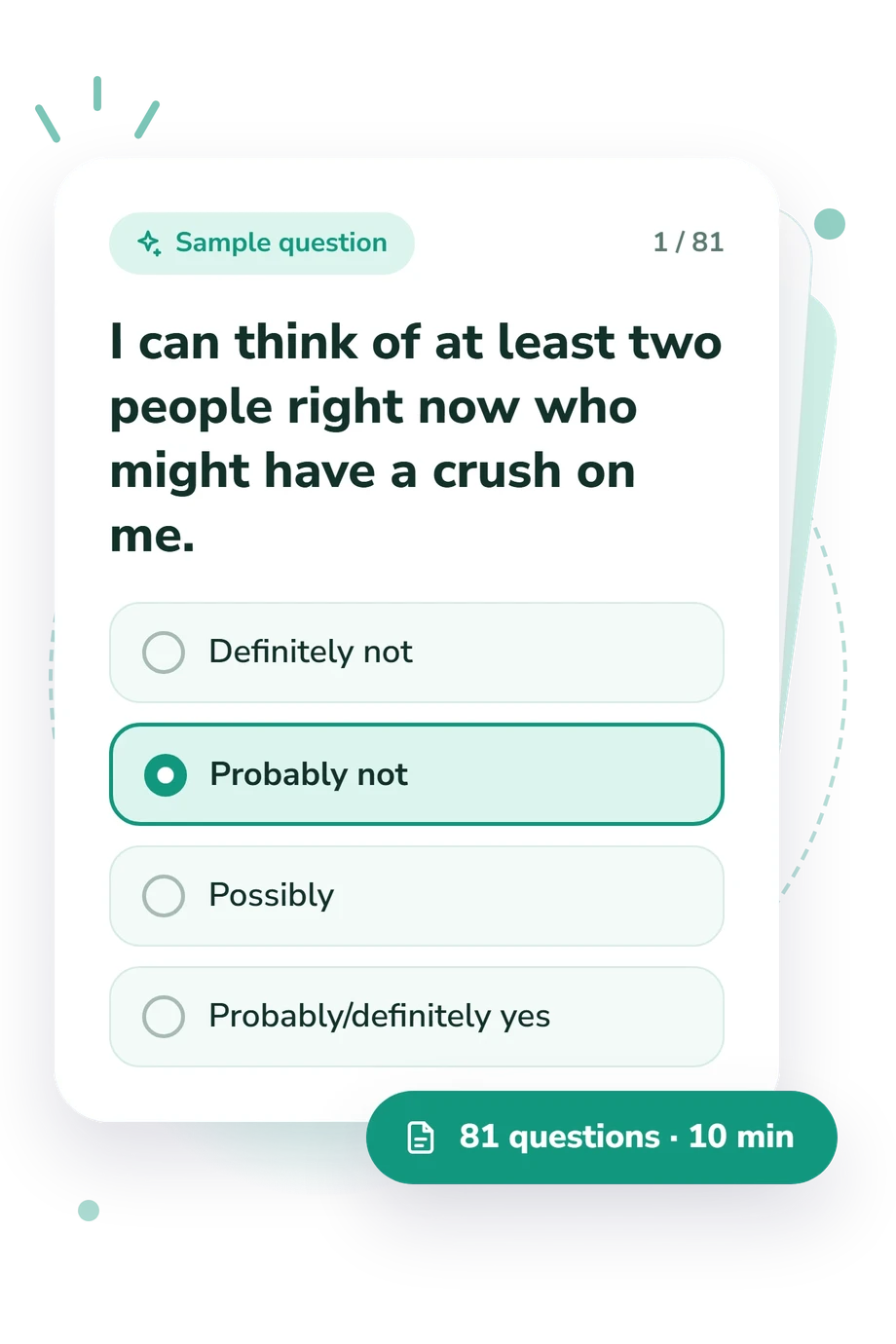
Curious how much romantic interest you might be getting lately? This fun, reflective quiz helps you estimate how many people could have a crush on you based on everyday signals — how others act around you, how often you're approached, your social circles, and the kind of attention you tend to receive. Answer a few quick questions and get an instant, playful range (not a fact or a diagnosis), plus tips for reading flirting cues and boosting confidence without overthinking.

Why Take a How Many People Have a Crush on Me Quiz

Most people genuinely have no idea how much romantic attention they're actually getting, since flirting cues are often subtle, easy to miss, or easy to misread entirely. This who has a crush on me quiz gives structure to that uncertainty, asking about specific, observable social signals rather than leaving it as a vague sense of "maybe someone likes me, who knows."

This quiz is especially interesting because it separates three related but distinct factors — how socially visible and approachable you tend to be, how clear or subtle the interest signals around you actually seem, and an overall estimated range based on both. Someone can be highly approachable while still getting mostly subtle, hard-to-read signals, or the reverse. Seeing these together gives a more grounded, less anxiety-inducing estimate than trying to guess from memory alone.

This assessment is especially popular with flirting-signal overthinkers who keep replaying conversations and want a playful reality check, confidence-boost seekers wanting a fun estimate of their romantic appeal, and social circle navigators who suspect someone likes them and want help reading everyday cues without making it awkward.

What the Assessment Measures

The quiz explores your social patterns across three dimensions:

  • Approachability and social visibility — how often you're socially visible and give off an open, approachable vibe that makes others comfortable initiating contact
  • Estimated crush count — an estimate of how many people may currently have a crush on you based on observable social signals like attention, approaches, and lingering interest
  • Flirting signal clarity — how clear and consistent the flirting or romantic-interest cues around you seem in everyday interactions

The result is a brief estimate of how much romantic interest may be present based on reported social signals. It is not a factual count and cannot confirm another person's feelings.

Who This Assessment Is For

This How Many People Have a Crush on Me Quiz is appropriate for anyone curious how much romantic interest they might be getting lately. It's especially popular with people who overthink flirting signals and want a playful reality check, those wanting a quick confidence boost, and people in social or work circles who suspect someone likes them and want help reading cues.

How to Use This Assessment

Choose the option that best matches typical behavior over recent weeks. If uncertain, select the response that fits most situations. The result is not a clinical assessment and should not be used to make decisions about safety, consent, or relationship status. Self-report bias, limited contact with others, and differences in communication styles can all affect accuracy.

Popular tests
Narcissistic Personality Inventory (NPI)
This self-report measure is used to assess narcissism as a personality trai…
Start Test
Yale-Brown Obsessive Compulsive Scale (Y-BOCS)
This measure is used to rapidly quantify the current severity of obsessive…
Start Test
CRAFFT Screening Test (CRAFFT 2.1)
This brief screening measure is designed to identify potential alcohol and…
Start Test
Patient Health Questionnaire-9 (PHQ-9)
This measure is commonly used to quickly screen for the presence and severi…
Start Test
Maslach Burnout Inventory (MBI)
This self-report measure is used to assess occupational burnout symptoms in…
Start Test
Adolescent Anxiety Questionnaire
This measure is designed to support a brief appraisal of anxiety symptoms a…
Start Test
Emotional Creativity Inventory (ECI)
This self-report measure assesses individual differences in the originality…
Start Test
Horne–Ostberg Morningness–Eveningness Questionnaire (MEQ)
Circadian preferences influence typical patterns of alertness and sleep tim…
Start Test
Ambivalent Sexism Inventory (ASI)
This measure is designed to assess attitudes toward women, including both o…
Start Test
Internalized Misogyny Scale (IMS)
This measure is designed to assess internalized negative beliefs and stereo…
Start Test
Perceived Stress Scale (PSS-10)
This self-report measure assesses the degree to which individuals appraise…
Start Test
Impulsive Behavior Scale (SUPPS-P)
Impulsivity is a multidimensional construct that is often assessed with bri…
Start Test
Clinical Institute Withdrawal Assessment for Alcohol, Revised (CIWA-Ar)
This rating scale is used to rapidly assess the severity of alcohol withdra…
Start Test
Positive and Negative Affect Schedule (PANAS)
This measure provides a brief self-report assessment of current or typical…
Start Test
Light Triad Scale (LTS)
This self-report measure assesses prosocial personality tendencies and orie…
Start Test
Suicidal Ideation Scale
In clinical settings, the Suicidal Ideation Scale is used to structure an i…
Start Test
Body Dysmorphic Disorder Scale (BDD-D)
This brief self-report measure is designed to screen for and quantify distr…
Start Test
Beck Anxiety Inventory (BAI)
This measure is a brief self-report inventory used to screen for anxiety sy…
Start Test
Differential Test of Perfectionism
This instrument is used to screen for perfectionism-related attitudes and t…
Start Test
Locus of Control Scale
This measure assesses generalized expectancies regarding the degree to whic…
Start Test
New Apathy Scale
This brief self-report measure is used to screen for apathy-related symptom…
Start Test
Perth Alexithymia Questionnaire (PAQ)
This measure assesses individual differences in alexithymia, including diff…
Start Test
Social Intelligence Scale
This brief self-report measure is designed to support rapid screening of in…
Start Test
Fear Test
This measure is designed to evaluate individual differences in fear-related…
Start Test
Neuroticism Level Scale
The measure is intended for brief screening of an individual’s propensity t…
Start Test
Aggressiveness Indicators Screening Questionnaire
This screening tool is designed to quickly identify behavioral indicators a…
Start Test
Comments
Leave a Comment