
Hidden Power Quiz
How the Scales are Structured
Who Usually Takes This Test?
See How You Compare
Below is a preview of how scores are typically distributed across each scale.
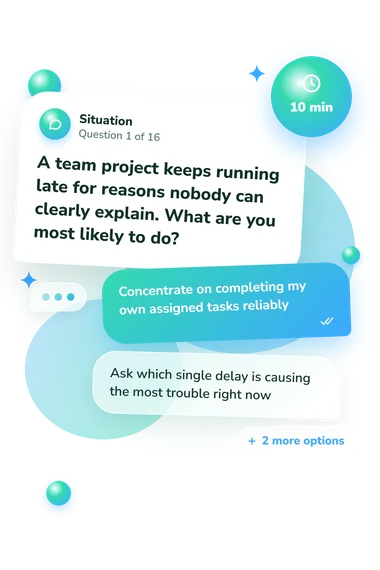
Example Questions From the Test
- I turn inward and protect my concentration
- I match the pace so I can keep up with events
- I become more deliberate and try not to add to the pressure
- I naturally slow my tone and help others regain perspective
- I look for the closest substitute to the original plan
- I take time to compare reliable alternatives before choosing
- I pick an interesting option and stay open to changing it again
- I choose a workable backup and see how the day develops
- A clear opinion about the most practical option
- A suggestion that keeps the group moving
- A pause to separate immediate reactions from the decision
- A question about what everyone needs before continuing
Hidden Power Quiz - Description and methodology of the test
For anyone curious about overlooked personal resources, the Hidden Power Quiz produces a profile of tendencies rather than a fixed identity. It gives self-reflection a practical focus, helping you connect a personal strengths profile with roles, habits, and situations in which you feel most effective. The result offers language for recognizing capabilities that may otherwise remain easy to overlook.
What This Assessment Explores
Questions use familiar situations involving plans, ideas, clues, and tense conversations.
This questionnaire captures hidden strengths through self-reflection: it describes tendencies and affinities, not universally better ways of responding. The four dimensions are:
- Adaptive Courage (0-12) measures moving through uncertainty by experimenting, adjusting, and acting without every answer; Careful Navigator 0-4, Flexible Mover 5-8, or Brave Improviser 9-12.
- Creative Spark (0-12) measures imagining alternatives, combining influences, and giving ideas an original form; Practical Shaper 0-4, Inspired Maker 5-8, or Possibility Generator 9-12.
- Pattern Sight (0-12) measures noticing connections, inconsistencies, and underlying structures; Concrete Focus 0-4, Emerging Connector 5-8, or Pattern Seer 9-12.
- Steadying Presence (0-12) reflects bringing calm, perspective, and emotional room to tense moments; Independent Current 0-4, Grounding Influence 5-8, or Calm Anchor 9-12.
Methodology and Evidence Base
Each item presents a recognizable situation with four response choices, creating a structured self-report format with forced-choice elements. The options show different ways to approach the same challenge; there is no knowledge test and no inherently correct answer.
The result identifies the highest scale as your strongest affinity; scales within one point form a blended result. The displayed ranges and labels are descriptive bands for this questionnaire.
Its conceptual reference is the character strengths framework developed by Peterson and Seligman, which treats strengths as recurring qualities expressed across situations. Studies by Park, Peterson, and Seligman connected character strengths with well-being, while McGrath examined why factor structure and item-level behavior need careful examination. The resulting inner strengths profile is conceptually consistent with that work, not a direct administration or adaptation of a published instrument.
Interpret the profile as a snapshot: mood, recent experiences, self-awareness, and impression management can influence self-report, so compare it with patterns in real situations rather than treating it as fixed.
- Peterson, Christopher, and Martin E. P. Seligman. Character Strengths and Virtues: A Handbook and Classification. Oxford University Press and American Psychological Association, 2004.
- Park, Nansook, Christopher Peterson, and Martin E. P. Seligman. “Strengths of Character and Well-Being.” Journal of Social and Clinical Psychology, vol. 23, no. 5, 2004, pp. 603-619. 10.1521/jscp.23.5.603.50748
- McGrath, Robert E. “Scale- and Item-Level Factor Analyses of the VIA Inventory of Strengths.” Assessment, vol. 21, no. 1, 2014, pp. 4-14. 10.1177/1073191112450612
Updated: