
Gay Stereotype Quiz
How the Scales are Structured
Who Usually Takes This Test?
See How You Compare
Below is a preview of how scores are typically distributed across each scale.
Example Questions From the Test
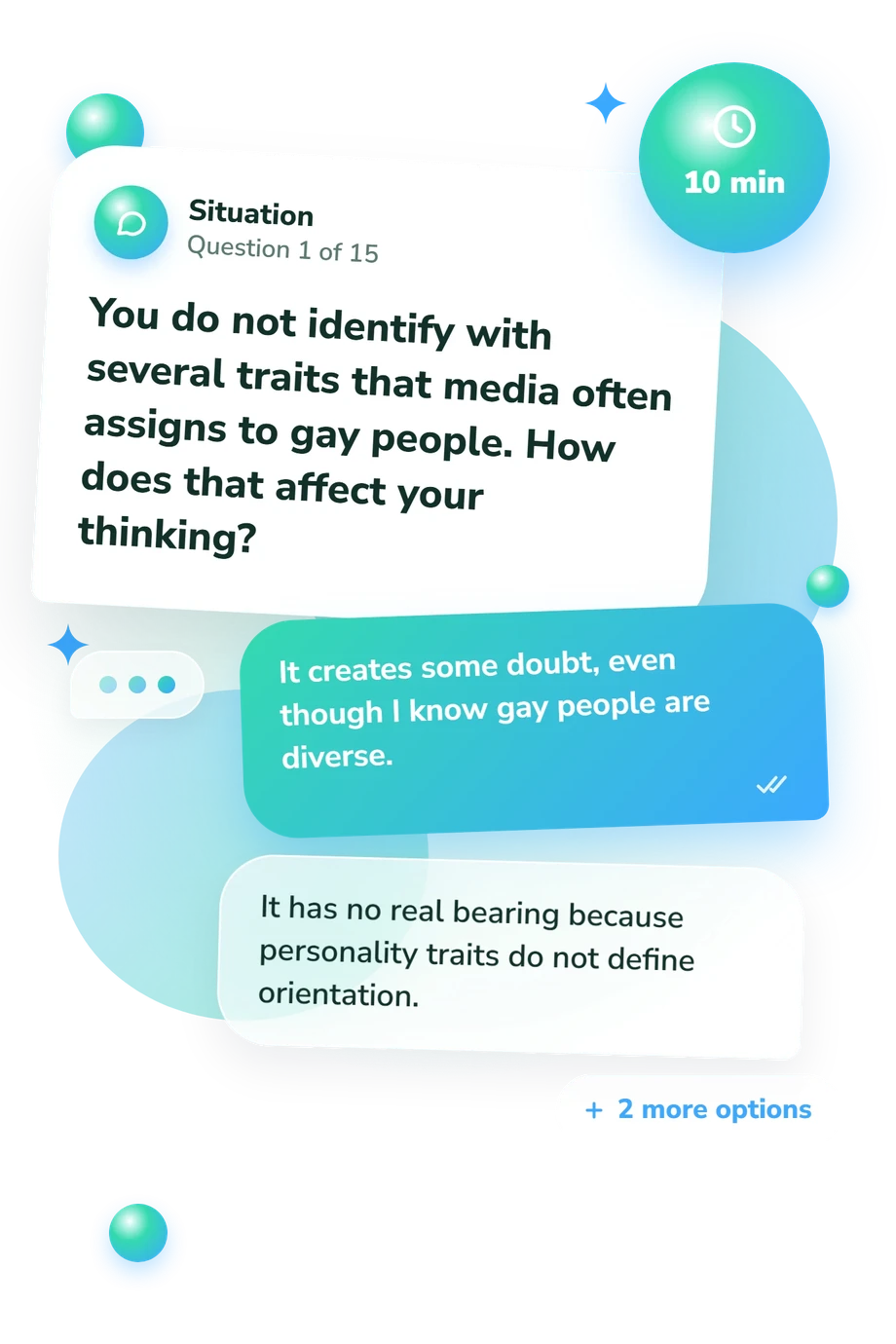
- It creates some doubt, even though I know gay people are diverse.
- It has no real bearing because personality traits do not define orientation.
- It feels like strong evidence that a gay identity could not fit me.
- I notice the mismatch but give more weight to my attraction and identity experience.
- It generally does not match what I desire.
- It feels neutral, unfamiliar, or difficult to evaluate.
- It feels consistently or strongly appealing.
- It can feel genuinely appealing, though not in every situation or with every imagined partner.
- It currently feels authentic and personally meaningful.
- It seems interesting to consider, but still feels fairly distant.
- Another description—or no orientation label—fits me better.
- It may fit, although I am still exploring how well.
Gay Stereotype Quiz - Description and methodology of the test
Designed for people reflecting on identity, attraction, and cultural pressure, the gay stereotype quiz separates personal experience from assumptions about how someone should look or behave. It may help someone questioning a label, someone who feels certain but has met stereotypes, or anyone examining social influence. The gay identity quiz offers a structured snapshot of identity resonance, same-gender attraction, and the influence of stereotypes.
What This Assessment Explores
Questions cover private reactions to same-gender closeness, crushes, dates, identity language, and recognition in other people’s stories. They also examine whether clothing, music, hobbies, mannerisms, or media ideas are treated as evidence about orientation. Unlike a what gay stereotype are you quiz, this links experience and assumptions.
The result organizes that reflection into three dimensions:
- Gay Identity Resonance (0-15) shows how closely gay feels like a current self-description: Little resonance (0-5), Possible/emerging resonance (6-10), or Strong resonance (11-15).
- Same-Gender Attraction (0-15) describes reported pull: Little reported pull (0-5), Mixed or emerging pull (6-10), or Recurring pull (11-15).
- Stereotype Independence (0-15) shows separation from stereotypes: Strong stereotype influence (0-5), Growing separation (6-10), or Clear separation (11-15).
The first two scales describe present self-understanding and attraction patterns; neither assigns an orientation. The third measures stereotype influence only, not whether you are gay.
Methodology and Evidence
Each item presents a social or personal situation with four response options. They cover low, uncertain, mixed, stronger, and stereotype-resistant reactions rather than one fixed progression. Responses produce three scores, but point allocation is not provided, so ranges should not be reverse-engineered. Addressing sexual orientation stereotypes, the questionnaire is best read as a pattern across answers, not one item's conclusion.
Morandini et al. (2023) is the closest conceptual reference: it examined links between sexual-orientation beliefs and identity labeling among sexual-minority participants. Cox et al. (2016) addresses stereotypes and the “gaydar” myth in judgments about orientation, while Arseneau et al. (2013) describes the Sexual Orientation Beliefs Scale. These studies and that published scale are conceptual comparators, not the source, adaptation, validation, or scoring basis of this questionnaire; they do not establish its displayed ranges or cutoffs.
Interpret the result as a time-sensitive self-report. Context, privacy, self-awareness, and changing identity language can affect answers; the displayed scoring procedure and normative status are not provided or established for this questionnaire, and its result cannot assign or confirm an orientation label.
- James S. Morandini, Rachel E. Menzies, Sam G. Moreton, and Ilan Dar-Nimrod (2023). Do Beliefs About Sexual Orientation Predict Sexual Identity Labeling Among Sexual Minorities? Archives of Sexual Behavior, 52(3), 1239-1254. 10.1007/s10508-022-02465-7
- William T. L. Cox, Patricia G. Devine, Alyssa A. Bischmann, and Janet S. Hyde (2016). Inferences About Sexual Orientation: The Roles of Stereotypes, Faces, and The Gaydar Myth. Journal of Sex Research, 53(2), 157-171. 10.1080/00224499.2015.1015714
- Julie R. Arseneau, Patrick R. Grzanka, Joseph R. Miles, and Ruth E. Fassinger (2013). Development and Initial Validation of The Sexual Orientation Beliefs Scale (SOBS). Journal of Counseling Psychology, 60(3), 407-420. 10.1037/a0032799
Updated: