
Future Tense Spanish Quiz
How the Scales are Structured
Who Usually Takes This Test?
See How You Compare
Below is a preview of how scores are typically distributed across each scale.
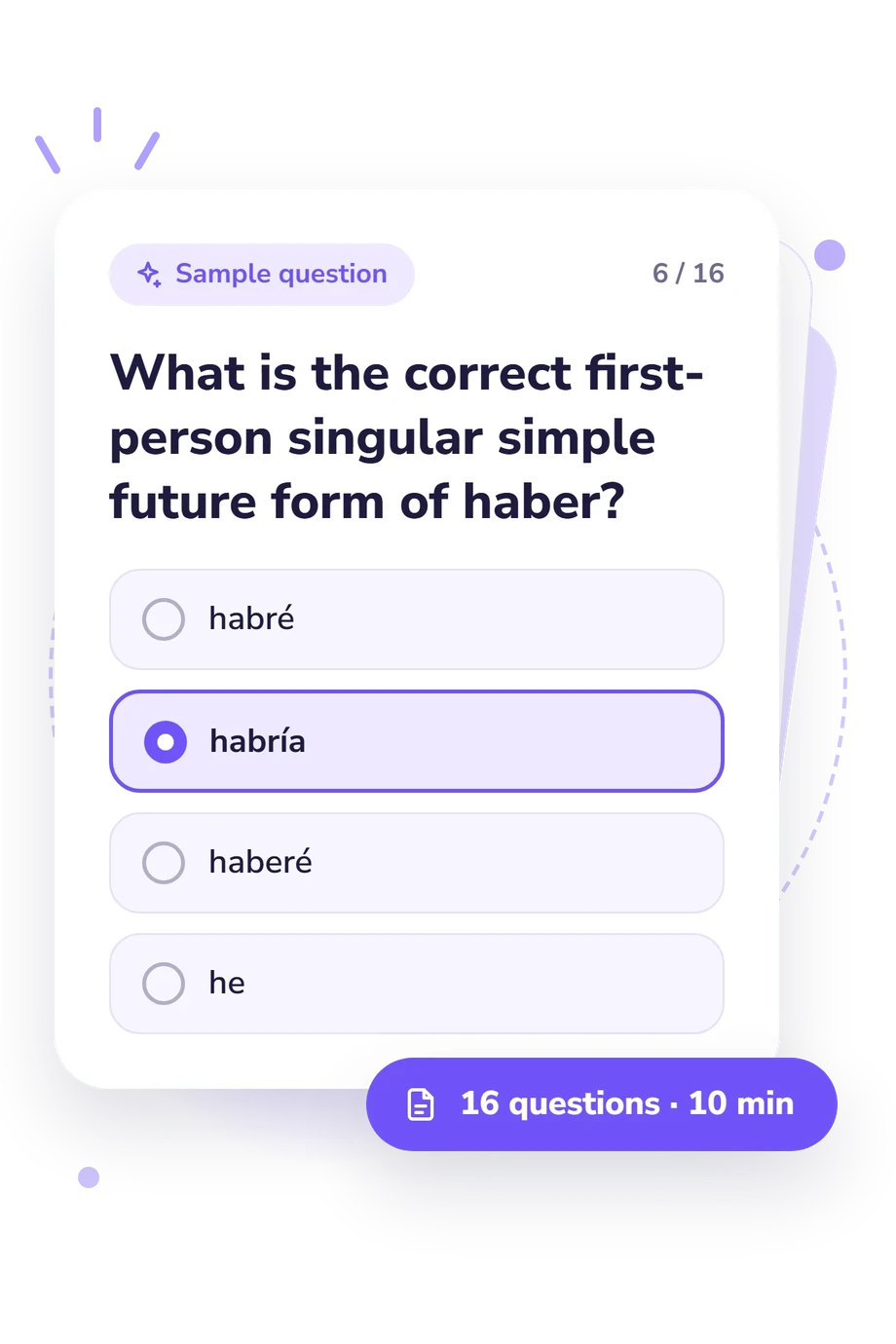
Example Questions From the Test
- Add preterite endings to the verb stem.
- Combine estar with the gerund.
- Combine the present subjunctive with haber.
- Add future endings to the complete infinitive.
- Voy a llamarte en cuanto llegue.
- Te llamaría en cuanto llegara.
- Te llamo en cuanto llego.
- Te llamaré en cuanto llegue.
- Harías tu tarea esta noche.
- Hacerás tu tarea esta noche.
- Harás tu tarea esta noche.
- Haces tu tarea esta noche.
Future Tense Spanish Quiz - Description and methodology of the test
For learners reviewing Spanish grammar, this assessment checks whether you can identify and interpret the simple future in meaningful sentences. The Future Tense Spanish Quiz summarizes overall performance across the tested material, helping plan the next stage of study. Students can use it as a future tense Spanish practice quiz before revising verb forms, irregular stems, accents, or tense contrasts.
What This Assessment Explores
The questionnaire examines practical control of the Spanish simple future: regular formation with the complete infinitive, accent placement, irregular stems, and contrasts with near-future, conditional, present, and past forms. Contexts include promises, forecasts, plans, negative statements, and questions, so the result reflects form recognition together with sentence meaning.
The result can guide Spanish future tense exercises by placing performance in an overall context rather than identifying specific weaknesses. The displayed scale is Spanish Future Tense Knowledge (0-16), with Foundations (0-6), Developing (7-12), and Strong (13-16). These labels summarize overall performance across the sampled areas.
The questions sample three content areas:
- Regular formation covers whether you attach future endings to an unchanged infinitive.
- Irregular and accent patterns cover recognition of forms such as habré, querrán, vendrás, and podremos.
- Contextual meaning covers whether a sentence expresses a forecast, promise, plan, or conjecture.
Methodology and Scientific Basis
Each item presents a short Spanish sentence or grammar question with four choices. The respondent selects the option that completes, translates, corrects, or interprets it. Distractors use nearby tenses, incorrect accents, regularized irregular forms, or contextually unsuitable meanings, so the format tests recognition and discrimination. The score summarizes performance on these items rather than overall language proficiency.
The content focuses on Spanish simple future grammar and is conceptually consistent with Butt and Benjamin's account of infinitive-based future formation and common irregular forms, but the questionnaire is not an adaptation of that grammar. Its conjecture item, “¿Dónde estará Ana?”, also aligns with Escandell-Vidal's discussion of future forms used to infer a present situation rather than describe only a later event. The assessment therefore includes meaning in context as well as conjugation.
Its bands are descriptive performance categories, and the quiz has no reported norming or reliability evidence. The sampled tasks cover grammar recognition and contextual interpretation, while productive writing, listening, and conversation remain outside this format.
- Butt, John, Carmen Benjamin, and Antonia Moreira Rodríguez. A New Reference Grammar of Modern Spanish. 6th ed., Routledge, 2019. DOI 10.4324/9781315648446
- Escandell-Vidal, Victoria. "Evidential Futures: The Case of Spanish." In Future Times, Future Tenses, edited by Philippe De Brabanter, Mikhail Kissine, and Saghie Sharifzadeh, 219-246. Oxford University Press, 2014. DOI 10.1093/acprof:oso/9780199679157.003.0010
Updated: