
Freaky Test
How the Scales are Structured
Who Usually Takes This Test?
See How You Compare
Below is a preview of how scores are typically distributed across each scale.
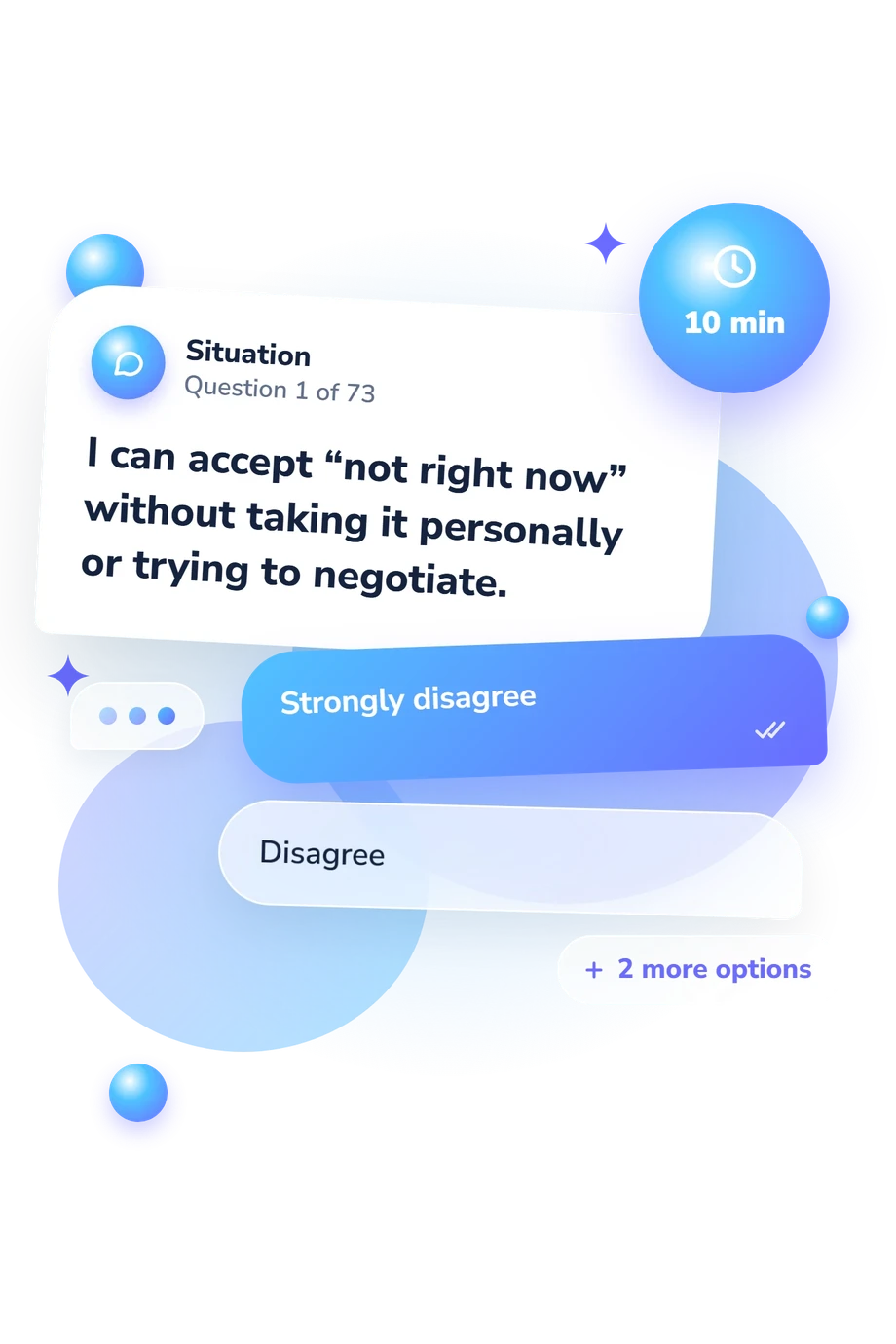
Example Questions From the Test
- Strongly disagree
- Disagree
- Not sure
- Agree
- Strongly disagree
- Disagree
- Not sure
- Agree
- Strongly disagree
- Disagree
- Not sure
- Agree
Freaky Test - Description and methodology of the test
People who want to understand novelty, flirtation, social daring, and personal limits can use this freaky quiz for structured self-reflection. Its questions connect adventurous choices with openness, consent-minded communication, and appetite for excitement. The freaky test describes an adventurous style rather than assigning a fixed identity, helping you notice how these tendencies appear together. It also gives language for preferences, comfort zones, and boundaries.
What This Assessment Explores
Rather than reducing the subject to a daring label, the statements frame this freak test around playful experimentation, uncertainty, flirting, humor, unfamiliar activities, and intensity over routine. They also ask whether you can pause, notice discomfort, accept a no, and state limits clearly. The result is a profile of how adventurous behavior and boundary awareness coexist, not a verdict on character or experience.
The three dimensions describe this profile:
- Adventurous Vibe (0-40) reflects comfort with novelty, playful risk, and bold self-expression; Reserved (0-13), Open & Playful (14-27), and Bold Adventurer (28-40) mark the shown bands.
- Boundary Confidence (0-20) reflects clear, respectful limit-setting during exploration; Hesitant (0-7), Developing (8-14), and Clear & Confident (15-20) are the shown bands.
- Thrill-Seeking (0-20) reflects enjoyment of excitement, intensity, and social or situational risk; Low (0-7), Moderate (8-14), and High (15-20) are the shown bands.
Methodology and Scientific Basis
Each item is a self-report statement with four response options. Some run from Strongly disagree to Agree with Not sure included; others end at Strongly agree. This captures comfort or preference in a situation, not observed behavior.
Responses combine into the three dimensions. The questionnaire shows score bands but no documented standardized or norm-referenced scoring rule. The result addresses the question behind a how freaky are you quiz: it shows current response patterns, not a universal cutoff or fixed trait.
Conceptually, risk-taking content is closest to DOSPERT (Weber, Blais, & Betz, 2002), which treats risk attitudes as domain-specific. Boundary items align with the consent-communication focus of the Sexual Consent Scale-Revised (Humphreys & Brousseau, 2010), while excitement and intensity overlap with the Brief Sensation Seeking Scale work of Hoyle et al. (2002). These conceptual parallels do not make the questionnaire an adaptation of those instruments.
Because this is self-report, mood, context, self-awareness, and the wish to appear cautious or adventurous can influence answers. Read this freak quiz result as a snapshot, especially when your responses vary by situation.
- Weber, Elke U., Blais, Ann-Renée, & Betz, Nancy E. (2002). A Domain-Specific Risk-Attitude Scale: Measuring Risk Perceptions and Risk Behaviors. Journal of Behavioral Decision Making, 15(4), 263-290. 10.1002/bdm.414
- Humphreys, Terry P., & Brousseau, Mélanie M. (2010). The Sexual Consent Scale-Revised: Development, Reliability, and Preliminary Validity. Journal of Sex Research, 47(5), 420-428. 10.1080/00224490903151358
- Hoyle, Rick H., Stephenson, Michael T., Palmgreen, Philip, Lorch, Elizabeth Pugzles, & Donohew, R. Lewis. (2002). Reliability and Validity of a Brief Measure of Sensation Seeking. Personality and Individual Differences, 32(3), 401-414. 10.1016/S0191-8869(01)00032-0
Updated: