
Fashion Designer Quiz
How the Scales are Structured
Who Usually Takes This Test?
See How You Compare
Below is a preview of how scores are typically distributed across each scale.
Example Questions From the Test
- “You always look composed without seeming overdone.”
- “You make traditional pieces feel fresh and personal.”
- “Your outfit is clever—I noticed something new on a second look.”
- “Nobody else would have thought to combine all of that.”
- A controlled neutral palette with differences in fabric and shape
- One saturated shade against quieter supporting colors
- Two rich colors combined with a patterned or metallic accent
- A coordinated palette that feels expressive without becoming busy
- Try it on and imagine building several bold outfits around it
- Admire it, but look for a quieter version that integrates easily
- Pair it with simple pieces so it can be my one dramatic flourish
- Pass in favor of a clean coat with little visible decoration
Fashion Designer Quiz - Description and methodology of the test
Readers asking whether they are a fashion designer can use this are-you-a-fashion-designer quiz to compare design preferences across silhouettes, materials, color, and construction. Its four-profile comparison gives the exercise a clear focus on aesthetic direction. The fashion designer quiz shows which named style profiles most closely align with those preferences, creating a practical vocabulary for discussing clothing and design.
What This Assessment Explores
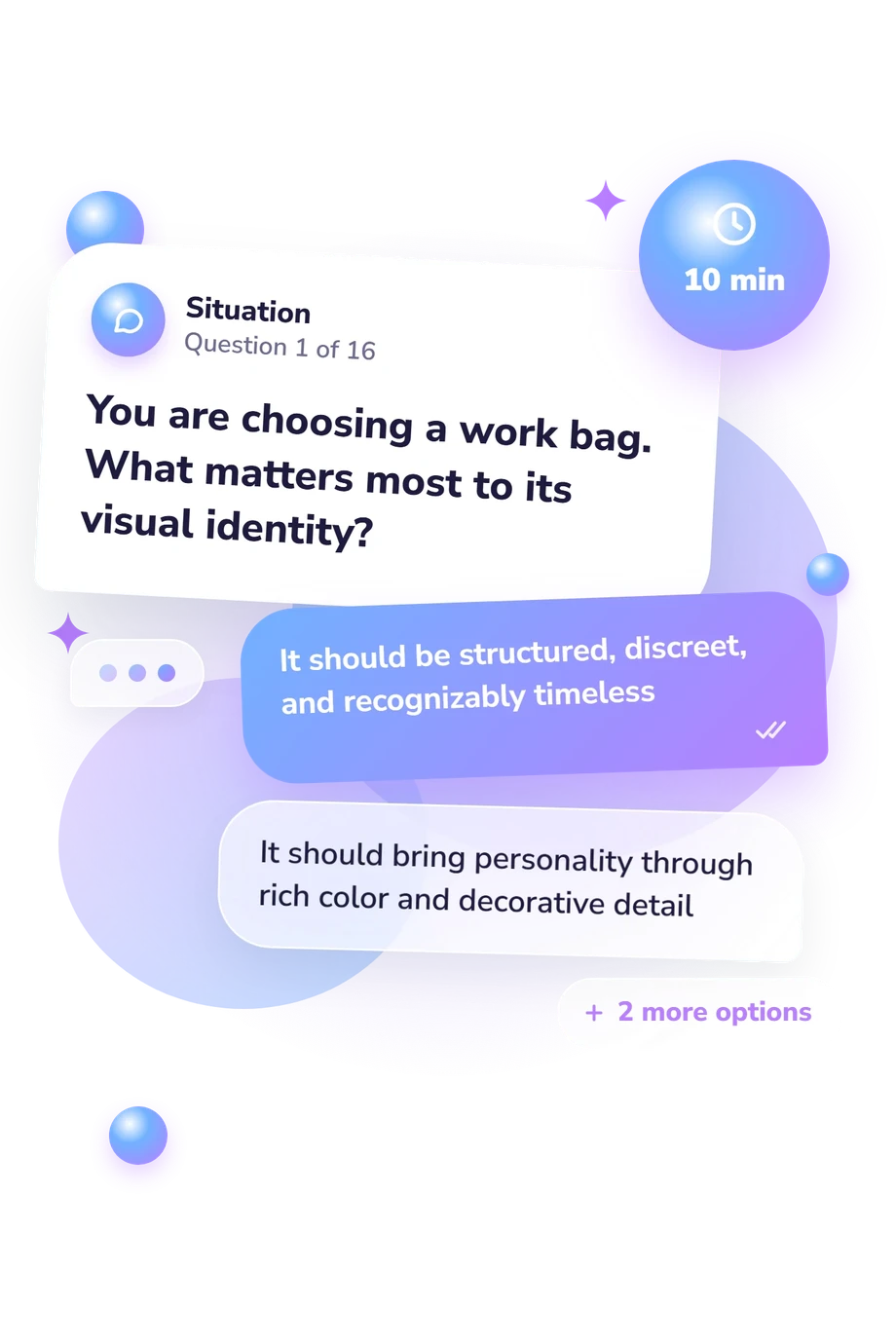
Items contrast design languages rather than technical sewing or sketching ability. Bags, repairs, color, formalwear, and travel reveal restraint, ornament, utility, disruption, and expressive layering. This fashion design quiz describes relative affinity with four named profiles, not a general personality type.
A high score shows close alignment; a middle score shows mixed appreciation, while close scores indicate a blend. The highest score indicates strongest affinity; scores within one point produce a blend. Profiles and bands are:
- Chanel (0-12) measures structured pieces and refined restraint: Different Direction (0-4), Modern Classic (5-8), Signature Elegance (9-12).
- Gucci (0-12) measures layered references and bold combinations: Edited Elsewhere (0-4), Selective Eclectic (5-8), Joyful Maximalist (9-12).
- Prada (0-12) measures precise, functional modernism: Expressive Alternative (0-4), Thoughtful Modernist (5-8), Cerebral Edge (9-12).
- Vivienne Westwood (0-12) measures punk disruption and romantic rebellion: Conventional Counterpoint (0-4), Independent Spirit (5-8), Rebellious Romantic (9-12).
Methodology and Evidence Base
Each item presents a recognizable styling situation with four options. The alternatives emphasize different priorities, such as timeless polish, vivid ornament, unexpected construction, or rebellious disruption. The result compares the four displayed affinity scores, keeping this fashion style quiz focused on style preferences; individual answer weights are not disclosed, so the scoring logic should be understood through the ranges and highest-score rule rather than reverse-engineered.
The construct is conceptually consistent with Tong et al. (2018), which links luxury-brand personality with trust and commitment, and with Sung et al. (2015), whose work treats luxury brand personality as multidimensional. Anand and Kaur (2018) add a fashion self-congruity perspective, while Aaker (1997) supplies a broader personality-dimension model. These sources provide conceptual background only; they do not establish this questionnaire’s validity, reliability, authorship, or four profile definitions.
As an online self-report, the result is context-dependent. Mood, aspirations, label familiarity, and self-awareness may shape answers. The displayed bands describe affinity levels within this questionnaire, not population percentiles or clinical cutoffs. Scores therefore describe aesthetic preferences, and close scores indicate a blended style profile.
- Xiao Tong, Jin Su, and Yingjiao Xu (2018). Brand personality and its impact on brand trust and brand commitment: An empirical study of luxury fashion brands. International Journal of Fashion Design, Technology & Education, 11(2), 196-209. 10.1080/17543266.2017.1378732
- Yongjun Sung, Sejung Marina Choi, Hongmin Ahn, and Young-A Song (2015). Dimensions of Luxury Brand Personality: Scale Development and Validation. Psychology & Marketing, 32(1), 121-132. 10.1002/mar.20767
- Sahiba Anand and Harsandaldeep Kaur (2018). Fashion self-congruity: scale development and validation. Journal of Fashion Marketing and Management: An International Journal, 22(2), 158-175. 10.1108/JFMM-05-2017-0048
- Jennifer L. Aaker (1997). Dimensions of Brand Personality. Journal of Marketing Research, 34(3), 347-356. 10.1177/002224379703400304
Updated: