
Eyeglasses and Hearing Aids Quiz
How the Scales are Structured
Who Usually Takes This Test?
See How You Compare
Below is a preview of how scores are typically distributed across each scale.
Example Questions From the Test
- Myopia, which mainly makes distant objects appear blurred
- Presbyopia, a gradual loss of the eye’s ability to focus up close
- Astigmatism caused specifically by reading in dim light
- Color-vision deficiency that begins in middle age
- The age at which hearing changed
- The physical size of the ear canal
- Sound frequency, from lower to higher pitches
- The number of words used during testing
- The left eye
- The right eye
- The distance between the pupils
- The lens coating type
Eyeglasses and Hearing Aids Quiz - Description and methodology of the test
People choosing, wearing, or supporting someone with glasses or hearing aids can use the eyeglasses and hearing aids quiz to check practical understanding of everyday vision and hearing-device use. It is intended for readers who want clearer terminology, safer habits, and better questions for an eye-care or hearing professional. Patient comfort matters in this quiz about eyeglasses and hearing aids, which addresses fit, handling, and communication in ordinary situations.
What This Assessment Explores
Questions move from terminology to practical decisions about focusing, prescriptions, lens care, hearing-aid function, listening, and safety. They connect knowledge with what a person should notice and do, making this eyeglasses and hearing aids knowledge test about everyday literacy rather than visual acuity or device suitability.
Three thematic groups organize the result:
- Vision and lens items show whether you recognize focusing changes, prescriptions, cleaning, and protective eyewear.
- Hearing-device items show whether you understand feedback, moisture, audiograms, listening in noise, and routine care.
- Safety items show whether you can choose timely action for loss, battery ingestion, discomfort, or blockage.
The displayed scale is Eyeglasses and Hearing Aids Knowledge (0-16), measuring general knowledge rather than vision, hearing, diagnosis, or device suitability. Foundation to build (0-6) indicates basics to review; Developing knowledge (7-12) reflects many essentials with some gaps; Strong knowledge (13-16) indicates solid routine knowledge. These are educational bands, not validated clinical cutoffs.
Methodology and Scientific Basis
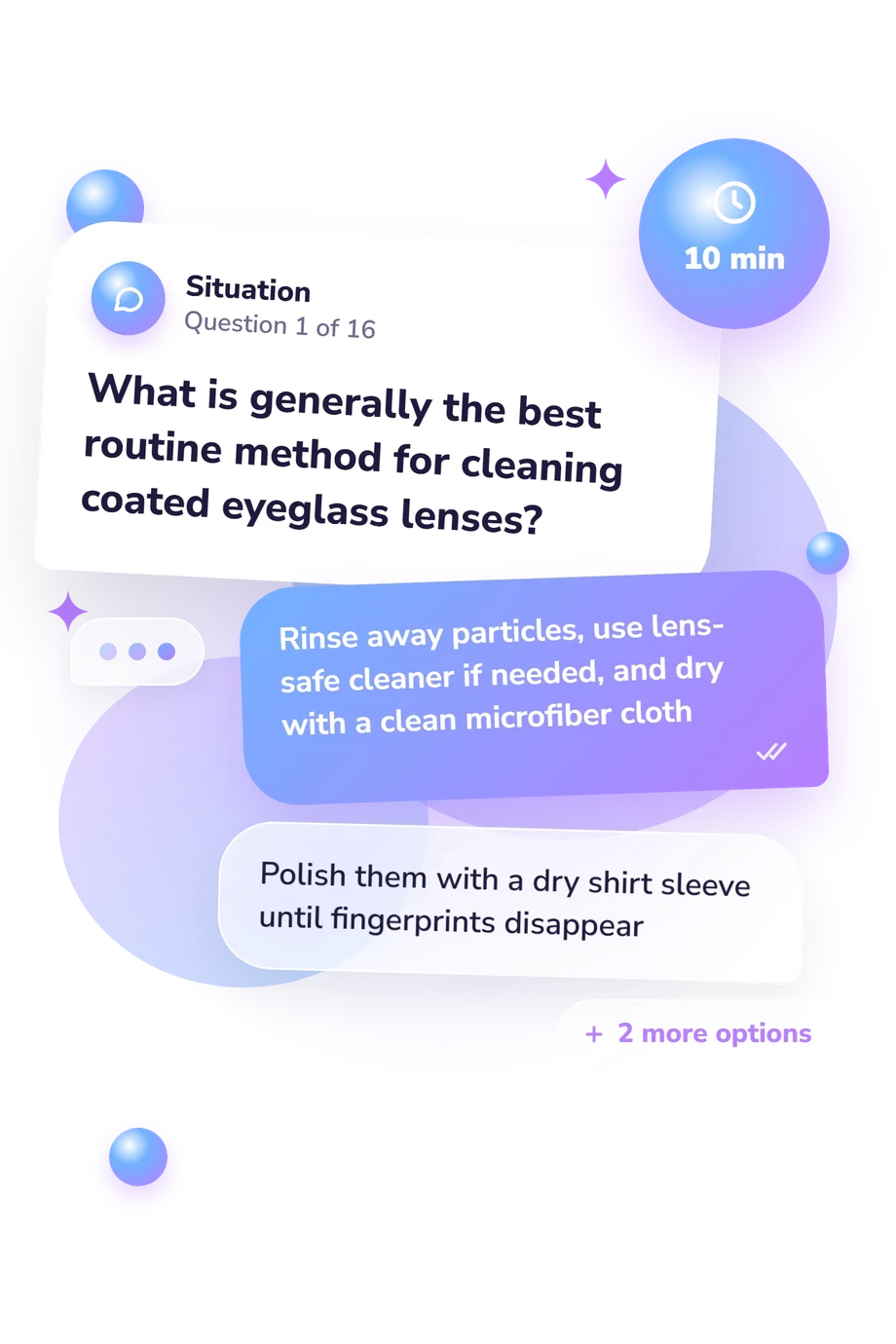
Each item presents a short scenario with four answer choices. The respondent selects the best explanation or safest response, so the format tests applied recognition rather than simple definition recall.
Answers are combined into a single displayed total; the questionnaire does not state additional weighting, so one response should not be treated as a separate diagnosis or device recommendation. With its safety emphasis, the assessment also functions as an eyeglasses and hearing aids safety quiz: the best answer often identifies a hazard, a careful next step, or the need for prompt help.
Its themes are conceptually consistent with HASK (Saunders et al., 2018), a published measure of hearing-aid skills and knowledge. The SENSE-Cog GLASK toolkit and HASKI (Bennett et al., 2018) provide related glasses and hearing-aid skills frameworks. This online questionnaire is conceptually consistent with those works, not a documented adaptation of any one instrument.
As an online self-report questionnaire, it has no stated population norms or standardization procedure. Scores may vary with guessing, prior experience, current context, and self-awareness, and the result cannot determine a prescription, device fit, or the cause of persistent or sudden symptoms.
- Gabrielle H. Saunders, Charlotte Morse-Fortier, Daniel J. McDermott, Jay J. Vachhani, Leslie D. Grush, Susan Griest, and M. Samantha Lewis. Description, Normative Data, and Utility of the Hearing Aid Skills and Knowledge Test. Journal of the American Academy of Audiology. 2018;29(3):233-242. 10.3766/jaaa.16153
- SENSE-Cog. Glasses Skills and Knowledge Test (GLASK) Toolkit Version 1.0 English. SENSE-Cog; 2022.
- Rebecca J. Bennett, Carly J. Meyer, Robert H. Eikelboom, and Marcus D. Atlas. Evaluating Hearing Aid Management: Development of the Hearing Aid Skills and Knowledge Inventory (HASKI). American Journal of Audiology. 2018;27(3):333-348. 10.1044/2018_AJA-18-0050
Updated: