
Emotional Trauma Test
How the Scales are Structured
Who Usually Takes This Test?
See How You Compare
Below is a preview of how scores are typically distributed across each scale.
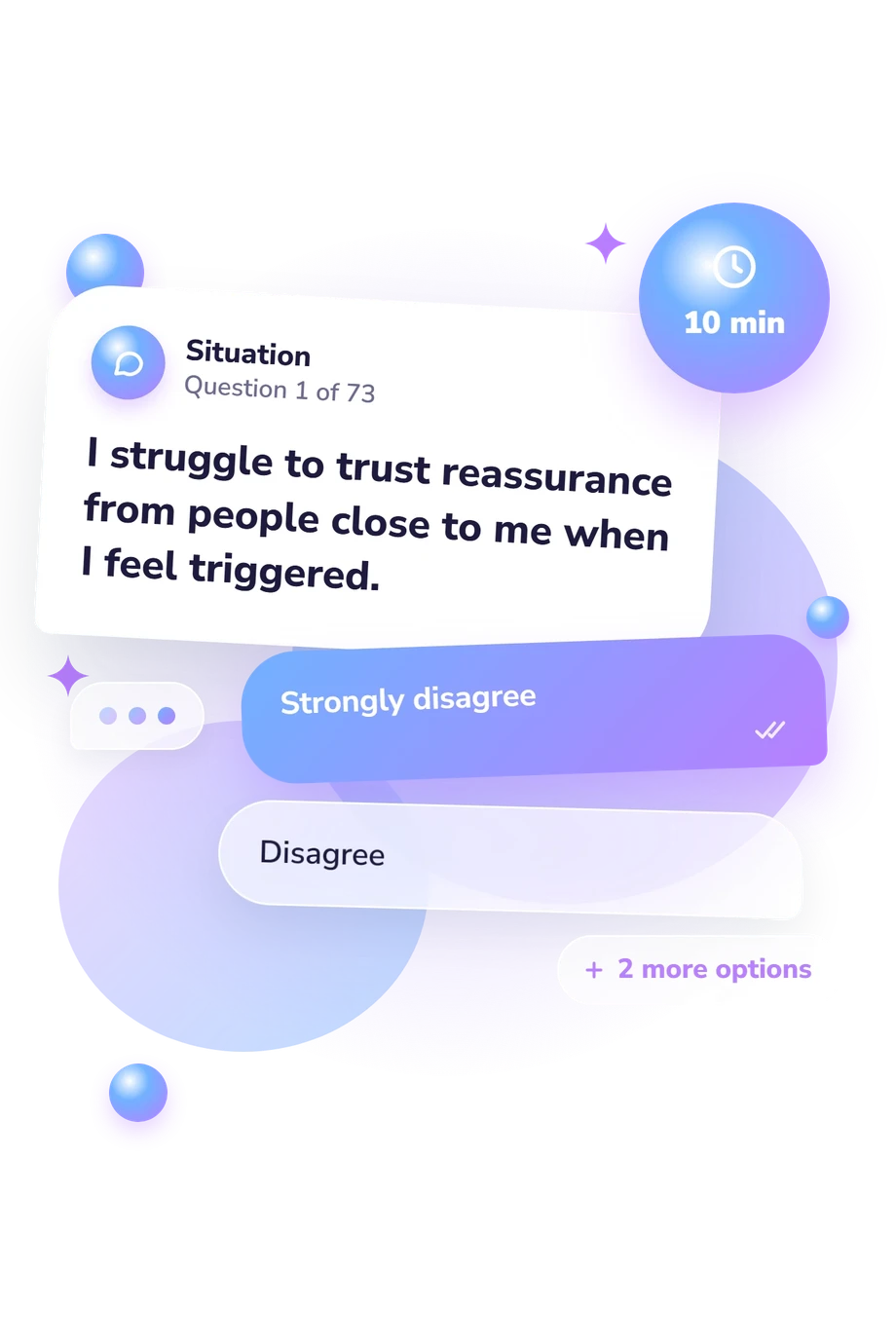
Example Questions From the Test
- Strongly disagree
- Disagree
- Not sure
- Agree
- Never
- Sometimes
- Often
- Almost always
- Strongly disagree
- Disagree
- Not sure
- Agree
Emotional Trauma Test - Description and methodology of the test
People who want to examine recurring reactions to closeness, conflict, reminders, or ordinary uncertainty may use this emotional trauma test as a structured self-reflection tool. It focuses on recurring patterns rather than judging you by one difficult moment. It examines present-day trauma-response patterns in feelings, safety behaviors, attention, and relationship responses, while past overwhelming experiences may provide context rather than a conclusion about cause.
What This Assessment Explores
This questionnaire suits people exploring recurring response patterns in closeness, conflict, uncertainty, or situations that feel unsafe; overwhelming experiences may be one context for them. Its items cover distancing, mistrust, startle, danger-scanning, irritability, anxiety, detachment, and sensitivity to reminders or rejection.
Some items address memory avoidance, reminders, and emotionally loaded topics. The stated construct is current avoidance and numbing, not the accuracy or recovery of memories.
The result is organized into three dimensions, each with its own displayed range and bands:
- Avoidance & Numbing (0-30) shows efforts to avoid reminders and emotional shutdown; Low 0-10, Moderate 11-20, High 21-30.
- Hypervigilance & Safety (0-30) reflects alertness, startle, danger-scanning, and difficulty feeling safe; Low 0-10, Moderate 11-20, High 21-30.
- Mood & Relationship Triggers (0-30) captures mood shifts, conflict sensitivity, and relationship triggering; Low 0-10, Moderate 11-20, High 21-30.
Methodology and Evidence Base
Questions use ordered self-report choices, such as Strongly disagree to Agree, Never to Almost always, and Not sure. They ask how strongly or frequently a pattern fits, and responses are combined into three scale totals. Higher totals indicate more of the tendency defined by that scale; the format does not support assuming an identical point value for every answer.
The conceptual reference point is the International Trauma Questionnaire (Shevlin et al., 2018), whose PTSD and complex PTSD framework includes threat, avoidance, and emotional or relational disturbance. Development and validation studies by Cloitre et al. (2018) and Hyland et al. (2017) support the relevance of these domains. This questionnaire is conceptually consistent with that work, not a direct adaptation or validated administration of the published ITQ.
The profile describes current reactions and the tendencies represented by the scores, including how trauma reactions may appear in mood, safety, and relationships; it is not a clinical classification. Current stress, memory, self-awareness, and willingness to answer openly can influence self-report, and evidence for the published ITQ does not validate every item or displayed cutoff here.
- Shevlin, M., Hyland, P., Roberts, N. P., Bisson, J. I., Brewin, C. R., & Cloitre, M. (2018). A psychometric assessment of Disturbances in Self-Organization symptom indicators for ICD-11 Complex PTSD using the International Trauma Questionnaire. European Journal of Psychotraumatology, 9(1), 1419749. 10.1080/20008198.2017.1419749
- Cloitre, M., Shevlin, M., Brewin, C. R., Bisson, J. I., Roberts, N. P., Maercker, A., Karatzias, T., & Hyland, P. (2018). The International Trauma Questionnaire: development of a self-report measure of ICD-11 PTSD and complex PTSD. Acta Psychiatrica Scandinavica, 138(6), 536-546. 10.1111/acps.12956
- Hyland, P., Shevlin, M., Brewin, C. R., Cloitre, M., Downes, A. J., Jumbe, S., Karatzias, T., Bisson, J. I., & Roberts, N. P. (2017). Validation of post-traumatic stress disorder (PTSD) and complex PTSD using the International Trauma Questionnaire. Acta Psychiatrica Scandinavica, 136(3), 313-322. 10.1111/acps.12771
Updated: