
Do I Like My Guy Best Friend Quiz
How the Scales are Structured
Who Usually Takes This Test?
See How You Compare
Below is a preview of how scores are typically distributed across each scale.
Example Questions From the Test
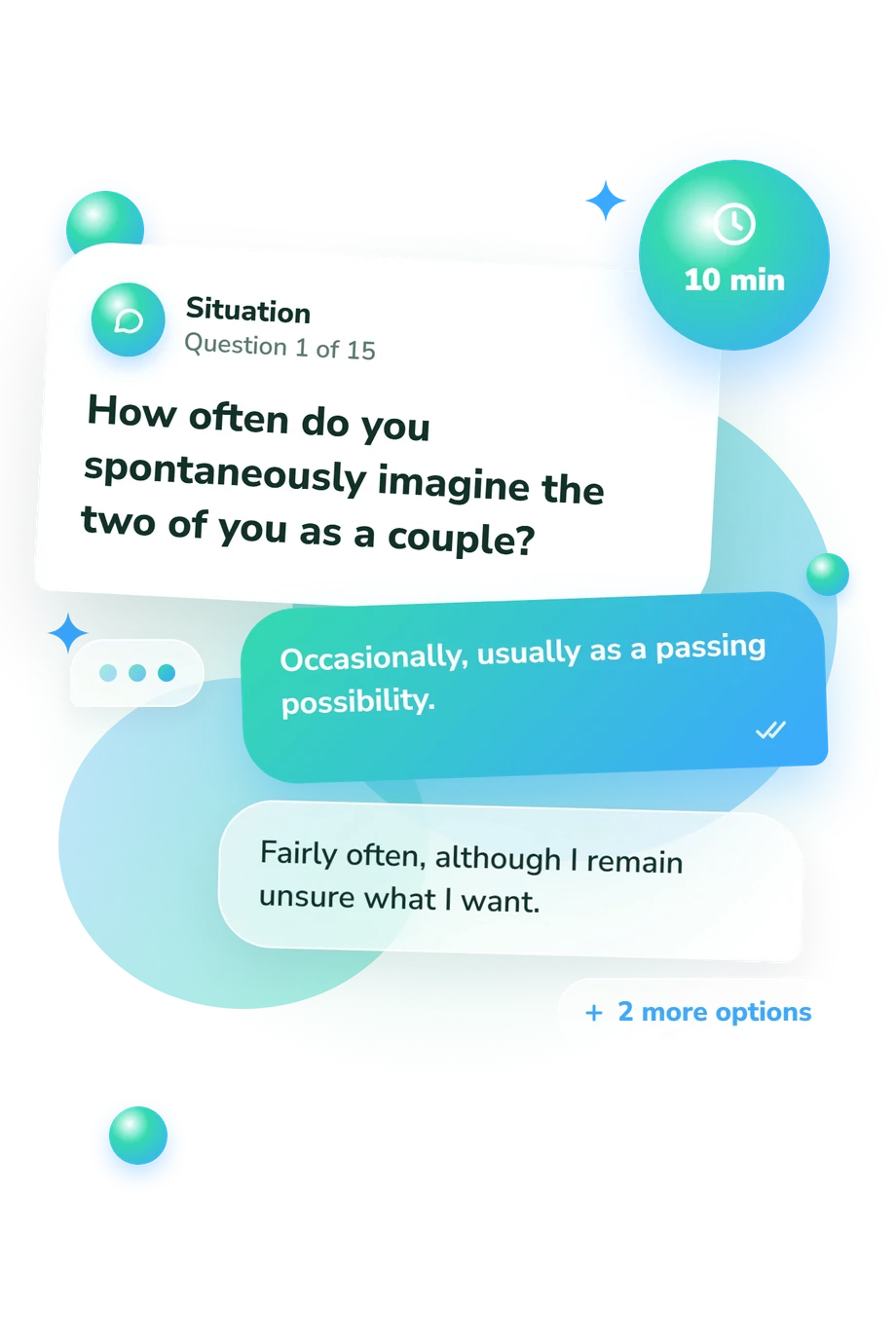
- Occasionally, usually as a passing possibility.
- Fairly often, although I remain unsure what I want.
- Rarely or never; my mind keeps him in the friend category.
- Regularly, and the idea feels genuinely appealing.
- It feels appealing and emotionally meaningful to me.
- I can imagine it, but my reaction changes depending on my mood.
- It feels more awkward than appealing.
- I am mildly curious, though I do not actively want it.
- Having plans to fill the time, regardless of who joins me.
- Enjoying a familiar activity with someone I get along with.
- The ease of being myself around someone who knows me well.
- Catching up and strengthening a friendship that matters to me.
Do I Like My Guy Best Friend Quiz - Description and methodology of the test
People who feel unusually close to a male friend can use the Do I Like My Guy Best Friend Quiz to sort affection, attraction, and willingness to date without rushing into a decision. When you are unsure whether you like your guy friend romantically, the Do I Like My Guy Friend Quiz separates the friendship's importance from the possibility of romance. The result offers a focused starting point for honest self-reflection.
What This Assessment Explores
The questionnaire suits people reflecting on a close friendship and distinguishing companionship from romantic or physical interest. It measures the bond, willingness to explore dating with him independently of attraction, and romantic or physical pull toward him; these dimensions may diverge, so a friendship profile can coexist with or without romance. The Are You in Love With Your Best Guy Friend Quiz frames that question for reflection. Neither score predicts compatibility, proves feelings, or requires action. They are:
- Friendship Attachment (0-15) measures companionship, trust, and shared history: Lighter bond (0-5), Meaningful bond (6-10), Deep anchor (11-15).
- Openness to Dating (0-15) measures willingness to explore dating apart from attraction: Prefer current boundary (0-5), Cautiously open (6-10), Ready to explore (11-15).
- Romantic Attraction (0-15) measures romantic or physical pull toward him: Mostly platonic (0-5), Mixed signals (6-10), Strong romantic pull (11-15).
Methodology and Evidence Base
Items use first-person self-report choices about imagined couplehood, kissing, affection, conflict, support, appearance, circumstances, compatibility, and next steps. Across situations, the four first-person alternatives cover friendship attachment, uncertainty, attraction, and openness rather than forming one ordered response continuum. The result reports three displayed scores; choices vary by topic, and the scoring description does not establish how individual answers add points.
When best friend feelings are unclear, reading the dimensions together gives a more useful profile than seeking a single verdict.
The evidence base is conceptual rather than a claim of direct adaptation. Reeder's 2000 study examined attraction in cross-sex friendship; Halatsis and Christakis's 2009 study and Bleske-Rechek and colleagues' 2012 study considered related tensions, benefits, and burdens. Grote and Frieze's 1994 study distinguished friendship-based love from other intimate feelings. The questionnaire is conceptually consistent with this subject matter, but it is not an adaptation of or validated by those published instruments or studies.
No standardization, clinical norms, or diagnostic validation are stated. Self-reported answers can reflect current mood, recent interactions, hopes, fears, and concern about losing the friendship; use the profile to clarify feelings and boundaries.
- Reeder, Heidi M. (2000). 'I like you... as a friend': The role of attraction in cross-sex friendship. Journal of Social and Personal Relationships, 17(3), 329-348. 10.1177/0265407500173002
- Halatsis, Panayotis, and Christakis, Nicolas. (2009). The challenge of sexual attraction within heterosexuals' cross-sex friendship. Journal of Social and Personal Relationships, 26(6-7), 919-937. 10.1177/0265407509345650
- Bleske-Rechek, April, Somers, Erin, Micke, Cierra, Erickson, Leah, Matteson, Lindsay, Stocco, Corey, Schumacher, Brittany, and Ritchie, Laura. (2012). Benefit or burden? Attraction in cross-sex friendship. Journal of Social and Personal Relationships, 29(5), 569-596. 10.1177/0265407512443611
- Grote, Nancy K., and Frieze, Irene H. (1994). The measurement of Friendship-based Love in intimate relationships. Personal Relationships, 1, 275-300. 10.1111/j.1475-6811.1994.tb00066.x
Updated: