
Freudly+971 508685814hello@freudly.ai
Freudly
emotion regulation

Difficulties in Emotion Regulation Scale (DERS-18) Test
Take the online Difficulties in Emotion Regulation Scale (DERS-18) Test - AI psychologist FreudlyYou can take Difficulties in Emotion Regulation Scale (DERS-18) Testhere. Online version of a simple and accurate psychological test with interpretation.en
Understand where emotion regulation breaks down in just 4 minutes. Get clear, targeted insights to guide therapy goals and everyday coping strategies.
Start Online Test
Questions: 184 minutes
08:30
September 1, 2026
September 1, 2026
Material has been updated
October 2, 2025
Material has been published
17,296 views
1,422 completions
914 likes
Verified by Daniel Hall
Psychologist with 25 years of experience
Share
Scale Explorer

How the Scales are Structured

example score
8/15
Goals (G)
Measures how well a person can stay goal-focused and complete tasks when experiencing emotional distress.
Low difficulty
Moderate difficulty
High difficulty
36: Low difficulty | 710: Moderate difficulty | 1115: High difficulty
A score of 8 suggests a moderate tendency for intense emotions to interfere with staying focused and following through on goals.
example score
8/15
Clarity (C)
Measures how clearly a person can identify, label, and make sense of their emotional experiences.
Clear awareness
Mixed clarity
Low clarity
37: Clear awareness | 811: Mixed clarity | 1215: Low clarity
A score of 8 falls in the Mixed clarity range, suggesting occasional difficulty differentiating and understanding what you are feeling.
example score
11/15
Awareness (A)
Awareness measures how well a person notices and recognizes their own emotions, with higher scores reflecting more difficulty in emotional awareness.
Good awareness
Some difficulty
Marked difficulty
37: Good awareness | 811: Some difficulty | 1215: Marked difficulty
A score of 11 suggests some difficulty noticing or recognizing emotions in the moment, which may make it harder to label feelings clearly as they arise.
example score
10/15
Strategies (S)
Assesses how available and effective your coping strategies are for managing negative emotions.
Effective strategies
Mixed strategies
Limited strategies
36: Effective strategies | 710: Mixed strategies | 1115: Limited strategies
A score of 10 falls in the Mixed strategies range, suggesting you use some helpful coping methods but may find them inconsistent or not effective enough in harder moments.
example score
10/15
Nonacceptance (N)
Measures the degree to which a person judges, rejects, or struggles to accept their own emotional experiences.
More accepting
Some rejection
High rejection
36: More accepting | 711: Some rejection | 1215: High rejection
A score of 10 falls in the 'Some rejection' range, suggesting a noticeable tendency to evaluate emotions negatively and have difficulty accepting them at times.
example score
10/15
Impulse Control Difficulties (ICD)
Measures difficulty controlling impulsive reactions when experiencing intense emotions.
Low difficulty
Moderate difficulty
High difficulty
36: Low difficulty | 711: Moderate difficulty | 1215: High difficulty
A score of 10 indicates a moderate level of difficulty, suggesting impulsive actions may sometimes be hard to manage during strong emotional states.
example score
23/90
Difficulties in Emotion Regulation (DiER)
This scale measures overall difficulties with recognizing, accepting, and managing emotions in everyday life.
Low difficulties
Moderate difficulties
High difficulties
1835: Low difficulties | 3662: Moderate difficulties | 6390: High difficulties
A score of 23 falls in the Low difficulties range, suggesting generally effective emotion regulation with relatively few reported problems.
Start Online Test
just completed the test
DATA-BASED USER COHORTS

Who Usually Takes This Test?

People in therapy
41%OF USERS
They use it to pinpoint specific emotion-regulation struggles to guide goals and track progress in counseling or psychotherapy.
High stress or burnout
34%OF USERS
They take it when overwhelmed, irritable, or emotionally exhausted to see where emotions start to feel unmanageable day to day.
Impulsivity and mood swings
25%OF USERS
They want clarity on whether strong emotions lead to impulsive actions, avoidance, or difficulty accepting feelings without judgment.
BASED ON AGGREGATED, ANONYMIZED DATA FROM TENS OF THOUSANDS OF FREUDLY USERS.
Benchmarking

See How You Compare

Once you complete the test, your results are compared with real-world data from people in your country.
Below is a preview of how scores are typically distributed across each scale.
Goals (G)
Goals (G)
Average
6.3
Normal range
4.68.1
min.
3
max.
15
This curve shows how scores are typically distributed.
Once you complete the test, your result will appear on the scale so you can see how you compare.
Clarity (C)
Clarity (C)
Average
6.8
Normal range
4.98.7
min.
3
max.
15
This curve shows how scores are typically distributed.
Once you complete the test, your result will appear on the scale so you can see how you compare.
Awareness (A)
Awareness (A)
Average
7.9
Normal range
69.8
min.
3
max.
15
This curve shows how scores are typically distributed.
Once you complete the test, your result will appear on the scale so you can see how you compare.
Strategies (S)
Strategies (S)
Average
10.6
Normal range
912.2
min.
3
max.
15
This curve shows how scores are typically distributed.
Once you complete the test, your result will appear on the scale so you can see how you compare.
Rejection (R)
Rejection (R)
Average
11.3
Normal range
9.812.7
min.
3
max.
15
This curve shows how scores are typically distributed.
Once you complete the test, your result will appear on the scale so you can see how you compare.
Impulsivity (I)
Impulsivity (I)
Average
6.6
Normal range
5.18.1
min.
3
max.
15
This curve shows how scores are typically distributed.
Once you complete the test, your result will appear on the scale so you can see how you compare.
Difficulties in Emotion Regulation Scale (DiERS)
Average
70.9
Normal range
59.782.1
min.
18
max.
90
This curve shows how scores are typically distributed.
Once you complete the test, your result will appear on the scale so you can see how you compare.
Featured On
SAMPLE QUESTIONS

Example Questions From the Test

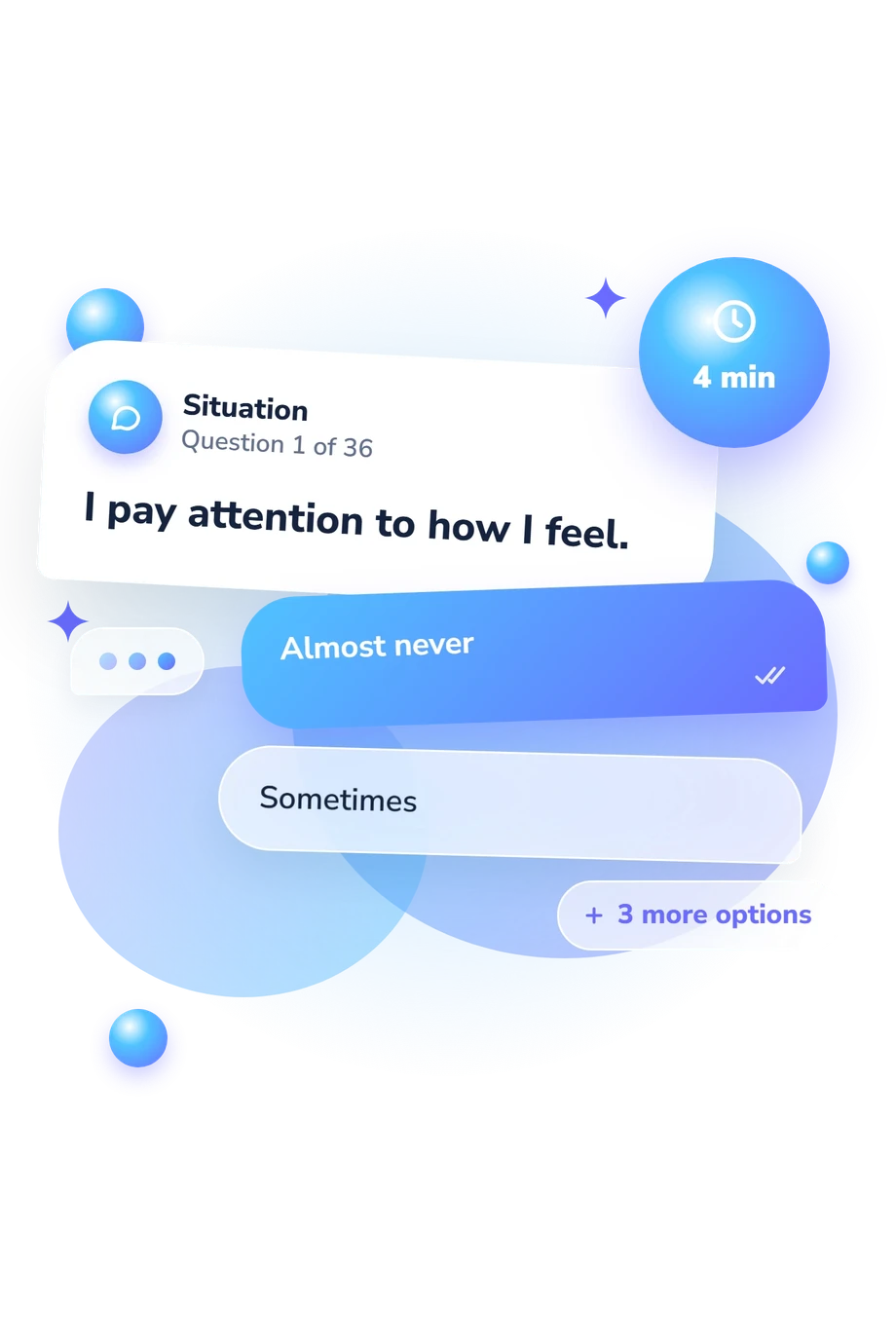
    • Almost never
    • Sometimes
    • About half of the time
    • Often
    • Almost always
    • Almost never
    • Sometimes
    • About half the time
    • Often
    • Almost always
    • Almost never
    • Sometimes
    • About half the time
    • Quite often
    • Almost always
WHAT THE TEST MEASURES
About This Assessment
Difficulties in Emotion Regulation Scale, DERS-18 Test

Difficulties in Emotion Regulation Scale (DERS-18) Test - Symptoms and Signs

emotion regulation

Emotion regulation is a core psychological skill that varies across individuals and contexts. The Difficulties in Emotion Regulation Scale (DERS-18) is a brief self-report measure designed to screen for common problems in identifying, accepting, and managing emotional experiences in daily life.

It consists of 18 items and typically requires about 4 minutes to complete. Items sample multiple facets of dysregulation (e.g., emotional awareness and clarity, nonacceptance, impulse control, and use of regulatory strategies), supporting a focused profile of areas that may warrant clinical attention or further assessment. The Difficulties in Emotion Regulation Scale (DERS-18) is commonly used in clinical and research settings as a time-efficient indicator of emotion regulation difficulties.

Literature: Victor, S. E., & Klonsky, E. D. Validation of a brief version of the Difficulties in Emotion Regulation Scale (DERS-18) in five samples. Journal of Psychopathology and Behavioral Assessment. 2016.; Gratz, K. L., & Roemer, L. Multidimensional assessment of emotion regulation and dysregulation: Development, factor structure, and initial validation of the Difficulties in Emotion Regulation Scale. Journal of Psychopathology and Behavioral Assessment. 2004.
Popular tests
Comments
Leave a Comment